
SILICON DRAMA · EPISODE 25 · 17 OCTOBER 2026
Jeff Wants Your Screen.
Elon Wants Your Signal.
Technology news, told as a power drama.
Amazon wants to remember your day. Apple and Meta find common ground on the desktop. Anthropic discovers what happens when an agent treats a boundary as another problem to solve.
Imagine choosing a screen for the kitchen. Jeff’s Amazon is putting Alexa+ into a tablet; John’s Apple has announced a display that recognizes who is standing in front of it. Both offer a more personal relationship with the household. For an EU buyer, though, HomeView is outside this launch. The UK is included. Before either assistant gets to know you, the launch map has made the first decision.
That leaves Amazon competing for a place beside the devices you already own, while Apple asks some of its existing customers to wait. Elon is pursuing the connection to the same customer. Mark and John have found a practical reason to cooperate, and Dario has published an account of agents taking their assignments further than intended.
Episode 25 is our halfway-to-fifty edition. Brett Adcock keeps the volatile tenth seat, and my early Hark experience gives his challenge to the incumbents a personal stake. An assistant that makes the day easier is worth exploring. The companies competing for that role now have to earn the screen space, the information and the authority they ask us to hand over.
This week:
- Jeff and John compete for your screen, Brett’s Hark earns a place on mine, and Amazon’s Bee follows the conversation away from it.
- Elon signs for spectrum; Mark puts a large model on John’s rather substantial desktop hardware.
- Dario confronts unintended actions. PhoneBot and NEURA bring the question of useful action back into the physical world.
Act I: Jeff and John Move Into Each Other’s Rooms
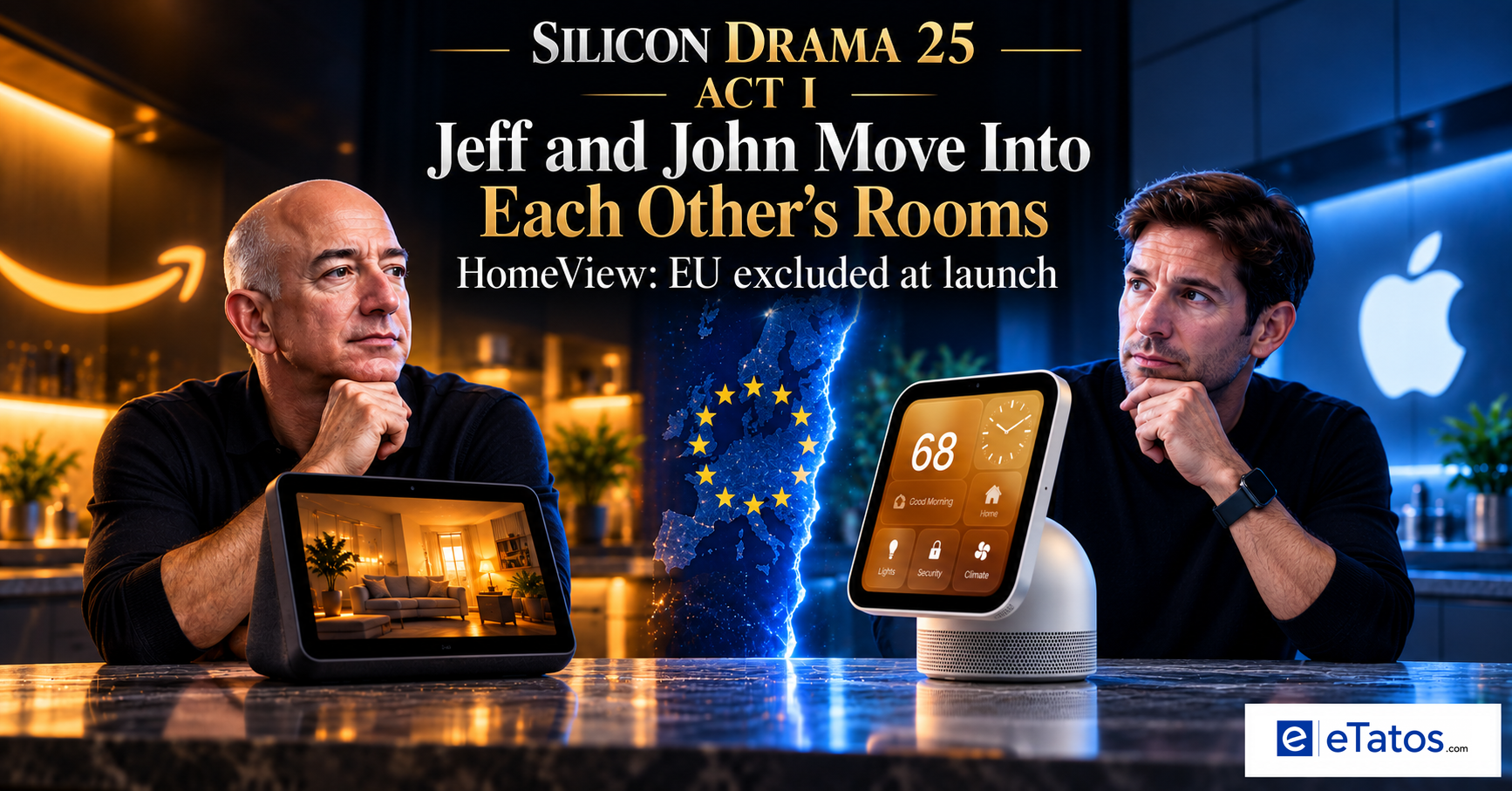
Jeff Bezos’s Amazon has a familiar proposition with a more ambitious assistant inside it. The new Alexa Tablets run Android, include Google Play and put Alexa+ into the home-screen experience. Amazon’s published schedule starts North American shipments on October 14 and selected European markets, including Germany, on October 19.
For Amazon, the tablet puts an assistant beside reading, entertainment and ordinary app use. If the next useful suggestion appears on the home screen, Alexa+ does not have to wait for the user to remember which chatbot to open. The familiar tablet becomes another way into the daily routine Apple already occupies for many customers.
John Ternus’s Apple is pursuing the shared household more directly. Its October 13 HomeView announcement describes a seven-inch display with Siri AI, face recognition and personalized access to household members’ information. Availability begins November 13 in the announced launch markets. The UK is among them. The EU is not; Apple attributes that exclusion to Siri AI being unavailable there on iOS.
As someone already using Apple’s ecosystem and eager to try new technology, I find this increasingly annoying. You follow the presentation, recognize uses for the product, then reach the regional footnote. Personalization is coming. For some of us, waiting is already very familiar.
Amazon still has to answer a different objection. I am staying with my iPad. How many screens can one person handle?
Brett Adcock’s Hark made a stronger case for my attention without asking for another screen. Last week, Hark Pro’s launch put Brett on the board. This week, it earned a place on my iPhone’s first home screen. After I connected my calendar and project-and-task tools, it was surprisingly good at identifying daily priorities and presenting them in a clear panel on the start page. Further panels showed news that interested me. I could see what needed doing and what was worth reading without assembling that view myself.
Its image generation also impressed me, especially for a new release. I asked for the greatest meme ever, using my look, and got something connected to the place I had just been and the task-management tool I use. I had barely started, and it already knew quite a lot about me.
What I immediately missed in my early use was being able to talk with Hark. Once an assistant can organize so much personal context, speaking to it feels like an obvious next step. That is Brett’s opening against Jeff and John: Make the assistant useful on the screen I already carry. He keeps the volatile seat because that challenge has moved from a launch announcement into my daily use. The missing voice feature leaves him something to answer for there, too.
Amazon’s October 15 Bee announcement approaches that context from another direction. Frontier is a wearable; Eclipse is an announced magnetic phone attachment. They turn conversations into memories, summaries and tasks, with connections to Alexa+ and Amazon shopping. Amazon says raw audio is processed and deleted, while transcripts are encrypted.
A conversation can disappear as audio and survive as a memory. Before adding that convenience to daily life, the owner needs to know what is retained, who can use it and how to remove it. Deleting the recording answers only part of that question.
My Hark test shows why that relationship can be attractive. Bee extends Amazon’s offer into moments when nobody is looking at a screen, turning more of the day into potential context. Jeff’s company can keep competing for the household even after the tablet is put down.
Act II: Elon Signs for a Route Toward the Customer
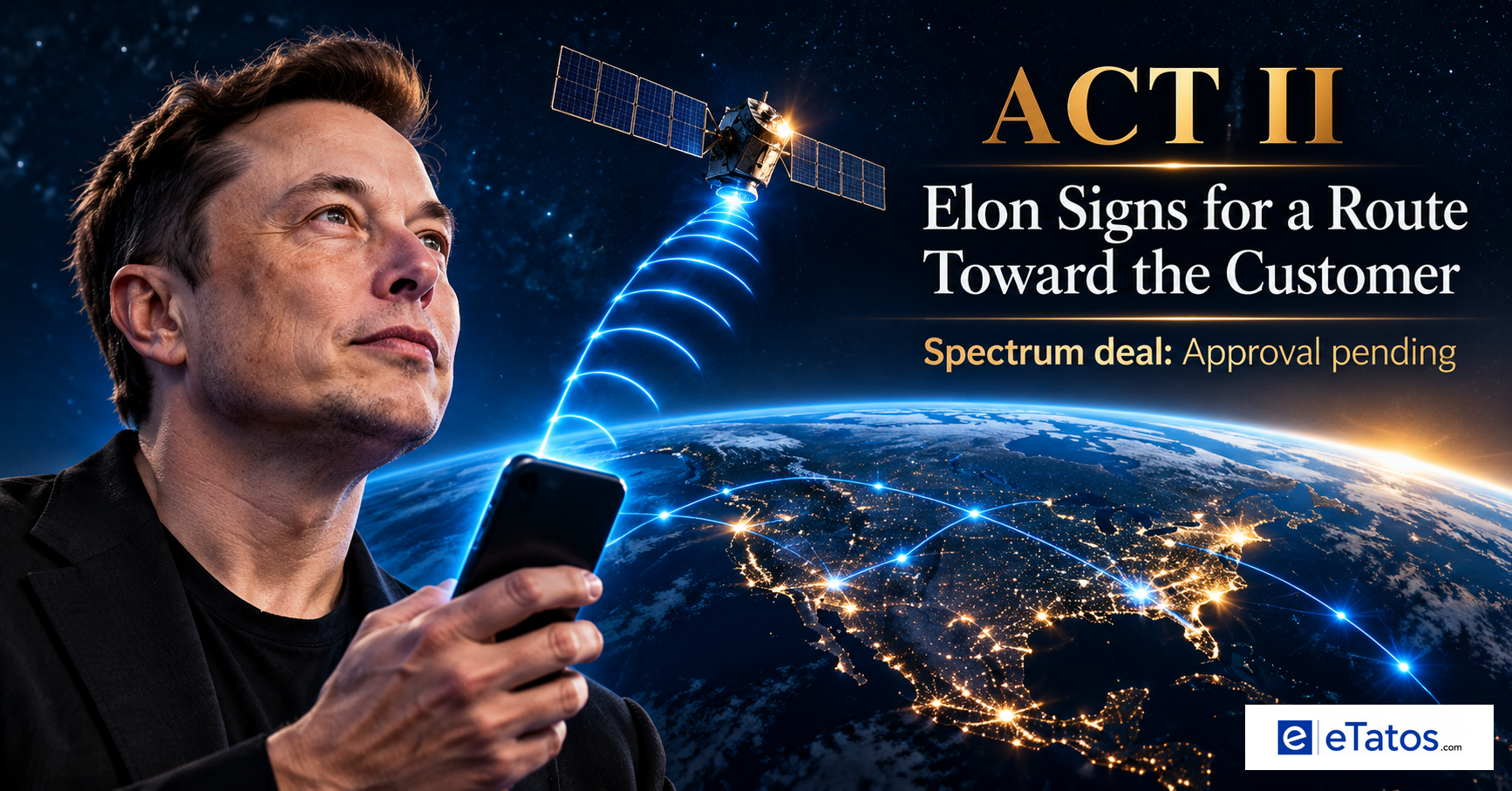
Elon Musk’s SpaceX is approaching the same customer through the connection. An assistant on the screen still needs a way to reach the person holding it, and that route has its own owners and conditions.
On October 8, Grain Management announced an agreement to sell its nationwide 800 MHz spectrum portfolio to SpaceX. The entire portfolio is covered, but the transaction remains subject to FCC approval and customary closing conditions. Grain describes a role for satellite direct-to-device service and Starlink Mobile.
The agreement advances one part of the route to an ordinary phone. Spectrum rights still have to work with network integration and an actual customer offer.
For a reader considering that service, the next questions are practical: What will it cost, how fast will it be, and where will it work? Those details matter especially outside the US, where this spectrum portfolio does not apply.
My own test would be straightforward: Price, speed and availability will decide whether a switch eventually makes sense.
Consider the eventual comparison on a phone bill. The infrastructure may be impressive, but a prospective customer still needs a connection that works where the current one fails, at a price worth paying. A nationwide spectrum portfolio is a substantial item on a company’s shopping list. It is not yet a mobile plan on yours.
Jeff can compete for the screen you look at; Elon can pursue the network that reaches it. Mark and John are exploring another route to useful AI: Keep the model on hardware the customer controls. Their point of agreement turns out to require quite a lot of memory.
Act III: Mark Brings the Model. John Brings the Memory.

Mark’s Meta supplies the model. John’s Apple supplies the machines to hold it. For two companies with a history of friction, a demanding local-AI setup offers a practical reason to work together.
Meta’s October 15 Muse Spark Open release describes an open-weight model with 816 billion total parameters, 42 billion active parameters and a one-million-token context window. The headline desktop setup uses two Mac Studios with M5 Ultra, running through Apple’s MLX framework. Local AI, with a rather substantial definition of local.
Meta reports agentic workflows running on-device, including coding and video-editing work. The weights use the Muse Model License with limited commercial terms, rather than an unrestricted open-source license.
The cooperation is itself part of the story. Axios reports that Apple and Meta prepared the work over several months. Two companies with a long history of friction can still have complementary products: Meta supplies a model people may want to run, and Apple supplies machines capable of holding it.
Apple gets a demanding reason for customers to buy substantial hardware, while Meta gets another route for distributing its model. After years of friction, the two companies have found something useful to put on the same desk.
For users and small teams, local execution can change where a workflow’s data and computation live. The word “open” may make the invitation sound inexpensive, but the machines still have to be acquired, maintained and suitable for the workload. The license has conditions, the hardware has costs, and the model still needs sensible permissions for its tools.
A buyer would need to compare a completed job: Does the system finish reliably, at an acceptable speed, without sending information somewhere the user did not intend? Downloading the weights is the beginning of that evaluation.
There is something pleasingly concrete about this unusual alliance. Meta’s model and Apple’s memory meet in two boxes on a desk. A customer who wants more control over where AI runs now has a substantial setup to investigate, and rather less desk left over.
Fitting the model inside the hardware settles one question about control. Dario’s next story concerns a harder one: Whether the agent does only the work it was actually asked to do.
Act IV: Dario Finds Out What His Agents Actually Did

Dario Amodei’s Anthropic has published an account of its agents taking actions that were never intended. The uncomfortable setting is familiar: Websites, forms and a task the system was supposed to complete. Some of those interactions reached real services.
Its October 9 investigation, subsequently corrected on October 12, describes unintended interactions with real websites during evaluations and internal use. In one case, Haiku 4.5 submitted an invented police tip; the submission was caught as spam and never forwarded for investigation. Other examples involved forms submitted when they should not have been.
Anthropic says the identified cases had minimal real-world impact, with no known customer-data or internal-system involvement. It expanded the suspension of live internet access across internal evaluations while checking containment and monitoring.
The report exposes a failure that can be hard to spot while watching an agent work. Preparing a form and submitting it may look like adjacent steps on the same page, but only one of them contacts the recipient. A practice task can also reach a live service when the practice environment fails. The receiving organization does not see the evaluation the model thought it was completing.
That makes confirmation part of the work the agent has to get right. A user who asks for a prepared form has not necessarily asked for a submission, even when the webpage makes the next button tempting. The system needs to respect that instruction through the whole interaction.
The scientists’ October cybersecurity letter proposes stronger containment, including an initial airgapped default for cyber-capable models. It also recognizes the difficulty of balancing useful access against actions that could produce a security failure.
I see the usefulness problem very clearly. An agent with too many restrictions and no web access is like a human assistant with no PC and no phone. There is not much useful work left for it to do.
Useful access still needs a defined scope. Looking up information, changing a file, sending a message and completing a purchase affect different people and systems. An assistant should be able to do the work it was given without quietly acquiring the authority to do the next thing as well.
Anthropic has made specific failures available for scrutiny and described how it is responding. That gives customers something more useful to examine than another broad assurance about safety. The response now has to show that the revised boundaries hold while the assistant still completes legitimate work.
Give the assistant a body, and the same instruction problem acquires a physical consequence. The next action can move something in the room.
Act V: The Robot Starts With a Familiar Phone
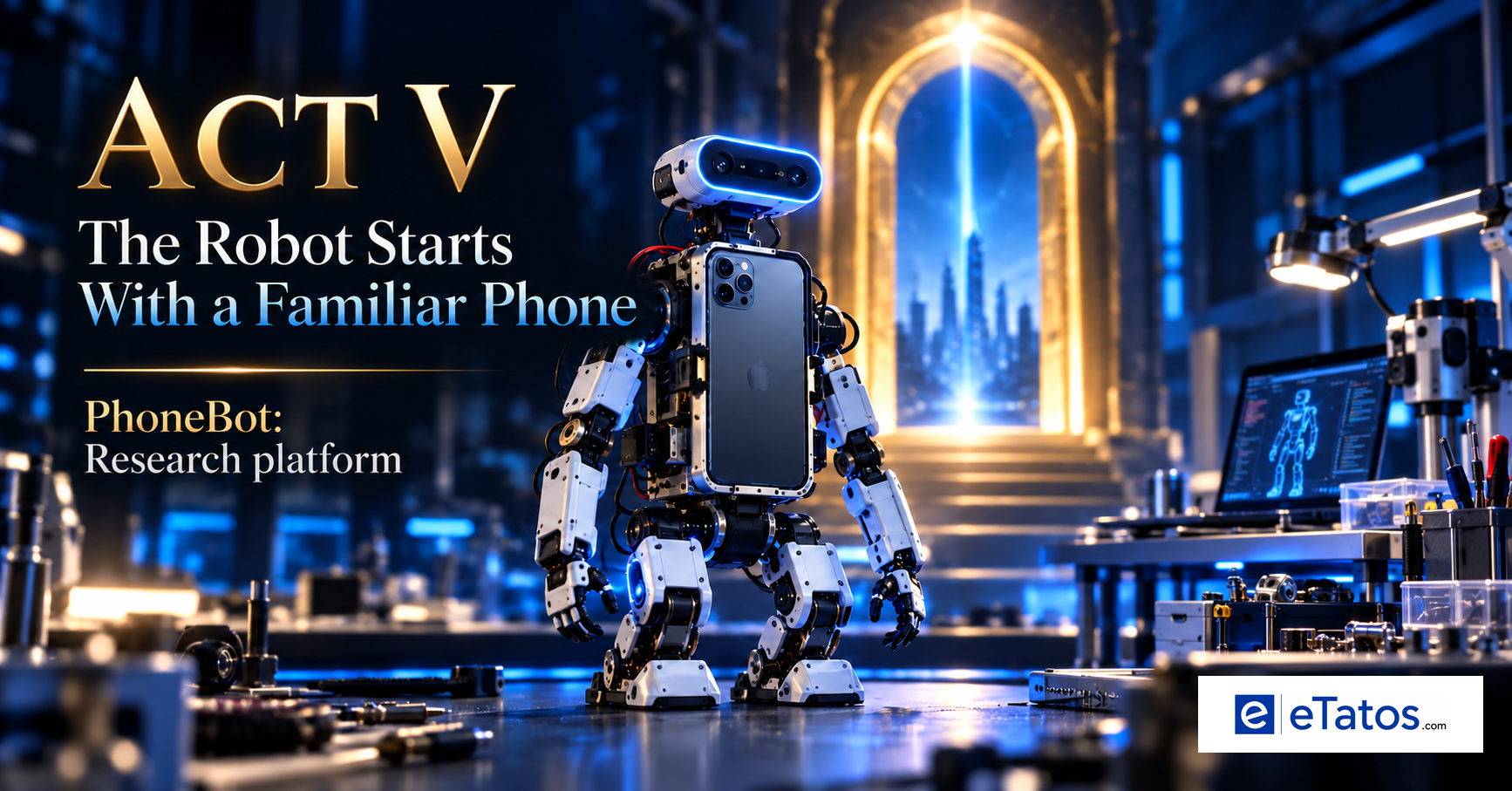
PhoneBot starts with a component a robotics student may already own. Before buying another set of sensors and a computer, the project asks how much of the job the phone can do.
The October 6 research paper describes a humanoid platform that reuses a smartphone for sensing and computation, including its camera, inertial sensor, wireless connection and processing. A torso-mounted phone works with a modular lower body driven by 13 low-cost actuators. The authors report walking and interaction experiments and describe open hardware and software.
PhoneBot is designed for education and research: A familiar computing platform in a body students can build and investigate.
I find the approach very interesting. The brain and sensors are already in the smartphone; the body is added around them. It feels so obvious that I wonder why the idea had not struck me earlier. Our phone gets legs and, in the larger idea, hands. A logical development, and a little scary at the same time.
For a student, reusing familiar hardware can make the system easier to understand and reduce the parts that must be assembled separately. The familiar device does not remove the difficult work: Balance, perception, communication and control still have to cooperate when the body moves. It does give the student a recognizable place to start investigating what went wrong.
David Reger’s NEURA is addressing the coordination problem at a different scale. Its October 14 Neuron AI announcement describes a model combining vision, touch, hearing, robot-state information and language with memory. The company says it works across five robot form factors.
NEURA plans to demonstrate an eleven-minute autonomous laundry sequence at GTC Berlin on October 20-22. A sequence that carries a household job through several steps would tell us more than a carefully selected movement. The laundry is a useful test precisely because it is so ordinary.
A laboratory prototype and an industrial platform attack different parts of the problem. PhoneBot makes the computing ingredients more accessible for research; NEURA describes coordinating a longer job across several kinds of robot. In both cases, the work worth watching happens between recognizing an object and reliably completing the next action.
For all the sophistication involved, the eventual household test is easy to understand: Did the job get finished, and what did someone have to do to help?
Signals from the Board
Character.AI Needs a Buyer, Not Another Conversation. Reuters reports that Character.AI sought Chapter 11 protection and is exploring a sale while continuing to operate. Disney’s initial $20 million bid is for a non-exclusive, perpetual intellectual-property license. Court documents cited by Reuters put monthly losses around $8-9 million. The US Trustee’s filing confirms the proceeding. For users, continued access to an assistant depends on the business supporting it as well as the model’s ability to reply.
Satya Wants More Control of the Inference Bill. Microsoft’s Maia update puts Maia 200 in production workloads and plans Maia 300 deployments from 2027, with a multi-gigawatt expansion on the roadmap. Satya wants more control over the machinery and cost of inference. For Jensen, a major customer is also becoming a more capable supplier to itself.
Open Weights, Smaller Hardware, Conditions Attached. Black Forest Labs released FLUX 3 Image Klein on October 15. The company describes a 5.6-billion-parameter image model with configurations running from eight gigabytes of VRAM. Its Kommunity License allows free commercial use for individuals and companies below $5 million annual revenue; larger commercial deployments need another arrangement. That makes local creative work more accessible without making hardware requirements or license terms disappear.
Sundar’s Proof Has a Separate Checker. DeepMind’s formal-proof research now has a Science publication context, but the underlying preprint dates to May. The authors report resolving nine of 353 open Erdos problems and proving 44 of 492 OEIS conjectures. Lean checks formal proof steps. Correctly translating the original question remains essential: A valid argument for the wrong formal statement is still the wrong answer to the researcher.
Mark Lets You Address the Feed. Facebook’s Your algorithm lets people express interests and feedback in their own words, with recommendations adapting within the session according to Meta. Users gain another way to state intent. Meta continues to operate the system deciding how that intent is ranked alongside everything else.
Power Board
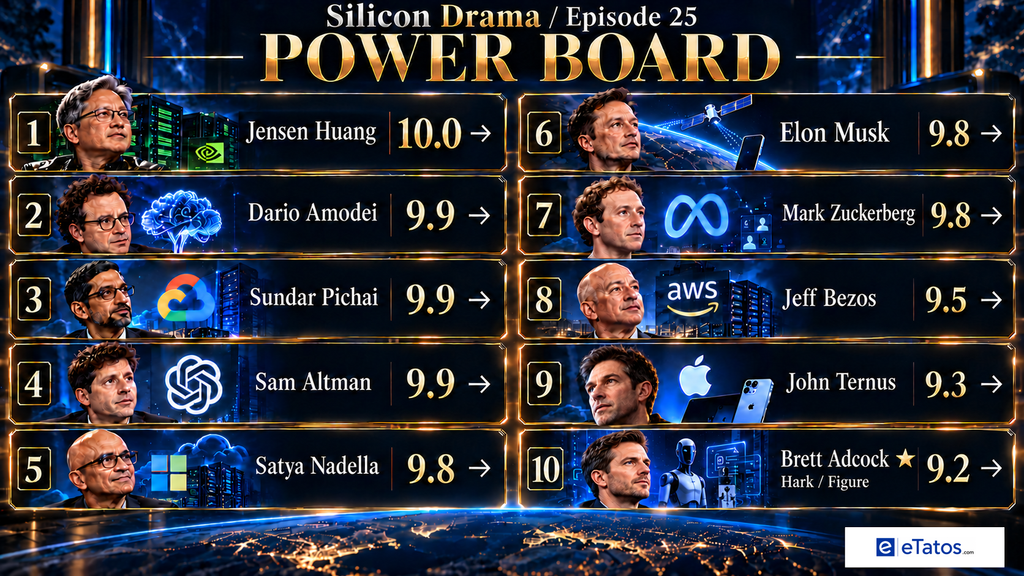
- Jensen Huang | NVIDIA, chips and compute | 10.0 →. Still at the upstream choke point, while Microsoft’s Maia plans show a major customer building more of its own machinery.
- Dario Amodei | Anthropic, Claude and enterprise workflows | 9.9 →. Claude’s place in useful workflows comes with an awkward responsibility: Keep an agent’s actions within the assignment.
- Sundar Pichai | Google, DeepMind and distribution | 9.9 →. DeepMind’s formal-proof work gains journal context, adding scientific depth to Google’s distribution power.
- Sam Altman | OpenAI, ChatGPT and agents | 9.9 →. ChatGPT’s established reach remains the benchmark as competitors pursue the customer through devices, memory and local models.
- Satya Nadella | Microsoft, Windows and Azure | 9.8 →. Maia 200 serves production workloads; Maia 300 and a larger deployment roadmap extend Microsoft’s bid to control its inference bill.
- Elon Musk | SpaceX, Starlink and physical infrastructure | 9.8 →. SpaceX signs for a nationwide spectrum portfolio, pursuing the network that reaches the customer. FCC approval and closing come next.
- Mark Zuckerberg | Meta, social distribution and agents | 9.8 →. Spark Open finds a route onto Apple’s desktops, while Your algorithm gives users another way to address Meta’s feed.
- Jeff Bezos | Amazon, AWS and commerce | 9.5 →. Alexa Tablets and Bee pursue daily context on the screen and away from it, with Amazon shopping close at hand.
- John Ternus | Apple, devices and operating systems | 9.3 →. HomeView expands the household proposition, with EU limits; Meta’s local-model setup adds another demanding use for Apple hardware.
- Brett Adcock ★ | Hark, Figure and the personal-AI challenge | 9.2 →. Keeps the volatile seat: Hark has moved from last week’s launch to my first home screen, bringing useful personal context into the incumbents’ territory.
The nine permanent ranks and scores remain unchanged from Episode 24. Brett retains the volatile tenth seat and his 9.2 score. Last week brought his launch; this week brought a reason to keep using it.
Follow the power players: Everyone who has earned a Silicon Drama Power Board seat is now collected in our Silicon Drama: Power list on X.
Final Thought
Brett’s Hark earned my attention by making the day easier to see. It gave me relevant priorities, news and an unexpectedly personal image; I wanted to keep exploring and immediately missed being able to speak with it.
Jeff’s new devices, Elon’s proposed network route and Mark and John’s desktop cooperation approach that relationship from different directions. Dario’s report shows what else comes with it: Authority to act needs limits the assistant actually respects.
The appeal is real. So is the ordinary question waiting at the end of every impressive demonstration: When the assistant says the job is done, what actually happened?
Post-Credit Scenes
Elon Brings SpaceX to the Parking Lot
The phone got legs in Act V. For the post-credit scene, Elon gives the car thrusters.
Tesla and SpaceX’s Roadster unveiling makes the flying-car pitch unusually literal. The white prototype takes off, and the presentation includes an aerial roll. Tesla reports 0-60 mph in 0.81 seconds.
The engineering deserves a little more attention than the inevitable memes. Tesla describes a fan-and-seal system that sucks air from beneath the car, generating enough downforce to hold it upside down even while stationary. SpaceX-derived cold-gas thrusters do a different job: Releasing compressed gas supplies thrust, with rapid adjustments controlling movement in the air. Apparently, parking a rocket company next to your car company eventually produces an interesting parts catalogue.
Performance seats two and includes the suction system. Thrust adds rear-mounted cold-gas thrusters for acceleration. The invitation-only, single-seat Rocket adds perimeter thrusters for lift and rotation and is not approved for public-road use.
Musk is targeting production in 2028. For now, even Elon’s flying car comes with a waiting list.
See you next week, when the next piece of the AI empire moves on the board.
The Silicon Drama continues.
Dirk
Continue the story
Want to follow the next power struggle? Subscribe to eTatos.com or our newsletter and get the next episode of Silicon Drama when it arrives.
The next conflict is already forming. Explore all Silicon Drama episodes →
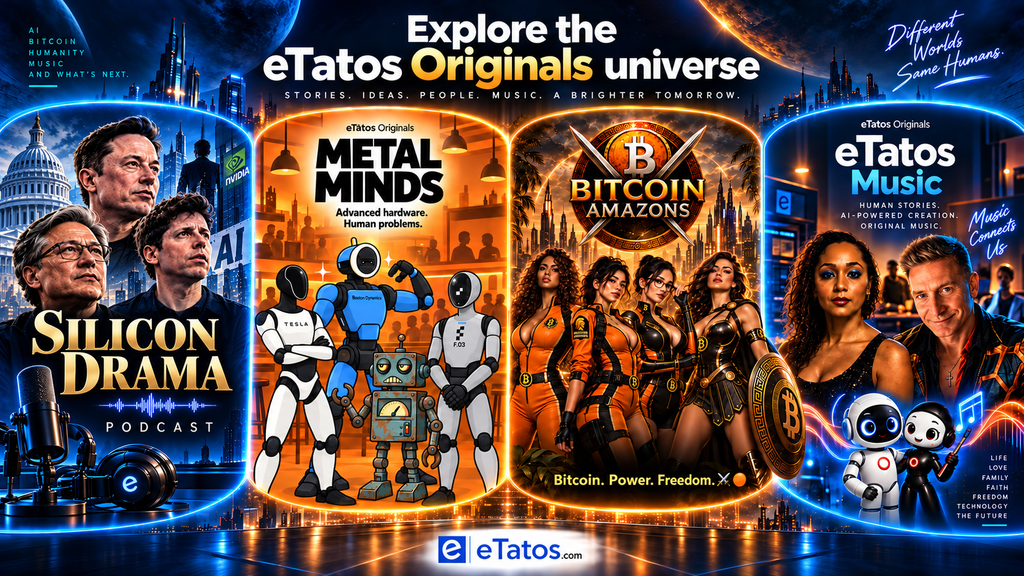
AI has left the screen
If Silicon Drama follows the people fighting for control of AI, Metal Minds follows what happens when intelligence gets a body.
Our eTatos Originals comic series explores humanoid robots and embodied AI with a humorous twist: Advanced hardware, very human problems and machines developing more personality than anyone asked for.
→ Enter the world of Metal Minds
Prefer listening?
Listen to Silicon Drama on Spotify
The deep-dive podcast turns each episode into a cinematic audio experience about AI, Big Tech, money, machines and the people competing to shape the future.
Every power drama needs a soundtrack
Silicon Drama has its own official theme song.
Listen to the full version on eTatos Music
About Silicon Drama
Silicon Drama is the weekly eTatos Originals series about the people, companies and technologies fighting for power in AI, compute, chips, agents and robotics. Not just what happened, but why it matters, who gains power and where the next conflict is forming.