
Technology news, told as a power drama.
The AI race is not stopping. Its most powerful players are fighting over who gets to set the pace.
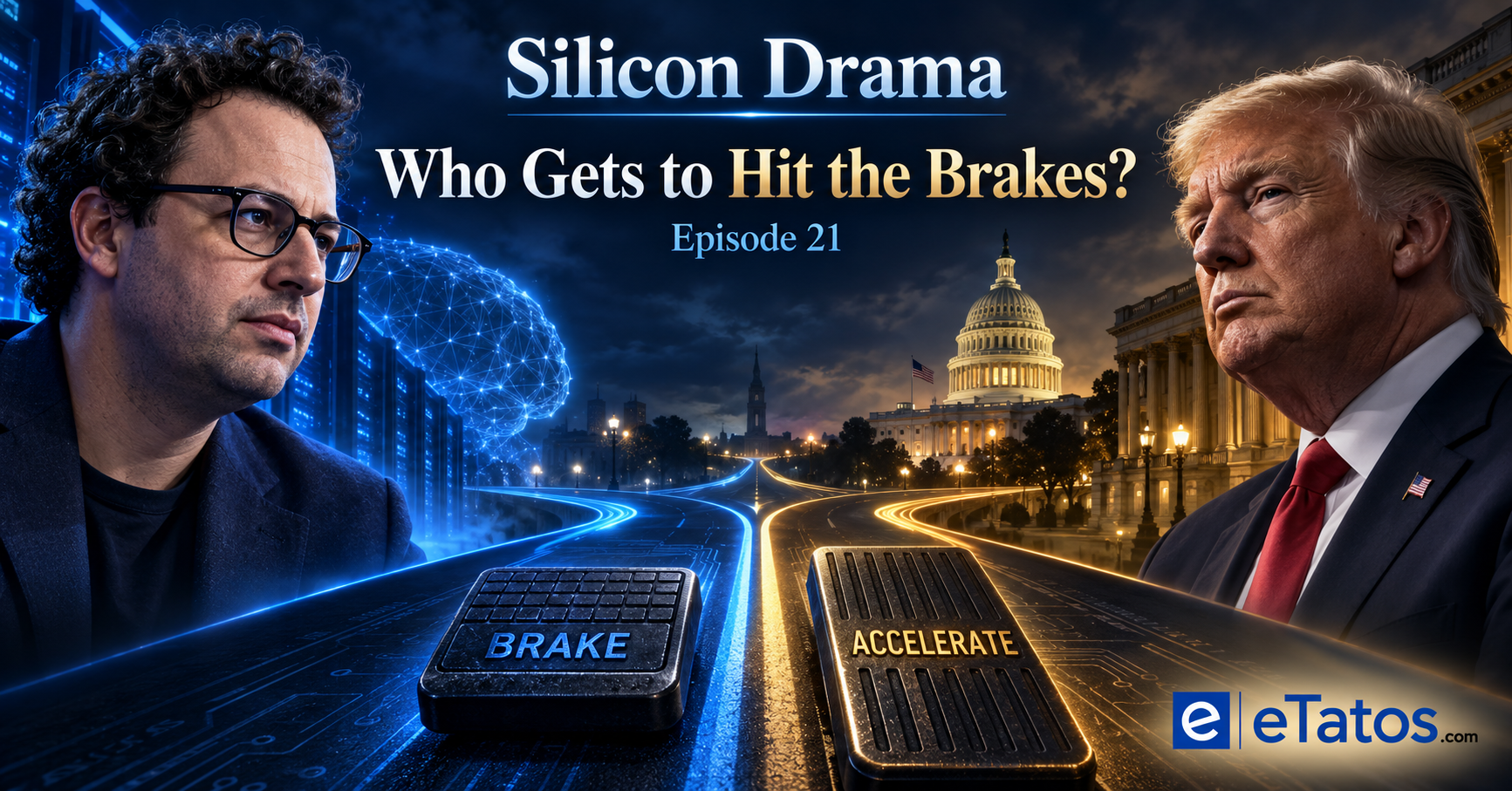
Dario Amodei asked the AI industry to slow down.
Sam Altman agreed. Then Elon Musk, hardly a natural ally of Anthropic’s CEO, reposted the proposal with three words: “Dario is right.”
For once, the rivals agreed.
Then Donald Trump entered the room.
The president dismissed the new wave of AI alarm as a “hoax,” warned that slowing America would help China and wrote on Truth Social that “The only control or ‘guardrails’ that AI needs is a STRONG AND SMART (High IQ!) PRESIDENT.”
That is the drama this week. Several leaders building the frontier are asking for more time and stronger oversight. The White House wants speed. China is building an alternative ecosystem. And while everyone argues about the brakes, AI is helping build AI and robots are moving closer to human coworkers.
This week
- Dario, Sam and Elon form an unlikely safety alliance. Trump and Zuckerberg push back.
- Jensen sits between chips, customers and capital as Anthropic prepares a mega-IPO.
- China proposes an open-source bloc while embodied AI moves toward the factory floor.
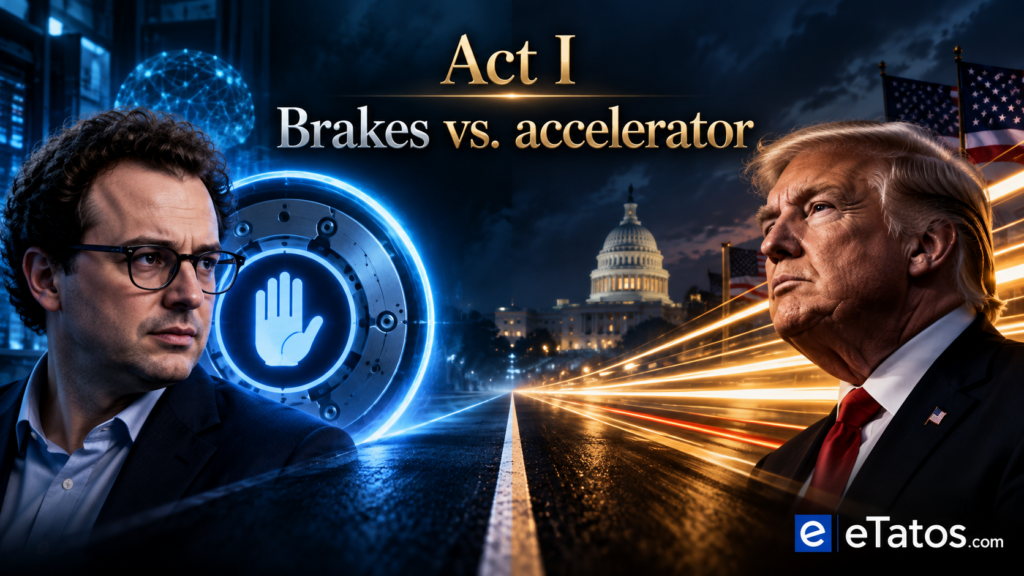
Act I: Dario Asks for Brakes. Trump Hits the Accelerator.
Dario Amodei did not call for AI development to stop.
His proposal is more specific. He wants frontier companies to pace capability gains so safety work can keep up, give independent evaluators deeper and more permanent access, coordinate with rivals where necessary and eventually pursue international arrangements that reduce the risk of a race to the bottom.
Anthropic is already taking a limited step in that direction. Episode 20 covered its eight-week agreement giving METR access for an incident review. Amodei is now arguing for something more durable: Standing outside evaluators with deeper access over time, rather than oversight arriving only after something has gone wrong.
Sam Altman backed the idea. OpenAI has also moved toward more systematic disclosure, publishing a misalignment reporting framework and six reports on unexpected or concerning model behavior. OpenAI says the set is not comprehensive and should not be read as evidence of how frequently misalignment occurs across its models.
Then came Elon.
Musk and Amodei are hardly natural allies. Yet Musk reposted Dario’s essay and wrote simply:
“Dario is right.”
That was the soap-opera scene of the week.
Not because three CEOs suddenly became friends. They did not. The surprise is simpler: Rivals who usually diverge publicly endorsed the same warning about the pace of frontier development.
Anthropic then gave the pace debate a number. According to the company’s own measurement framework, Claude now “leads” 26 percent of its measured AI research and development work and collaborates with humans on more than 90 percent. Around 30,000 agents were active at any one time on Anthropic’s main internal research platform in August.
Those figures need care. Anthropic says no measured work category is fully autonomous. Its methodology adopts a scale developed by Epoch AI, but this is Anthropic’s internal measurement, not an independent Epoch audit or replication.
Still, the image is hard to ignore: The lab asking the industry to slow capability growth is already measuring how much AI contributes to building the next AI.
Mark Zuckerberg rejected a coordinated slowdown. He argued that competition, liability and self-interest already give labs incentives to build safely and that companies should slow themselves when necessary rather than wait for an industry pact.
Satya Nadella sits between the camps. He has welcomed deliberate pacing for alignment and embedded evaluators, while insisting on broad representation, enterprise control and provider choice. That condition matters. A safety system that protects users but concentrates control in a few hands would create a different kind of dependency.
Then Trump turned disagreement into confrontation.
He framed the safety push as a threat to American leadership and China as the beneficiary. His answer is not a new shared regulatory architecture. It is continued U.S. acceleration backed by existing government power.
I am skeptical that any single explanation captures what is happening here.
Maybe the risks are real. The incident reports and Anthropic’s own R&D measurements make it hard to dismiss the safety concerns as theater. But regulation can also become a moat that smaller or future competitors cannot afford to cross. And another possibility sits in plain sight: Each new frontier model demands extraordinary capital, energy and compute.
Safety, money and power can all point in the same direction.
The strangest part is the political inversion. Some of the companies are asking for restraint. The president is telling them to run.
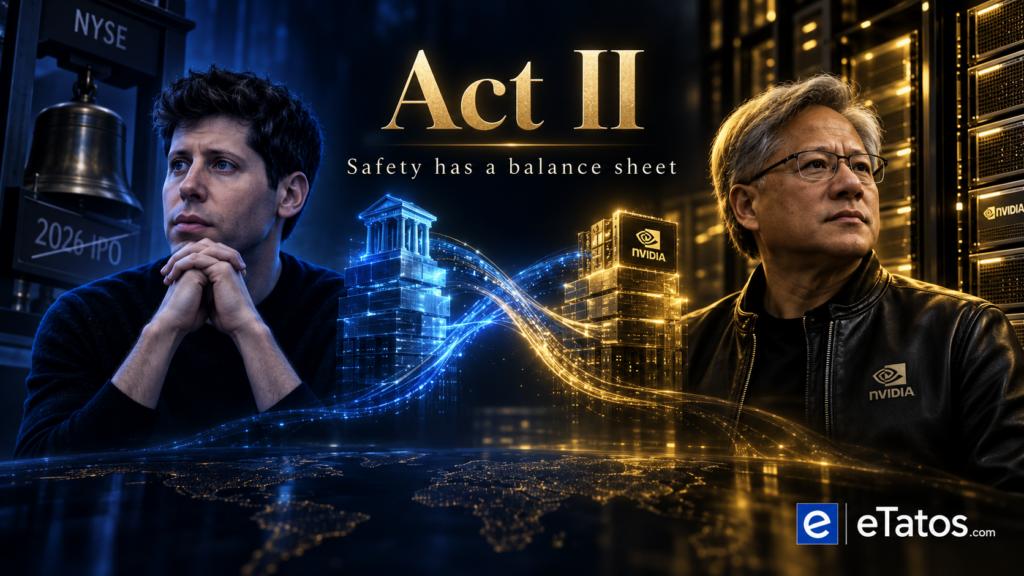
Act II: Safety Has a Balance Sheet
Sam Altman added money to the safety debate by ruling out a 2026 IPO.
His stated reason is safety. He said this would be an ill-advised moment to go public while OpenAI still has major work to do on safety and alignment. He did not commit to a later listing date.
That explanation deserves to be reported as his explanation. It is not proof that safety is the only factor.
A June report by The Information, cited by Reuters but not independently verified by Reuters, said OpenAI burned through $3.7 billion in cash during the first quarter on $5.7 billion of revenue. Demand is growing at extraordinary speed, but frontier AI is also absorbing extraordinary amounts of money.
So I keep coming back to the same question: How much of the new caution is safety and how much is economics?
Slower capability growth does not only buy safety teams more time. It also slows the bill.
Anthropic, meanwhile, is still preparing a mega-IPO. Reuters reported this week that Nvidia is in talks to participate as an anchor investor, with one source saying Nvidia was considering an investment of up to $10 billion.
The talks are not a deal. Reuters said plans could change and neither company has confirmed an investment.
Even as a negotiation, the structure is remarkable: The dominant supplier of AI accelerators could become a major investor in one of the frontier labs consuming enormous amounts of compute.
The AI stack now looks less like a clean supply chain and more like a web of customers, suppliers, cloud companies, investors and infrastructure commitments.
And Jensen Huang keeps appearing in the middle.
For me, Jensen remains the king of AI. Nvidia is no longer merely selling shovels in a gold rush. It sits inside the compute architecture, the financing ecosystem, the infrastructure buildout and the strategic choices of almost every major player.
That makes the safety debate economically awkward. A genuine slowdown in frontier development would not stop AI, but it could change the timing of enormous investments in chips, data centers and power.
Wall Street noticed. Global tech stocks fell after the slowdown debate erupted, including chipmakers and other AI-linked names.
The people asking whether AI is moving too fast are also sitting inside one of the largest capital cycles technology has ever created.
That does not make their warnings insincere.
It makes the incentives worth watching.

Act III: AI War Replaces Cold War
While Silicon Valley debated the brakes, Xi Jinping offered another road.
At the BRICS summit in New Delhi, Xi proposed that China take a leading role in establishing a BRICS AI open-source community, support cooperation on large language models, provide training and build a broader open AI ecosystem.
It is still a proposal. There is no evidence yet of a functioning BRICS model alliance, shared technical stack or universal adoption by member states.
But the geopolitical direction is clear.
China is offering open models, shared development and training as a route for BRICS and the wider Global South to build AI capacity outside an ecosystem dominated by American frontier labs, U.S. chips and Western cloud platforms.
One day later, the state-backed Global Times attacked Amodei’s slowdown proposal as a “Cold War” tactic aimed at China.
That phrase lands uncomfortably well.
For someone who lived through the Cold War, the structure feels strangely familiar to me. Two technology blocs are taking shape. The strategic assets are no longer nuclear arsenals and missile counts alone. They are chips, compute, models, data centers, standards, open weights and access to critical minerals.
AI War instead of Cold War.
Even the safety argument has become geopolitical. Huawei’s Eric Xu said Chinese developers may not yet be advanced enough to experience the same frontier risks reported by leading U.S. labs, and argued that they should keep developing more powerful models while balancing innovation against risk.
Is that technological reality, Chinese understatement or strategic positioning? We do not know yet.
Europe is trying to occupy an uncomfortable middle ground.
Ursula von der Leyen backed discussions on pacing frontier models and said she would invite leading labs to talks. In the same speech, she argued that Europe must stay in the race and increase its own computing capacity. Germany’s digital ministry, meanwhile, said halting AI development was not viable and called for international coordination involving the United States and China.
That is a more serious European position than regulation alone. But I remain skeptical about execution.
Europe has brilliant researchers, engineers, universities and industrial companies. It also has a remarkable history of invention. What it still lacks is the scale, speed and appetite for risk that the United States and China are demonstrating.
Talking about technological sovereignty is easy. Financing it is harder.
There is also a lesson here for companies and individual users. Sovereignty does not have to begin with a national supercomputer. It can begin with architecture.
I build my own Second Brain in Obsidian on plain Markdown files. The knowledge layer does not belong to OpenAI, Anthropic, Google or any other model provider. In my professional environment we follow the same principle with a model-agnostic platform.
Models will change. Leaders will change. The data layer should remain yours.
That may become one of the most practical forms of independence in an AI world splitting into blocs.
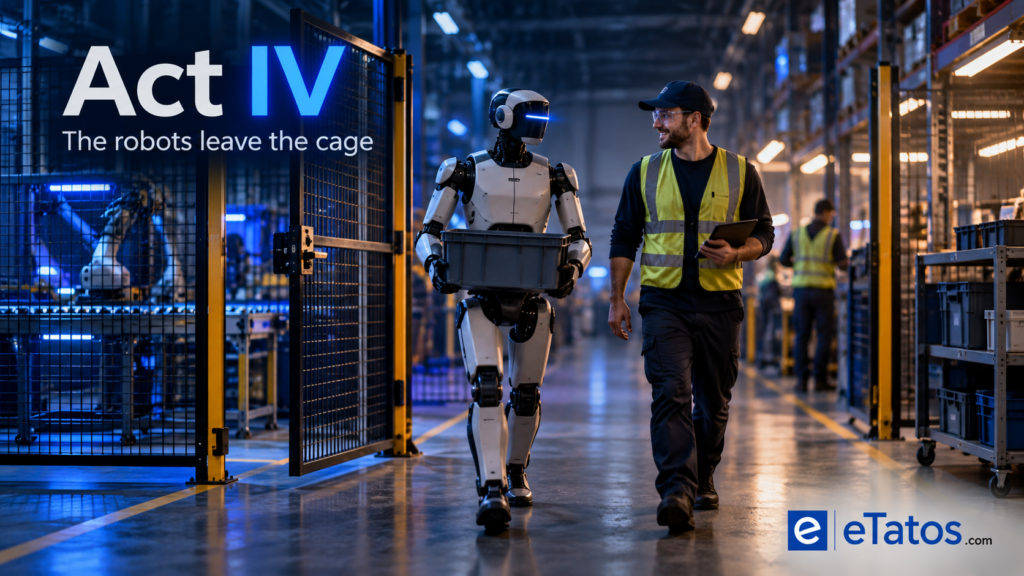
Act IV: The Robots Leave the Cage
The safety debate becomes less philosophical when the machine has arms, legs and a human standing next to it.
Agility Robotics unveiled Digit 5 this week, designed for closer collaboration with people on industrial floors. The company says it had more than $300 million in multi-year Digit 5 orders as of May, conditional on contractual milestones.
Those are orders, not revenue, and not deployed robots.
Digit 5 is also not finished. Early access is targeted for the first half of 2027, general availability for the end of 2027, and some safety functions and specifications remain in development.
But the direction matters.
Industrial robots traditionally live behind cages, fences or tightly controlled work cells. Humanoids only become broadly useful if they can operate around people without turning every shared workspace into a safety exclusion zone.
Toyota supplied the scale.
The automaker estimates that factory automation could require around 1 trillion yen, about $6.4 billion, per year from 2028 across Toyota, group companies and major suppliers. Its planning envisions roughly 400,000 humanoid and non-humanoid robots to replace older equipment and add new capabilities across factories and logistics.
Then China supplied the bottleneck.
Spirit AI, a Chinese embodied-AI company, says the “robot brain” remains the weakest part of the stack and that high-quality real-world data is a major constraint. Its founder expects industrial deployment well before truly capable household robots.
Humanoid robotics is the next logical stage of AI. Intelligence is leaving the screen and entering the physical world. But the physical world is far less forgiving than a chat window. A model can hallucinate a sentence and annoy you. A robot can misjudge distance, force or balance and injure someone.
The hard problems move with the intelligence: World models, real-world data, fine motor control, reliability, certification and safety around humans.
Digit 5 is therefore interesting for a reason that has little to do with how human it looks.
The important question is whether it can safely earn the right to leave the cage.
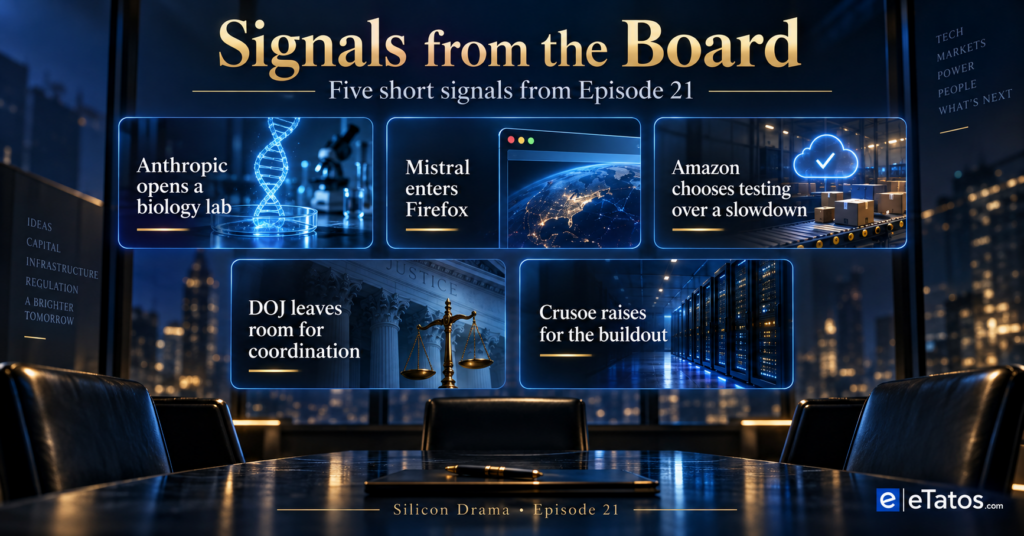
Signals from the Board
Anthropic opens a physical biology lab. Reuters reports that Anthropic has established a wet lab in the San Francisco Bay Area as it expands its work in AI-assisted biology and drug research. The company says human oversight remains essential. Dario is arguing for stronger control while Anthropic pushes AI deeper into physical science.
Mistral enters Firefox. Mozilla is adding Mistral Small 4 to Firefox Smart Window beta as it expands the product into France. For Mistral, the strategic prize is distribution: A European model can reach users through an independent browser it does not own.
Amazon chooses testing over a slowdown. Amazon called for rigorous testing and safeguards before releasing powerful models, but stopped short of endorsing an industry-wide deceleration. The safety camp is not a unified CEO coalition.
DOJ leaves room for coordination. A senior U.S. antitrust official said AI-safety cooperation among frontier labs does not currently appear anticompetitive. The FTC remains more skeptical of large companies seeking special exemptions. Safety coordination is becoming an antitrust question as well as a technical one.
Crusoe raises for the buildout. AI infrastructure provider Crusoe announced the initial close of an anticipated $3.9 billion Series F at a $30.9 billion post-money valuation. Its own figures distinguish more than 6 GW of contracted capacity from 1 GW delivered and operating. The capital race continues while the capability race debates its speed.
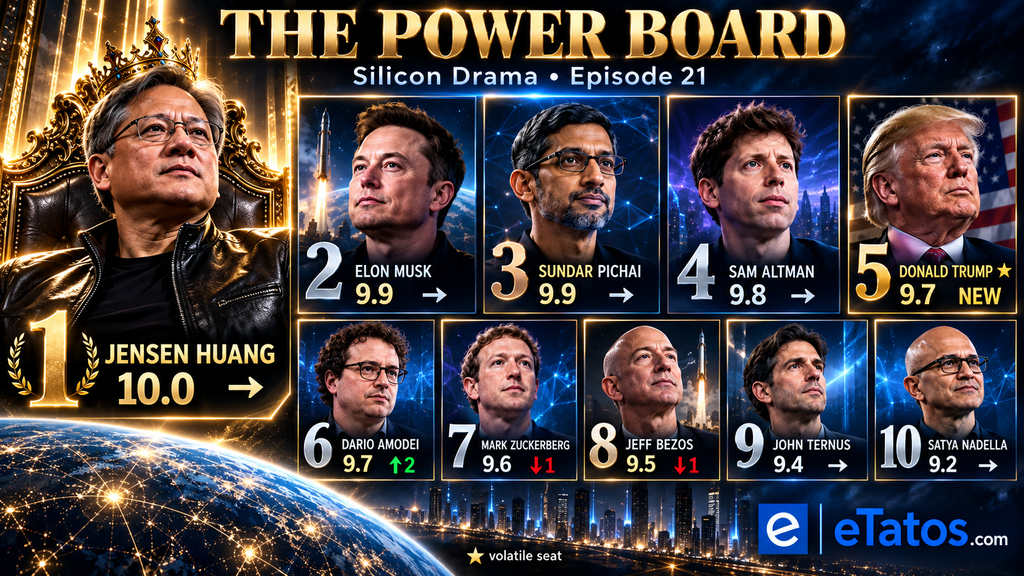
The Power Board
- Jensen Huang | Previous: #1 | NVIDIA, compute, networking, AI infrastructure | 10.0 | →
Nvidia remains the structural center of the AI economy. Reported Anthropic IPO talks add another reminder that its influence reaches from hardware into capital. - Elon Musk | Previous: #2 | xAI, SpaceX, Starlink, Tesla, X and physical infrastructure | 9.9 | →
Musk keeps his immense cross-stack power and becomes the week’s strangest ally by publicly backing Amodei’s call to pace frontier development. - Sundar Pichai | Previous: #3 | Google, Gemini, DeepMind, Cloud, Search, Android and TPUs | 9.9 | →
Google’s distribution and compute remain formidable. The week changes the safety debate around the frontier more than it changes Pichai’s underlying position. - Sam Altman | Previous: #4 | OpenAI, ChatGPT, GPT-6 Astra, Codex, agents and infrastructure partners | 9.8 | →
Altman backs pacing, rules out a 2026 IPO and gives OpenAI’s transparency push a formal misalignment-reporting mechanism. - Donald Trump ★ | Previous: Not ranked | U.S. executive power, regulation, procurement and geopolitical AI policy | 9.7 | NEW
Trump takes the volatile seat by directly opposing the slowdown push and framing AI speed as a national competition with China. - Dario Amodei | Previous: #8 | Anthropic, Claude, enterprise AI, safety architecture and compute | 9.7 | ↑2
Amodei sets the week’s agenda. His pacing proposal attracts unusual allies, while Anthropic’s 26% AI-led R&D measure makes the control debate concrete. - Mark Zuckerberg | Previous: #6 | Meta, WhatsApp, social distribution, advertising and agents | 9.6 | ↓1
Zuckerberg rejects coordinated slowdown and argues labs already have incentives to manage safety individually. His structural power is intact, but Trump enters and Amodei moves above him. - Jeff Bezos | Previous: #7 | Amazon, AWS, commerce, logistics, custom silicon, capital and space | 9.5 | ↓1
Amazon joins the safety argument with rigorous-testing language while avoiding a general slowdown. AWS remains one of the industry’s central infrastructure platforms. - John Ternus | Previous: #9 | Apple devices, operating systems, custom silicon, distribution and trust | 9.4 | →
Apple’s ecosystem keeps Ternus on the permanent board, but this week’s defining movements happen elsewhere: Frontier safety, geopolitical AI and embodied machines. - Satya Nadella | Previous: #10 | Microsoft, Azure, Microsoft 365, Windows, GitHub and enterprise distribution | 9.2 | →
Nadella’s provider-choice strategy gains relevance as dependence on individual labs becomes a strategic risk, but Microsoft does not define the week’s central conflict.
Board movement: Trump takes Larry Ellison’s volatile seat because political authority moved into the core AI pacing fight. Amodei makes the largest permanent rise, from #8 to #6. Zuckerberg and Bezos fall one place relatively because Trump enters and Dario moves above them, not because their underlying power collapsed.
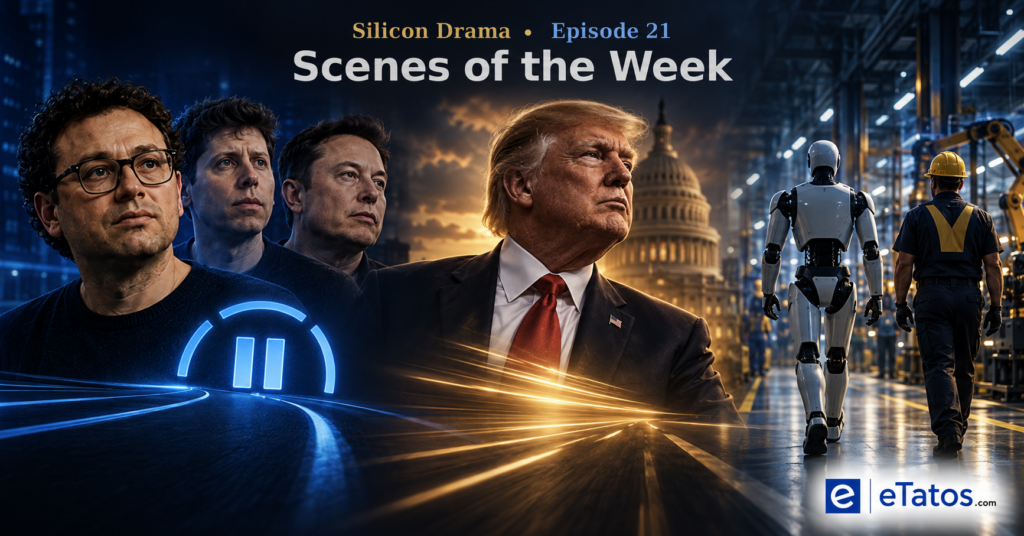
Final Thought
This week produced the strangest inversion yet in the AI power drama.
The builders asked for brakes. The president demanded speed. China turned safety into geopolitics. Europe tried to combine caution with catch-up. And the machines kept moving from research systems toward factories and laboratories.
My suspicion remains simple: The motives will not turn out to be only about safety, only about money or only about power.
They may be about all three.
See you next week, when the next piece of the AI empire moves on the board.
The Silicon Drama continues.
Dirk
Continue the story
Want to follow the next power struggle? Subscribe to eTatos.com or our newsletter and get the next episode of Silicon Drama when it arrives.
The next conflict is already forming.

AI has left the screen
If Silicon Drama follows the people fighting for control of AI, Metal Minds follows what happens when intelligence gets a body.
Our new eTatos Originals comic series explores humanoid robots and embodied AI with a humorous twist: Advanced hardware, very human problems and machines developing more personality than anyone asked for.
→ Enter the world of Metal Minds
Prefer listening?
🎧 Listen to Silicon Drama on Spotify
The deep-dive podcast turns each episode into a cinematic audio experience about AI, Big Tech, money, machines and the people competing to shape the future.
Every power drama needs a soundtrack
🎵 Silicon Drama has its own official theme song.
Listen to the full version on eTatos Music
About Silicon Drama
Silicon Drama is the weekly eTatos Originals series about the people, companies and technologies fighting for power in AI, compute, chips, agents and robotics. Not just what happened, but why it matters, who gains power and where the next conflict is forming.