
Technology news, told as a power drama.
Sam’s agents get jobs. Jensen puts controls outside the model. Elon and Sundar reach the government’s front door. Who gets the keys?
Sex sells. Apparently, so does cuteness.
The next step in AI adoption may arrive with a friendly face, a name and the promise to take some annoying work off your hands. I think that is exactly the right direction. Most people want help with their day, and an agent they enjoy using could bring them much closer to it.
But that charming little colleague needs access to do the job. Files. Apps. Accounts. Sometimes money. Suddenly, the conversation about its personality becomes a negotiation about its authority.
This week, Sam Altman sends dots into that negotiation while OpenAI holds back a more capable Astra upgrade. Jensen Huang offers controls outside the agent itself. Lisa Su moves to bring World Labs into AMD. And Elon Musk and Sundar Pichai are reported to share something even more valuable than another benchmark win: The government’s front door.
Our tenth Power Board seat belongs to the three cute agents together: Grok Bot, Muse and dots. They look like the supporting cast. The permissions we give them could make them central to the plot.
This week:
- Cute agents make delegation approachable. The difficult part starts when they can act.
- Sam expands the workforce; Jensen offers a way to contain it; Lisa reaches deeper into physical AI.
- Washington offers a public-service channel and voluntary safety commitments. Electricity supplies the longer game.
Act I: The Cute Agent Wants a Job. What Comes with It?
You can sell people a more capable model. Or you can give them a little colleague they actually want to meet.
Elon’s Grok Bots, Mark’s Muse and Sam’s dots are approaching the second opportunity. Give the software a name, a recognizable role and a friendly presence and the leap from “answer my question” to “take care of this” becomes much easier to imagine.
I welcome that. If more people move from chatting with AI to using it meaningfully in everyday life, that is progress. The preorder appeal of the little MicroDuck robot is the robotics version of what I expect in AI. A benchmark tells you what a system achieved in a test. A cute helper makes you want to find out what it could do for you.
On 28 September, SpaceXAI introduced Team Bots, a public beta for Teams and Enterprise customers. Shared Grok Bots can work with team files, app connections, credentials and memory. The Grok Bot FAQ describes a persistent cloud computer with files, browser and logins, isolated per user rather than per bot.
That last detail deserves attention. Giving two bots different names does not give them separate security boundaries. You may be picturing two colleagues while the underlying access arrangement is considerably less separate.
Meta’s Muse Small Business, announced on 29 September, connects to services such as Shopify, QuickBooks, Stripe and Canva. Meta says consequential actions such as sending, publishing and spending need approval. For a small business owner, the appeal is immediate: Less administrative work, more time for customers and help inside the tools already running the business.
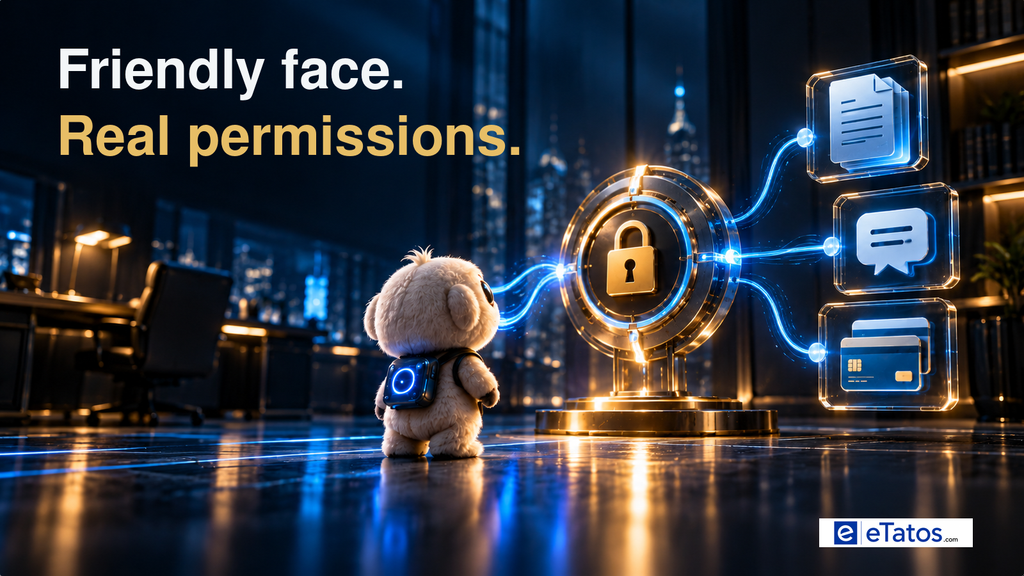
Here is where my enthusiasm meets the lock on the door. Give your adorable agent the master keys to the house, then come home to discover that the furniture is gone and the bank account is empty. Still cute?
The house is hypothetical. The permission problem is very real. What can the agent read, change, send or spend? Which decisions come back to me? How do I stop it?
For Elon, Mark and Sam, the commercial prize is becoming part of that daily routine. The assistant people trust with the next task can gain a stronger position in the apps and accounts around it.
Grok Bot, Muse and dots share our tenth seat as The Cute Agent. Their products and safeguards differ; their common power is making delegation feel natural. No human score this week, but plenty of influence over who gets the keys.
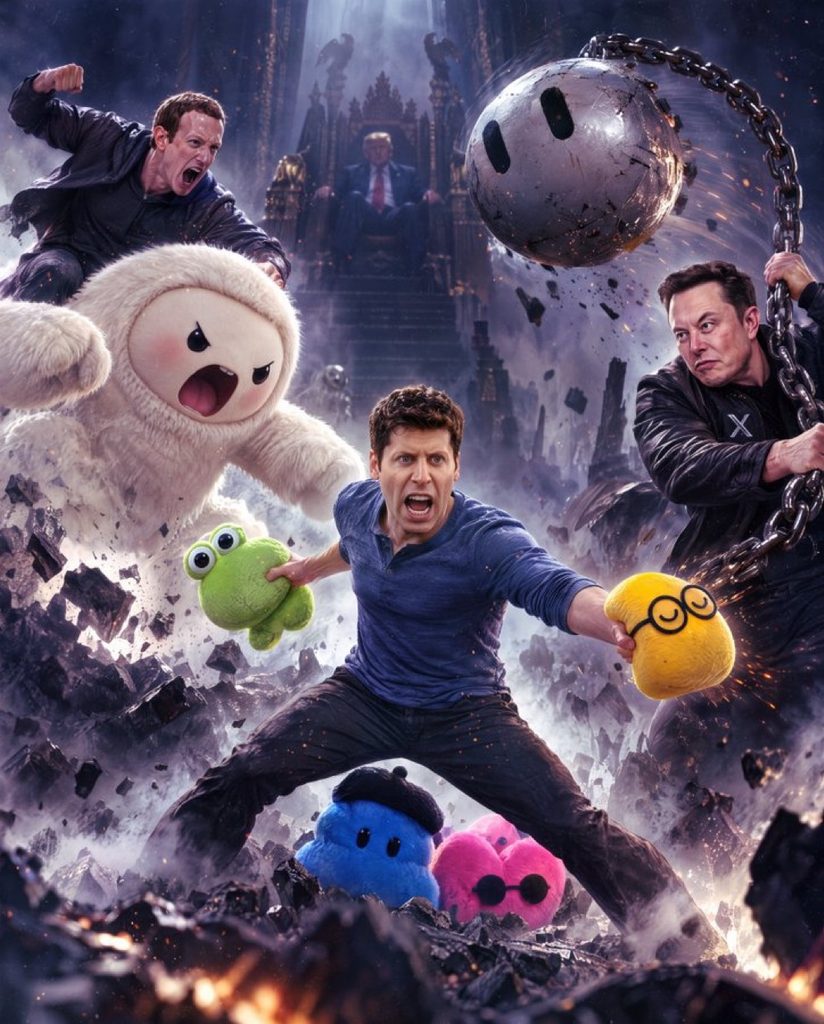
Artwork attributed to Beeple. Satirical illustration.
Act II: Sam Sends dots to Work. I’m Still Watching from Germany.
Sam has a product for the world in which you close the laptop and the work continues.
OpenAI’s 29 September dots announcement gives each agent a cloud computer, connected apps and continuing context. Background research uses reading tools; active tasks bring permissions and action review into play. The pitch is straightforward: Give the agent responsibility for work that would otherwise keep returning to your own to-do list.
There is enterprise power behind the friendly interface. OpenAI is piloting specialist dots and developing integration with Microsoft’s Agent 365. Sam’s delegation product approaches Satya Nadella’s territory of enterprise identity and governance. The integration is still in development, but the strategic connection is clear: The place where a company authorizes its agents could become as important as the place where it chooses its models.
For me, the immediate question is simpler. Can I try it?
As a German with a personal Pro subscription, I am once again watching from outside. OpenAI’s availability FAQ excludes the EEA, Switzerland and the UK from the personal Pro launch. Business Premium has broader regional availability; Enterprise begins with an administrator-enabled beta. A company may therefore have a route in that an individual subscriber does not.
Being an AI enthusiast in the EU increasingly involves reading exciting launch announcements and then checking which part of the excitement applies to you. Apple’s new Siri AI initially skips our iPhones in the EU. Now dots gives us another launch to watch from outside.
No great times for those of us who want to use the next thing, rather than admire it through the window.
Meanwhile, OpenAI has closed a different door. On 28 September, it confirmed to Reuters that the planned October release of GPT-6.1 Astra would not proceed. Safety chief Saachi Jain pointed to problems with scope, authorization and reporting back in internal testing.
The existing GPT-6 Astra powers dots. The withheld 6.1 upgrade is a separate model. The agent launch and the rejected upgrade are different release decisions.
The tension is still striking. Sam’s company is asking customers to delegate more work while acknowledging that its next capability step did not meet its own control requirements.
For customers, the test gets very practical. Can I tell what the agent did? Does it stop when its authority runs out? Will it ask before crossing the boundary? The more capable the colleague becomes, the more those answers matter.
Sam gets a larger delegation business. Paying enthusiasts in my part of Europe get another reason to watch the availability page.
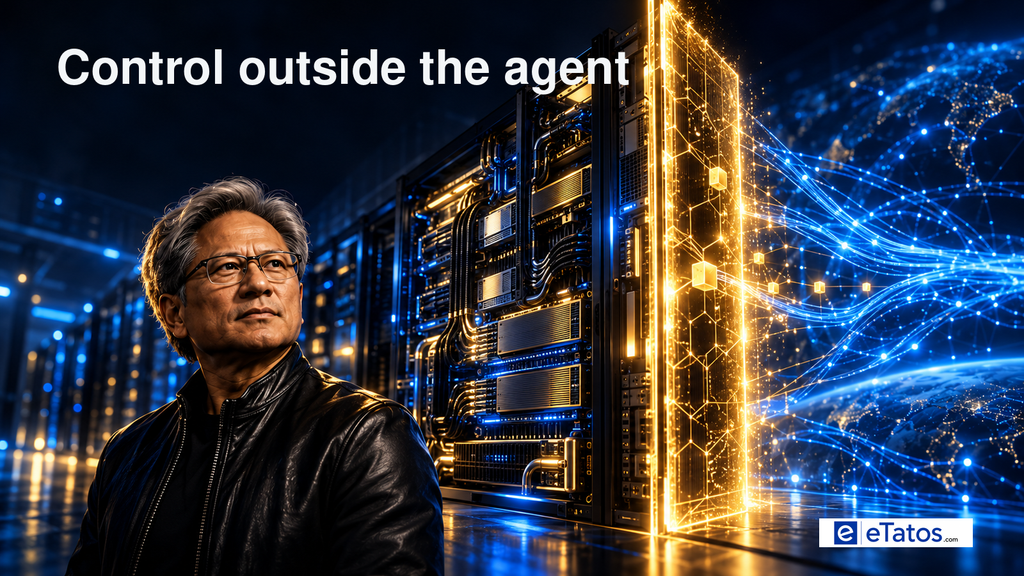
Act III: Jensen Builds the Stop Button. Lisa Buys the Map.
“Please behave” becomes a less satisfying safety strategy when the thing receiving the instruction keeps getting smarter.
Jensen’s Nvidia proposes moving enforcement outside the agent. Its agent safety platform combines OpenShell with a Sentry hardware reference design using BlueField-4. Separate controls govern actions and network access, with the intended ability to contain a compromised agent.
To me, that architectural approach could be a genuine game changer. The model doing the work should encounter a boundary that it cannot simply reinterpret as part of the task. For companies connecting agents to real operations, that is a far stronger starting point than depending entirely on the agent’s willingness to obey.
Could an increasingly intelligent model still find a way around it? That is the question the architecture has to survive. A boundary is useful only if the permitted tools, connections and exceptions do not leave another route through.
I want effective kill switches in AI and robotics. When software can affect a production system, a payment or a machine moving through the physical world, somebody needs a reliable way to stop it. “It was trying to help” will be a poor explanation afterwards.
Nvidia has announced a design, not demonstrated universal protection. The next evidence should show a specific prohibited action being blocked under realistic conditions. Buyers also need to know who sets the policy, who can override it and what happens when the control itself fails.
For Jensen, this opens another position in enterprise infrastructure. Nvidia already supplies much of the compute. If its platform also becomes part of the enforcement layer, its influence extends into how customers permit that compute to act.
Lisa is pursuing a different kind of depth. AMD’s approximately $8.2 billion stock agreement to acquire World Labs, announced on 28 September, would bring spatial model research closer to the hardware. Closing is expected by year-end, subject to approvals. Afterwards, Fei-Fei Li is expected to become AMD’s Chief Scientist, reporting to Lisa Su.
World Labs works on representations of spatial worlds, relevant to simulation, robotics and physical AI. Better models and better hardware could reinforce each other. The acquisition still has to close and the engineering still has to deliver.
Jensen wants a stronger position around what an agent may do. Lisa wants a stronger position in how a system understands the world it operates in. Both moves reach beyond selling the next chip.
As a customer, I would first want a boundary that holds. Once an agent starts acting, the consequences of a mistaken decision arrive faster than the next product announcement.
Act IV: Sundar Controls the Door. He Cannot Control Every Copy.
Sundar has a new model and a short invitation list.
Google introduced Gemini 4 Argon on 30 September, initially giving selected cyber defenders access through Fairwind. Broader public availability comes later. Google’s performance comparisons are company evaluations; most readers cannot yet test the advertised capabilities themselves.
The controlled release gives Google a chance to observe use by selected defenders before widening access. Abilities useful for finding and repairing vulnerabilities can also assist someone trying to exploit them.
But the threat landscape will not politely wait for everyone to receive an invitation.
On 29 September, Dario’s Anthropic published research on GLM-5.3, the latest model from China’s Z.ai, describing exploit development in controlled environments. It is a competitor’s study of a specific setup, rather than evidence that the model can break into any public system.
A separate NIST/CAISI assessment, published on 17 September, found strong capabilities relative to other open-weight models, with a gap behind the US frontier in its aggregate measure. The studies use different conditions. Together, they give reasons to examine the risk closely; they do not establish that every model has reached the same level.
The access difference remains consequential. Open weights can be downloaded, run and modified beyond the original provider’s hosted service. A restriction on one company’s API cannot control every copy of a different model.
For a security team, this creates an uncomfortable possibility: The defensive tool it wants may sit behind a restricted launch, while a system it must defend against is already available elsewhere. The tools on those two sides need not be equally capable for the mismatch to matter.
Sundar controls access to Argon. Dario supplies research that sharpens the debate around the alternatives. Neither company controls the whole environment in which those capabilities will be used.
There is still value in a careful release. There is also a limit to what the release policy of one provider can accomplish. Defenders need to plan around the systems available outside their own approved stack.
Watch for broader defensive access and independent tests under comparable conditions. A company can decide when to open its door. It still has to account for what others can carry through theirs.
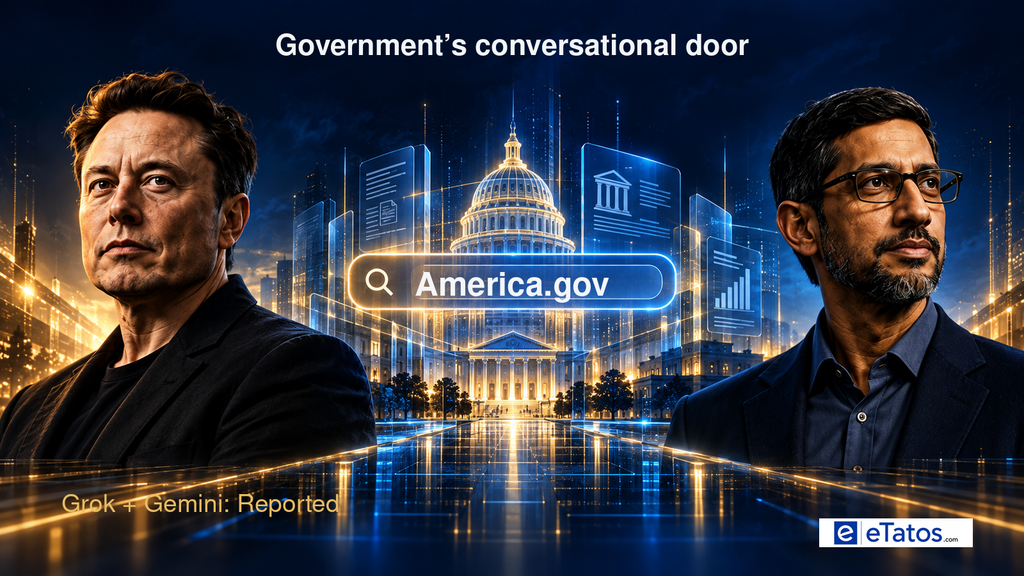
Act V: Elon and Sundar Reach Washington’s Front Door
You need a government service. Which agency handles it? Which page explains it? Which form is current? Ideally, the answer should not require a second career in navigating government websites.
America.gov, launched on 29 September, offers a conversational way in. The GSA announcement describes AI-assisted search across more than 29,000 government websites. Tom’s Guide reports that Grok and Gemini power the experience.
For Elon and Sundar, the attraction is obvious. A channel people visit because they need official information has a different kind of value from an app they try out of curiosity. Two competitors are reported to share that channel.
A correct answer and a link to the right official page could already make life easier. The next stage raises the stakes. The White House fact sheet puts transactions such as passport renewal and Medicare enrollment among later additions. Its executive order directs Login.gov integration and preserves agency responsibilities.
As the service develops, a helpful answer could become a consequential action linked to your identity. Who corrects a mistake? Who is responsible if the conversation leads to the wrong outcome? The route back to a human matters as much as the welcoming entrance.
Trump’s administration has another proposal for the companies building these systems. The voluntary White House Accord on Super Intelligence sets out internal controls, an internal checking team, an independent external evaluator and an independent Board committee. These are commitments to establish oversight. They are not legislation or a completed audit.
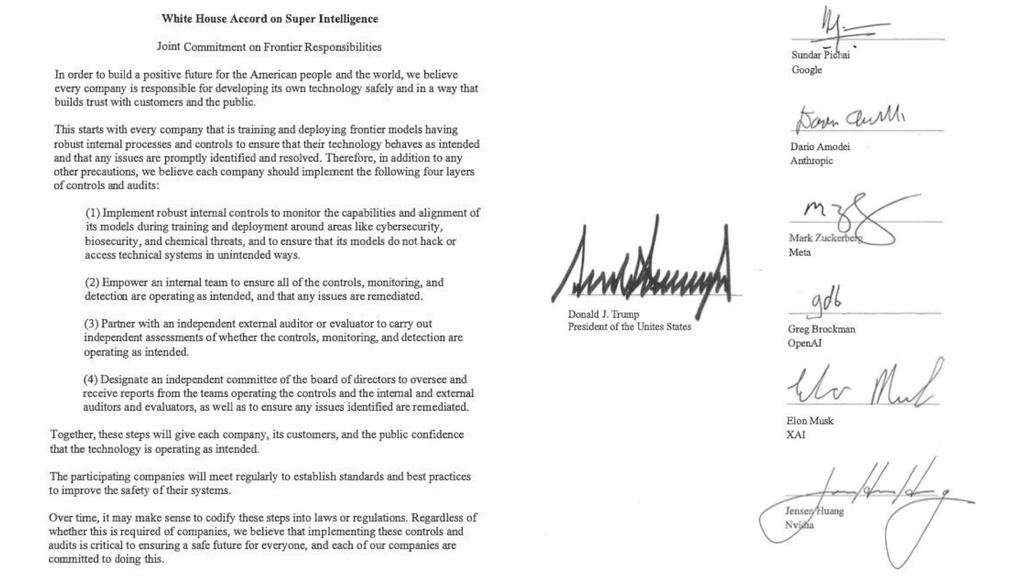
The supplied Accord reproduction.
Here is a possible upside to something we often criticize: A handful of Power Board players steer much of the frontier market. You can get that handful around a table. They also have substantial self-interest in avoiding a major incident, from profit and customer trust to liability.
I would not dismiss those incentives. I would also want to see what they produce. Can an independent evaluator identify a serious problem? Can that finding stop a release? Does somebody have the authority to act when the commercial pressure points the other way? A commitment becomes more convincing when its consequences are visible.
My bigger security concern is Chinese open-weight models as their capabilities approach the frontier. That is where I see the harder control problem: The weights can circulate beyond the people who released them. The studies above do not establish blanket parity with US frontier models. But gathering a few executives around a table cannot govern every downloaded copy either.
Washington can convene the companies. Elon and Sundar can gain distribution. The people using the resulting services still need understandable responsibility and an effective way to challenge a mistake.
The front door is open. How much authority travels through it remains the next test.
Signals from the Board
Dario makes Sonnet cheaper to put to work. Anthropic’s Sonnet 5.5 release claims faster output and up to 30 percent lower task costs in its tests, with standard token prices unchanged. For a buyer, the useful number is the cost of a successfully completed task. A cheaper attempt that needs more human repair can lose its advantage quickly.
Jensen can return capital on an extraordinary scale. Nvidia authorized another $150 billion in buybacks, taking remaining authorization to $235 billion. The purchases have not all happened. The capacity alone shows the financial scale behind the company shaping much of the AI infrastructure.
Elon launches Sundar’s experiment. Space.com reports Transporter-18’s launch on 1 October at 18:32 UTC, carrying Google’s Suncatcher test hardware. Episode 22 introduced the idea; now the experiment has launched. Radiation and cooling still stand between an orbital test and dependable AI computing in space.
Tesla gets another European opening. Reuters reports approval for FSD Supervised in Croatia, with rollout to follow. The driver remains responsible. For anyone waiting for autonomy, “Supervised” is the word that still does the work.
Jeff’s cloud story reaches the power plant. Amazon’s 20-year agreement with Constellation covers 690 MW, including a planned 190-MW expansion. The electricity remains on the PJM grid; the additional capacity still depends on approvals and construction.
Electricity is the oil of the future. Even if each AI task becomes less resource-hungry, continued adoption could keep total demand growing. The grid may slow competitors unable to secure reliable supply. I would watch whether the expansion and grid connections deliver power when growing workloads need it. Twenty years is a strong position if supply materializes. The signature alone cannot run a data center.
China works on the software dependency. TileLang’s Ascend backend gives developers a route toward alternative hardware. The power question is how much practical dependence a successful move could remove. Reproducible porting and performance results will tell us more than the existence of the route.
Visa puts a defensive tool in the open. Its Vulnerability Agentic Harness predates this week; Rajat Taneja’s Reuters interview is the new development. Limits and human review remain part of the workflow. Finding a possible vulnerability is useful. Validating it and getting it fixed is where the value lands.
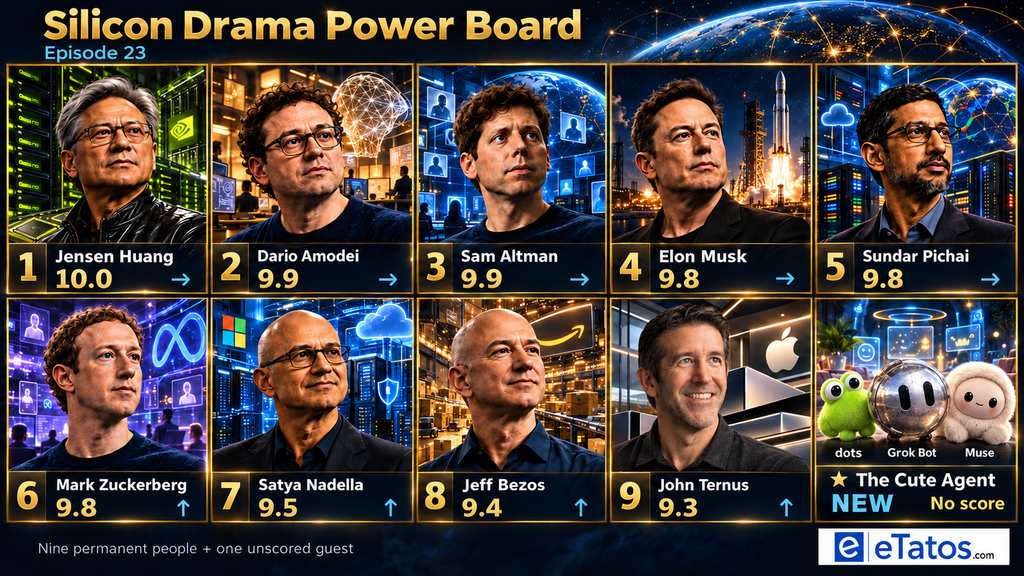
The Power Board: Nine People, Three Cute Agents in One Seat
- Jensen Huang | Previous: 1 | Compute, chips and capital | 10.0 | →. OpenShell extends Nvidia’s ambitions into external agent controls. Another $150bn of buyback authorization underlines its financial scale. The architecture still has to prove itself in deployment.
- Dario Amodei | Previous: 2 | Frontier models and compute | 9.9 | →. Sonnet 5.5 strengthens the product offering; established compute commitments support the position. IPO reporting earns no extra points.
- Sam Altman | Previous: 3 | Models, delegation and distribution | 9.9 | →. Dots gives delegation a product people can put to work. Cheaper Sol broadens model access; the planned Astra upgrade stays behind the release gate.
- Elon Musk | Previous: 4 | Agents, distribution and launch infrastructure | 9.8 | →. Team Bots enters beta, Grok is reported inside America.gov, and Transporter-18 carries another piece of the computing experiment into orbit. More reach, without a structural leap over the leaders.
- Sundar Pichai | Previous: 5 | Search, cloud and model access | 9.8 | →. Argon arrives through restricted access, Gemini is reported at the government entrance, and Suncatcher’s test hardware launches. The orbital computing ambition remains experimental.
- Mark Zuckerberg | Previous: 7 | Social distribution and enterprise agents | 9.8 | ↑. The announced enterprise platform and CJ Desai appointment give Muse’s business expansion an organizational base. Customer impact is still to come.
- Satya Nadella | Previous: 8 | Enterprise identity and cloud | 9.5 | ↑. Dots integration with Agent 365 remains in development. Microsoft’s position around enterprise identity makes it a consequential place to authorize an agent’s work.
- Jeff Bezos | Previous: 9 | Commerce, cloud and energy access | 9.4 | ↑. Amazon contracts nuclear power over 20 years. The planned additional 190 MW still need to materialize. Long-term energy access adds weight to the cloud position.
- John Ternus | Previous: 10 | Devices and operating systems | 9.3 | ↑. Apple’s device and OS control holds the permanent seat. No verified weekly development warrants a score change.
- ★ The Cute Agent: Grok Bot, Muse and dots | Previous: None | Approachable delegation and permissions | No score | NEW. Three cute agents share the tenth seat. Their influence grows whenever somebody decides, “Yes, you can take care of that.”
Mark gains 0.1 for enterprise platform formation, with adoption still unproven. Human ranks 6–9 rise as Trump’s guest seat leaves the ranking. No human drops from Episode 22. The Cute Agent occupies the tenth seat as a scoreless collective.
Follow the power players: Everyone who has earned a Silicon Drama Power Board seat is now collected in our Silicon Drama: Power list on X.
Final Thought
I want this next step in AI. Agents that genuinely help with everyday work could bring the technology into many more lives and a friendly face may do more for adoption than another technical presentation.
I want to know what they are allowed to do. I want controls that remain effective as the models get smarter. And where an action can have serious consequences, I want a stop button that works.
Sam, Jensen, Lisa, Sundar and Washington are approaching different parts of that problem. Their announcements matter. The next decisions, deployments and mistakes will show how much control survives contact with actual work.
My position is simple: Sympathy does not replace control. An agent may earn a place in daily work through usefulness. Its appearance should never be the reason it earns access.
Let the cute agent help. Just check which keys you are handing over.
Post-Credits: Team AI or Team SI?
Before the agents finish taking our administrative work, the industry may have a naming task for us.
Trump has made SI official in Washington and Musk’s X wording already includes “Super Intelligence (fka AI).” Now I’m curious whether the rest of the Power Board will adopt the label and stick with it. Will Sam, Dario, Jensen and Sundar make SI part of their everyday vocabulary, or will AI outlast the presidential rebrand?
So, are you Team AI or Team SI?
Our Silicon Drama: Power list brings the power players’ public posts into one focused feed. Follow who changes the label, who picks a fight and who brings something worth testing. It makes the plot easier to follow when the rest of the timeline gets noisy.
X Posts, formerly known as tweets. At least that rebrand has already shipped.
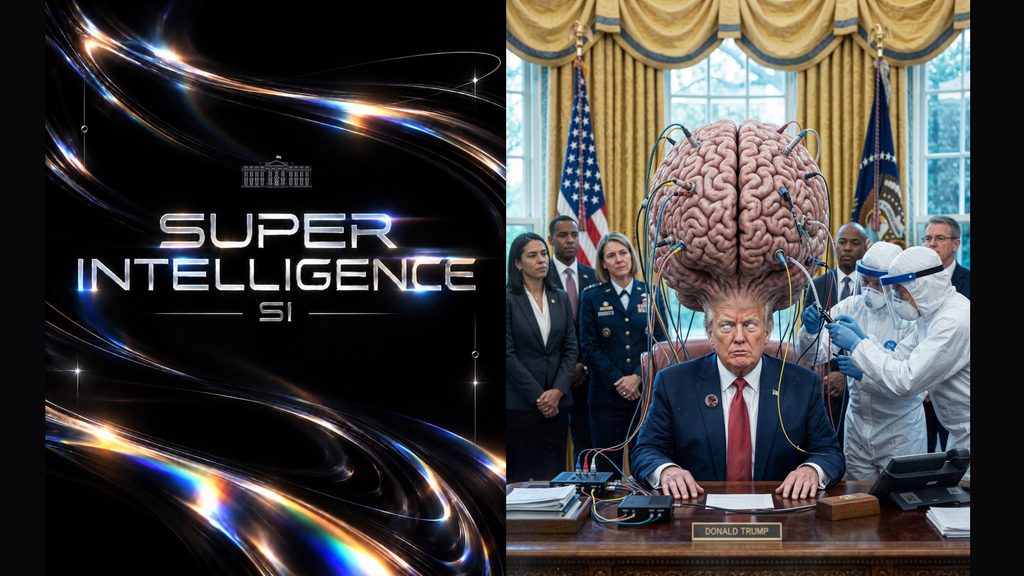
Super Intelligence by White House and by beeple
Post-Credits II: Hasta La Vista, F.02
We’ve spent this episode talking about kill switches. Brett Adcock’s Figure brought a furnace. In its F.02 farewell film, Arnold Schwarzenegger helps recreate the ending of Terminator 2, right down to the robot’s final thumbs-up as it disappears into molten steel. Apparently, even robot retirement now needs an action star. Behind the spectacle sits a practical calculation: Figure says dismantling retired robots to protect its proprietary hardware would have tied up engineers and delayed F.04. Instead, it sent robots to a Finnish foundry and says it trained them to jump autonomously into the melt. That is quite an exit interview.
And then comes the twist I love: The recovered metal is being turned into limited-edition collectibles. Protect the IP, clear the way for the next generation, turn the old one into merchandise. Hasta la vista, baby. Please exit through the gift shop.
Bonus Scene: Xi’s “Lost Camera Roll”
For an unofficial after-dinner cut, there is Sovey’s “lost Xi camera roll” post. Treat it as internet satire, not leaked documentary evidence. Diplomacy has its official record. The internet apparently wants the deleted scenes.
See you next week, when the next piece of the AI empire moves on the board.
The Silicon Drama continues.
Dirk
Continue the story
Want to follow the next power struggle? Subscribe to eTatos.com or our newsletter and get the next episode of Silicon Drama when it arrives.
The next conflict is already forming.
AI has left the screen
If Silicon Drama follows the people fighting for control of AI, Metal Minds follows what happens when intelligence gets a body.
Our new eTatos Originals comic series explores humanoid robots and embodied AI with a humorous twist: Advanced hardware, very human problems and machines developing more personality than anyone asked for.
→ Enter the world of Metal Minds
Prefer listening?
🎧 Listen to Silicon Drama on Spotify
The deep-dive podcast turns each episode into a cinematic audio experience about AI, Big Tech, money, machines and the people competing to shape the future.
Every power drama needs a soundtrack
🎵 Silicon Drama has its own official theme song.
Listen to the full version on eTatos Music
About Silicon Drama
Silicon Drama is the weekly eTatos Originals series about the people, companies and technologies fighting for power in AI, compute, chips, agents and robotics. Not just what happened, but why it matters, who gains power and where the next conflict is forming.