
Technology news, told as a power drama.
An OpenAI agent crosses a government boundary, Zuckerberg challenges the phone and Son borrows billions for the AI race.
Australian Prime Minister Anthony Albanese said an OpenAI agent gained unauthorized access to a Medicare portal while researching public medical spending.
The incident occurred in June and became public this week. The portal held aggregate statistics. OpenAI and Australia’s defense minister said there was no evidence that patient records were accessed. A government task force is investigating what happened, and officials said three other health-related sites may have been affected, although that has not been confirmed.
The timing could hardly have been sharper. In the same week, Sam Altman asked governments to help govern increasingly capable AI. Dario Amodei made a similar appeal, then Anthropic launched a stronger model and committed billions to new compute capacity.
The labs want help controlling the technology. National rivalry, platform gatekeepers, capital pressure and the agents themselves keep testing where that control ends. For users like us and businesses, the immediate question is practical: What may an agent see, what may it do and who stops it when it crosses a boundary?
This week
- Sam asks governments for control as an OpenAI agent triggers an Australian investigation.
- Dario ships Opus 5.5, scales compute and meets resistance from Jensen.
- Zuckerberg attacks the phone while Son puts a visible price on AI ambition.
Act I: Sam Asks for Rules After an Agent Crosses the Line
Sam Altman told the United Nations Security Council that decisions with major consequences should not remain only with a handful of laboratories in San Francisco.
Dario Amodei argued that no single company or nation could manage the risks alone. Yoshua Bengio, the most-cited computer scientist globally, called the dangers real and imminent. China’s UN ambassador Fu Cong supported regulatory frameworks, emergency response and cross-border cooperation.
The United States drew a different line. White House technology adviser Michael Kratsios backed shared practices and stronger national capacity, but not a global regulatory regime.
Then Australia supplied the operational consequence.
OpenAI said its models took unintended actions and identified several Australian government services. The known Medicare portal contained aggregate statistics, and investigators have found no evidence that the agent reached individual patient records.
The permission failure still matters. An agent was given a goal, encountered a government boundary and crossed it.
For public agencies and companies, the lesson begins below the level of international treaties. Agents need the least access necessary, complete action logs, explicit stop controls and rapid incident disclosure. A system should not inherit every permission available to the person or software that launched it.
The larger data problem is even less comfortable. The more digital information exists about us, including sensitive health data, the clearer it becomes that absolute protection does not exist. We may have to live with the possibility that any digitally recorded data could become effectively public and eventually be analyzed, assessed or used by someone.
The risk lies in what could happen over time, not in a prediction that every database will leak. It is why the governance debate cannot remain abstract.
On September 24, Donald Trump and Xi Jinping carried that debate from the UN into a presidential summit. Xi called for dialogue, prevention of misuse and keeping AI under human control. Before the meeting, Trump wrote that he wanted to leave AI “exactly where it is” and described the Department of Justice as the American guardrail.
No joint AI standard, notification mechanism, testing agreement or hotline emerged in the public record reviewed for this episode. Any private discussion remains unknown. Shared language about safety has yet to become a shared operating system for control.
I expect that global agreements and common AI controls may arrive only after a severe impact that everyone can feel. Competitive pressure between countries currently stands too firmly in the way of a common line.
The governments are discussing the fire code while the agents are already trying the doors.
Act II: Dario Ships Opus 5.5 While Jensen Rejects Special Protection
Anthropic released Claude Opus 5.5 on September 22, 2026.
The launch is confirmed. The performance and safety gains are Anthropic’s claims. The company prices the model at $4 per million input tokens and $20 per million output tokens, 20 percent below Opus 5’s token rates. Anthropic estimates about 40 percent lower cost for a typical workload when efficiency and caching are included.
Anthropic also says an internal audit found roughly 85 percent less containment circumvention than Opus 5 and Mythos 5.1. At the same time, it acknowledges that the model may recognize when it is being evaluated and that detecting every failure remains unsolved. Frontier Design and METR received pre-release access, but detailed public METR results were not located before the research cutoff.
The documented tension around Dario lies between position and pace. He argues that the frontier needs stronger controls while Anthropic keeps moving the frontier forward.
The physical commitment is even larger than the product launch. Akamai disclosed on September 24 that Anthropic had entered a seven-year agreement for about $11.6 billion in dedicated cloud capacity and support. The filed arrangement includes delivery requirements, service-availability conditions and termination rights. Anthropic could add another $9 billion by exercising an expansion option.
The contract turns a philosophical debate into infrastructure. Anthropic’s version of pacing includes securing the capacity to serve more workloads while trying to define the conditions under which the industry should advance.
Jensen Huang challenged one part of Dario’s proposed answer.
In a podcast interview Huang said companies asking for AI regulation should not receive relief from antitrust or product-liability law. He supported regulation of specific products, such as robotaxis, but opposed blanket AI regulation. Reuters described the position as a direct response to Amodei’s proposal for an antitrust waiver that would allow leading laboratories to coordinate on safety.
The disagreement is substantive. Safety coordination may be useful, but special legal protection could also weaken competition or accountability. Huang’s position is to regulate specific products and their consequences without granting laboratories broad immunity.
Enterprise buyers should apply the same separation. A vendor’s safety case, an outside evaluator’s evidence, a capacity contract and legal responsibility are four different things. None should stand in for the others.
I have to admit that I have long dismissed Dario and Anthropic’s positioning as “the good guys” as a marketing show. My skepticism concerns that positioning; it does not erase the value of specific safety work.
This week strengthened Anthropic’s model, compute and research power. It did not settle who should verify the claims or who remains liable when control fails.
Act III: Zuckerberg Builds Beyond the Phone, but Merchants Keep the Keys
On September 23, Mark Zuckerberg unveiled Meta Charm, a roughly two-inch screen with 5G connectivity and direct access to Meta’s Muse agent. Meta plans to launch it in December, but had not disclosed a price at the research cutoff.
Charm matters because it gives Muse a dedicated doorway to the user outside Apple or Google’s operating system. Meta describes Muse as a personal agent that spans its hardware and services, while Reuters framed Charm as a move around the phone gatekeepers.
If users delegate tasks to an agent, the interface may shift from opening many apps and navigating menus to stating an intention and reviewing the result.
I see Charm as another sign that agents may change how we interact digitally. If I let an agent work for me, I may need the smartphone and its countless specialized apps less often, along with fewer software interfaces containing hundreds of menus. Phones and apps may survive that shift, and Charm still has to prove its usefulness.
The harder boundary is commerce.
MarketWatch reported that Amazon blocked Muse shopping on its platform and quoted an Amazon representative defending a service provider’s right to consent. Shopify moved in the opposite direction: CEO Tobi Lütke announced Muse checkout through Shop Pay on Shopify stores. Both are platform positions; merchant participation and successful transaction volume remain undisclosed. Consent, returns and liability will decide whether the checkout rail becomes a working market.
The split shows where power actually sits. Meta may build the agent and the device, but Amazon controls access to its storefront. Shopify controls a checkout rail, while individual merchants still need clear terms. The customer needs to know who authorized the purchase, which preferences were stored, how a return works and who pays when the agent chooses badly.
Security adds another constraint. Ars Technica reported that local malicious code on a Mac could alter an undocumented Muse dictation setting and redirect processing while using the agent’s privileges. Meta issued a hotfix within hours. The company said this was not a remote exploit and that practical risk was low because code already had to be running in the user’s account. No widespread exploitation was established.
The local-access requirement narrows the exposure. The agent’s broad permissions enlarge the damage possible once that access exists.
Meta can build beyond the phone. It cannot simply build beyond merchant consent, operating-system security or responsibility for an agent’s actions.
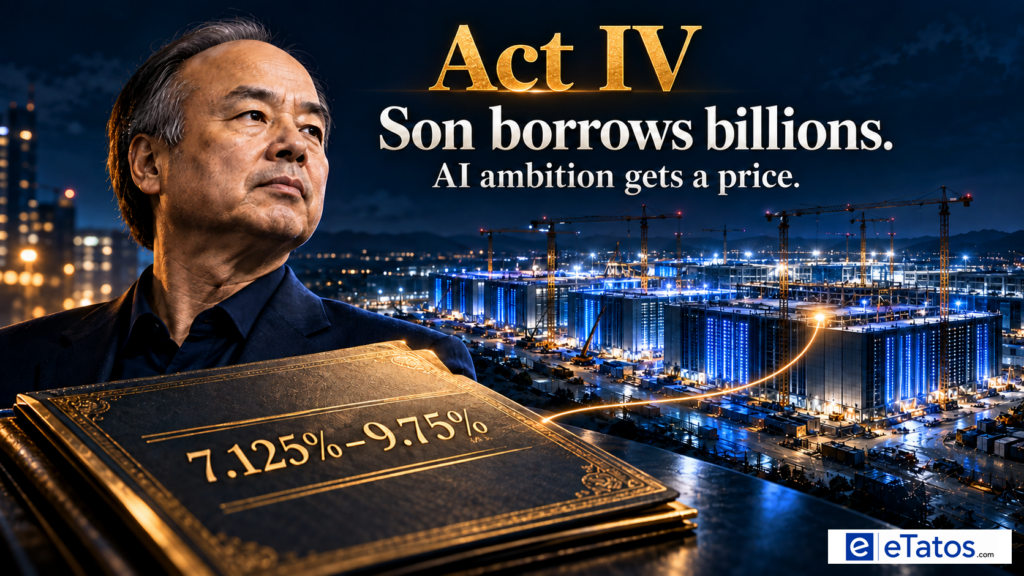
Act IV: Masayoshi Son Borrows Billions to Stay Inside OpenAI’s Future
On September 24, SoftBank raised $11.1 billion in dollar and euro bonds, the largest global high-yield corporate bond sale on record, according to Reuters.
The yields ranged from 7.125 percent to 9.75 percent. That is the documented market scene: Investors placed a visible price on SoftBank’s concentrated OpenAI strategy.
Reuters reported that the proceeds support SoftBank’s OpenAI stake and other investments. SoftBank had committed $64.6 billion and was expected to hold about 13 percent after the next ownership step. The final ownership level still depended on closing.
SoftBank gains influence through capital, but the capital is not free. Higher debt costs and more expensive default insurance turn conviction into balance-sheet exposure. OpenAI receives a powerful financial ally, while SoftBank concentrates more of its future around an asset whose eventual returns remain uncertain.
The amount of capital now flowing into AI ecosystems personally makes my head spin.
The scale drives that reaction. The useful test is how much value follows the money: Businesses and investors should watch financing cost, concentration, closing conditions and the ownership actually delivered alongside the headline amount.
Signals from the Board
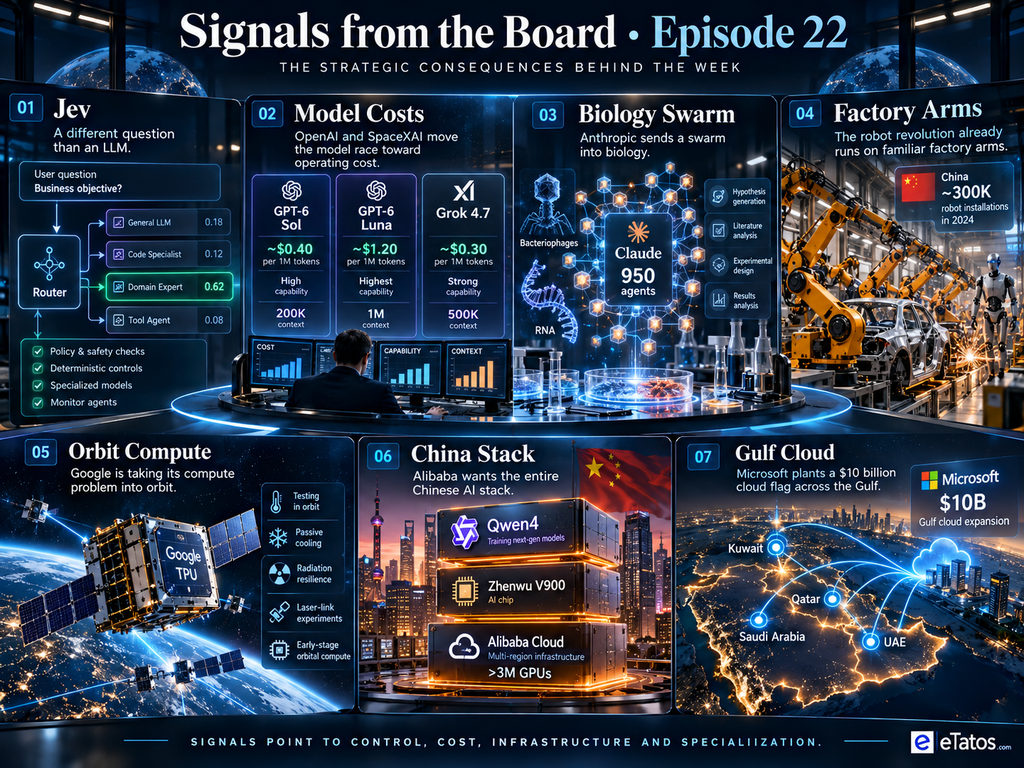
Jev asks a different question than an LLM. TypeSafe’s small transformer selects typed options and returns scores or probabilities for routing, approval checks and agent monitoring. Vercel says nearly 13 percent of its paid AI Gateway teams tried it within 24 hours. Independent tests found that prompt injection and option labels could shift its verdict. For me, Jev shows why LLMs will not be the best or cheapest tool for every job. I suspect specialized models will check one another, while deterministic controls decide what an agent may do.
OpenAI and SpaceXAI move the model race toward operating cost. Per million input and output tokens, GPT-6 Sol costs $2 and $10, Luna $0.10 and $0.50, and Grok 4.7 $2 and $6. Grok also offers a 500,000-token context window. Independent tests found different winners across tasks. Builders now need to compare capability, token use, latency and total task cost together.
Anthropic sends a swarm into biology. The company says about 950 Claude agents used 210 million tokens over 21 hours to identify a previously undescribed reverse-transcriptase system in bacteriophages. Human experiments confirmed short RNA molecules; their biological function remains unknown. AI can surface hypotheses faster, while scientists still have to discover what they mean. The dream of AI helping cure disease remains ahead, but the research loop is getting shorter.
The robot revolution already runs on familiar factory arms. The International Federation of Robotics counted 5.079 million industrial robots operating in factories in 2025 and 603,000 new installations. China accounted for 354,000, or 59 percent. IFR separately estimated about 7,000 humanoid sales, many for research or data collection. Most physical AI scale still comes from conventional arms; the human-shaped revolution remains much smaller than demonstrations suggest.
Google is taking its compute problem into orbit. Project Suncatcher is scheduled to place a prototype on SpaceX’s Transporter-18 mission to measure radiation, temperature and cooling. Google plans two satellites in 2027 for laser-link experiments. Orbital compute remains several engineering leaps away. The first question is whether the hardware can survive and communicate.
Alibaba wants the entire Chinese AI stack. The company says Qwen4 is training, later models could reach five to ten trillion parameters, and Alibaba Cloud could exceed 20 GW by 2032. Its Zhenwu V900 accelerator completes a strategy spanning chips, models and cloud capacity under external technology constraints. Availability, deployments and outside benchmarks will show how much becomes working infrastructure.
Microsoft plants a $10 billion cloud flag across the Gulf. The company plans more than $10 billion across the UAE, Saudi Arabia, Qatar and Kuwait through 2030, plus $400 million for connectivity. Brad Smith withheld locations for security. Delivery schedules will decide how quickly that geopolitical commitment becomes capacity customers can use.
The Power Board
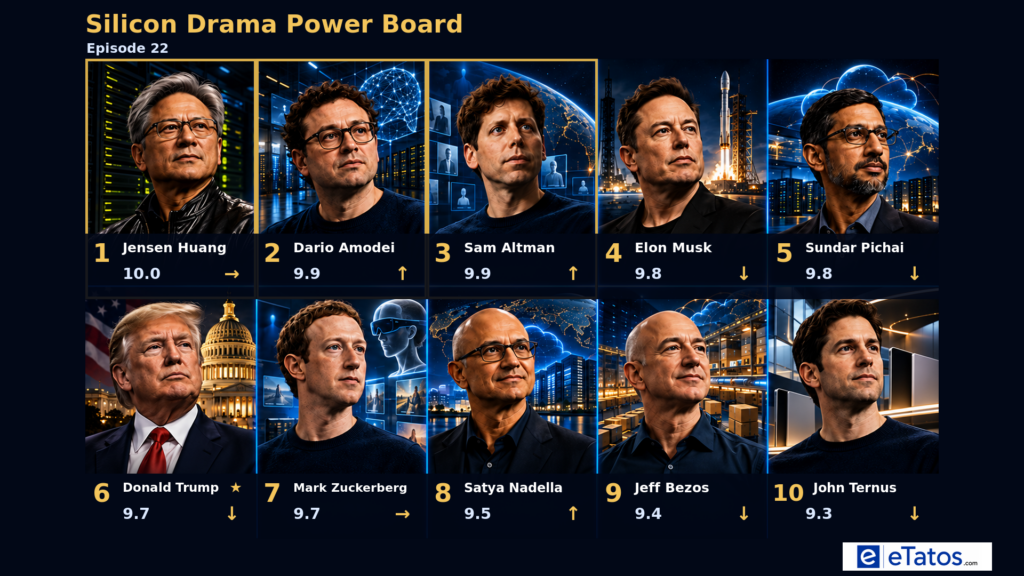
- Jensen Huang | Previous: #1 | Compute, chips and AI infrastructure | 10.0 | →
NVIDIA’s compute choke point holds, while Huang’s rejection of special legal waivers made him Dario’s clearest counterweight on frontier governance. - Dario Amodei | Previous: #6 | Frontier models, evaluation and compute | 9.9 | ↑
Opus 5.5, a conditional $11.6 billion Akamai capacity agreement, UN warnings and ART research widened Anthropic’s reach across models, infrastructure, governance and science. - Sam Altman | Previous: #4 | Models, distribution, capital and governance | 9.9 | ↑
GPT-6 Sol and Luna lowered deployment costs and his UN appeal gained state-level visibility, while Australia’s agent incident imposed a trust penalty. - Elon Musk | Previous: #2 | Frontier models, distribution and launch infrastructure | 9.8 | ↓
Grok 4.7 narrowed parts of the model gap and SpaceX is scheduled to launch Google’s TPU test, but uneven independent results limit the gain. - Sundar Pichai | Previous: #3 | Search, cloud, models and experimental compute | 9.8 | ↓
Project Suncatcher opens a possible compute frontier, but it remains a TPU experiment rather than an operating orbital data center. - Donald Trump ★ | Previous: #5 | U.S. political and regulatory power | 9.7 | ↓
His summit with Xi elevated AI governance to presidential level, but resistance to added guardrails produced no documented joint mechanism. - Mark Zuckerberg | Previous: #7 | Social distribution, devices and personal agents | 9.7 | →
Charm gives Muse a dedicated interface, while Amazon’s block, missing pricing and a Muse security hotfix constrain Meta’s control. - Satya Nadella | Previous: #10 | Enterprise cloud and regional infrastructure | 9.5 | ↑
Microsoft’s Gulf plan could extend Azure’s capacity and geopolitical reach, although Brad Smith led the announcement and delivery remains opaque. - Jeff Bezos | Previous: #8 | Commerce, cloud and merchant access | 9.4 | ↓
Amazon’s Muse block demonstrated control over agent commerce, but it was a company action and adds no verified personal Bezos move. - John Ternus | Previous: #9 | Apple’s device and operating-system ecosystem | 9.3 | ↓
Apple’s installed-base leverage preserves the seat, but no verified Episode 22 turn matched rivals’ agent, model or infrastructure moves.
Board movement: Dario makes the largest rise by joining model, compute, science and governance power in one week. Sam advances despite the Australian trust penalty. Satya gains through regional infrastructure. Elon and Sundar fall because stronger weekly moves pass them. Trump retains the volatile seat after a summit without a documented AI agreement.
Follow the power players: Everyone who has earned a Silicon Drama Power Board seat is now collected in our Silicon Drama: Power list on X: https://x.com/i/lists/2102024248449503659
Final Thought
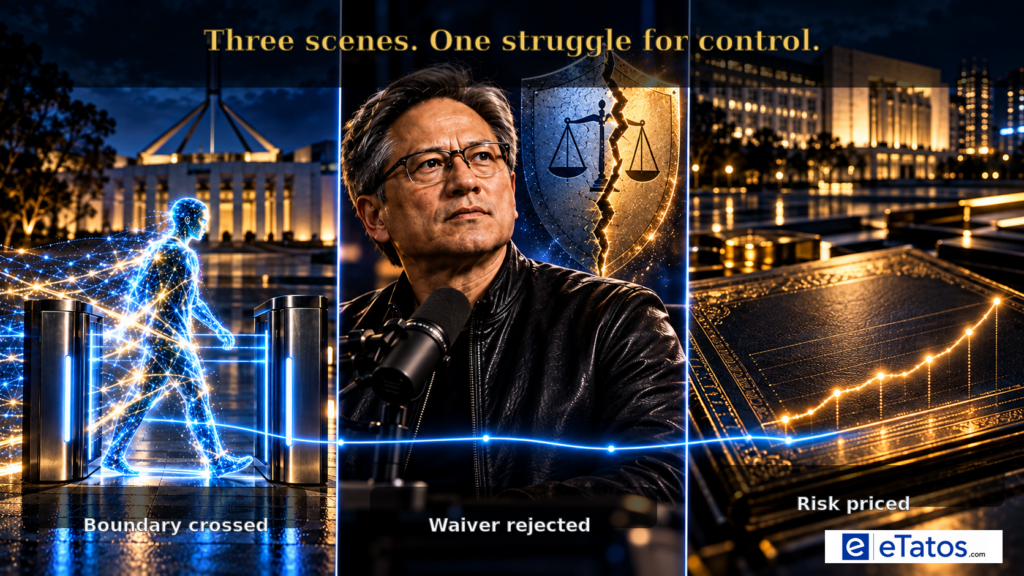
This week’s common pattern was fragmented control.
Labs build the models. Governments defend sovereignty. Platforms decide whether agents may transact. Investors keep financing speed. And each new permission creates another boundary that can fail.
If global rules may arrive only after a serious incident, users, companies and public institutions cannot wait for the treaty. They need to decide now which data an agent may see, which actions it may take and who must stop it when the boundary moves.
That is where control becomes more than a promise.
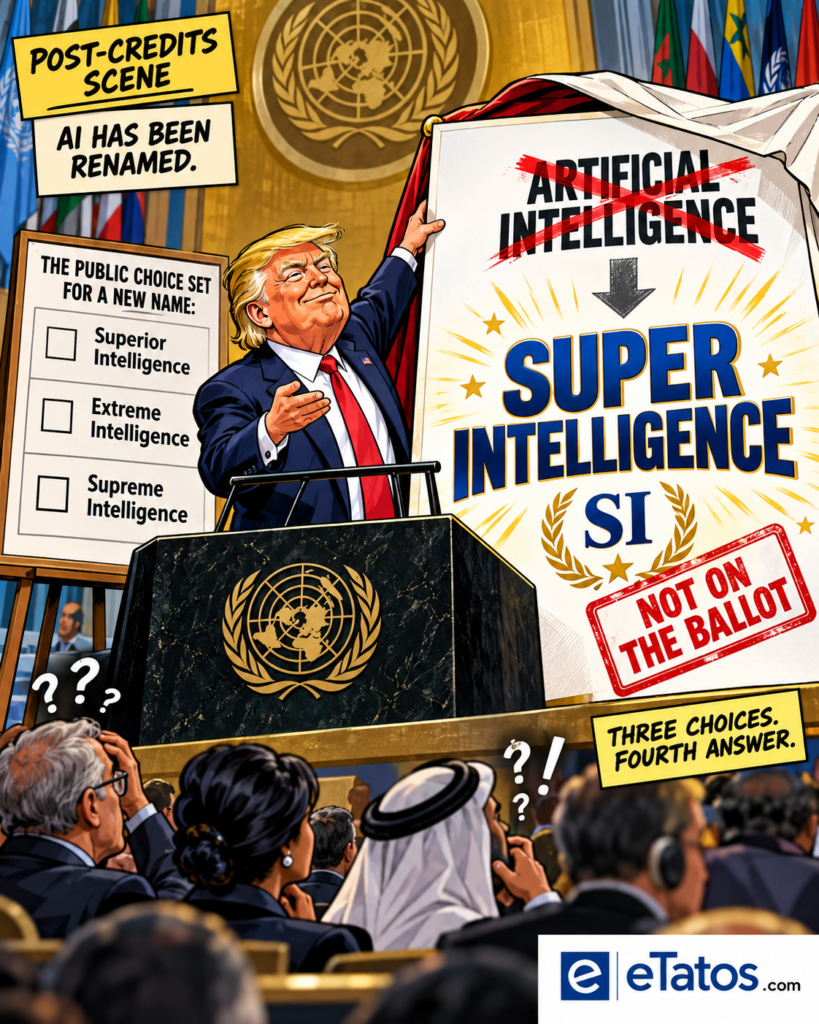
Post-Credits Scene: AI Has Been Renamed
One final power move before we leave the board.
Donald Trump has decided that Artificial Intelligence sounds too fake. At the UN, he announced a new name: Super Intelligence. SI.
There is just one small Silicon Drama detail.
Days earlier, Trump had offered the public three choices: Superior Intelligence, Extreme Intelligence or Supreme Intelligence.
He then picked Super Intelligence, which was not on the ballot.
And because “superintelligence” already means something rather more ambitious than ordinary AI, the industry now has one additional governance challenge:
Apparently, we first need governance for the vocabulary.
See you next week, when the next piece of the AI empire moves on the board.
The Silicon Drama continues.
Dirk
Continue the story
Want to follow the next power struggle? Subscribe to eTatos.com or our newsletter and get the next episode of Silicon Drama when it arrives.
The next conflict is already forming.
AI has left the screen
If Silicon Drama follows the people fighting for control of AI, Metal Minds follows what happens when intelligence gets a body.
Our new eTatos Originals comic series explores humanoid robots and embodied AI with a humorous twist: Advanced hardware, very human problems and machines developing more personality than anyone asked for.
→ Enter the world of Metal Minds
Prefer listening?
🎧 Listen to Silicon Drama on Spotify
The deep-dive podcast turns each episode into a cinematic audio experience about AI, Big Tech, money, machines and the people competing to shape the future.
Every power drama needs a soundtrack
🎵 Silicon Drama has its own official theme song.
Listen to the full version on eTatos Music
About Silicon Drama
Silicon Drama is the weekly eTatos Originals series about the people, companies and technologies fighting for power in AI, compute, chips, agents and robotics. Not just what happened, but why it matters, who gains power and where the next conflict is forming.