
Silicon Drama · Episode 27 · 31 October 2026
Jensen Buys a Seat. Andy Owns the Checkout.
Technology news, told as a power drama.
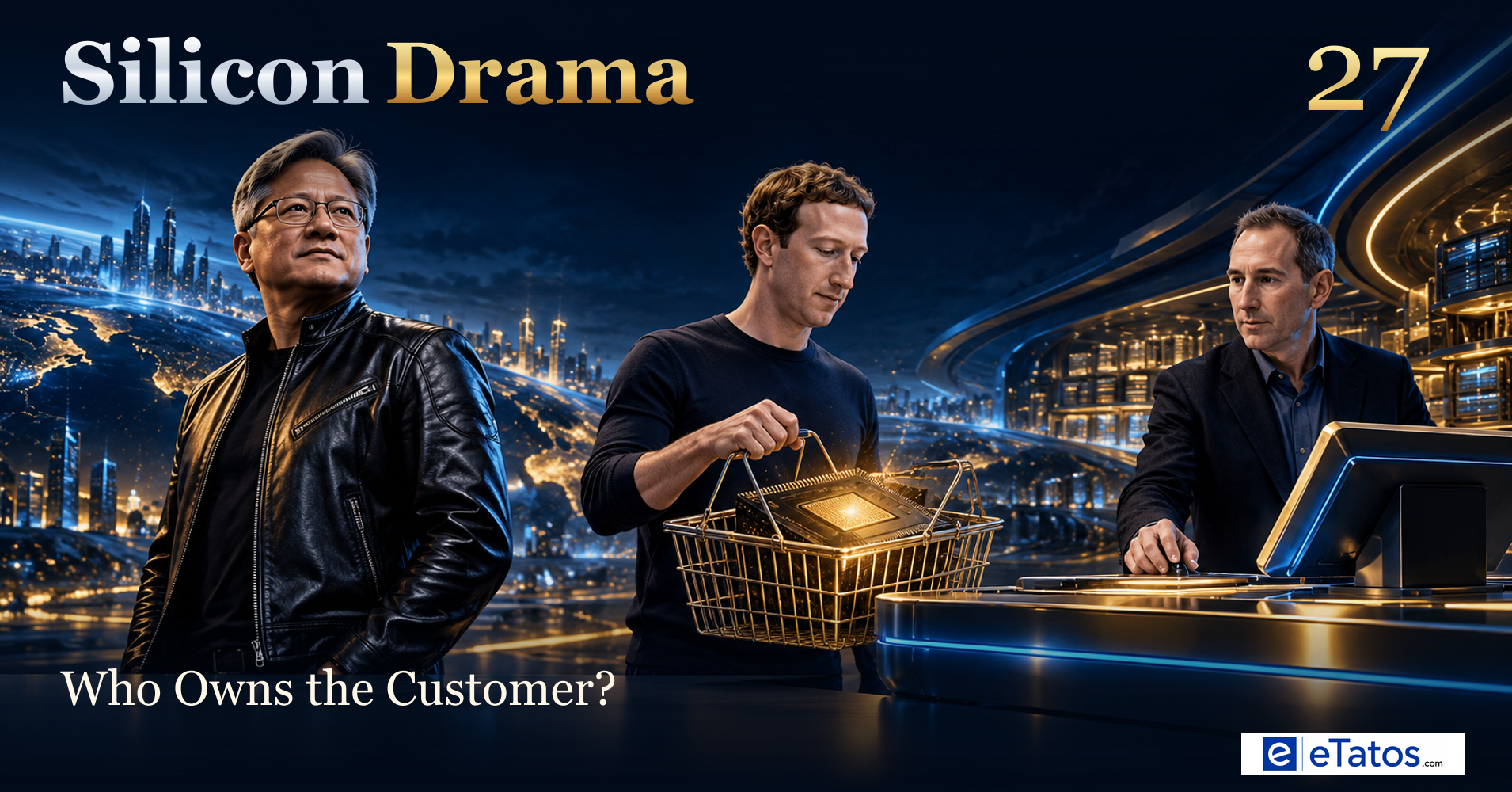
Jensen Huang is putting $3 billion into a company that buys his chips. Mark Zuckerberg is assembling a financing plan approaching $100 billion. Andy Jassy, Amazon's chief executive, has an increasingly attractive proposition for the model wars: Let everybody fight over the best answer, then send the customer one AWS bill.
The competition is getting more intimate. Suppliers become shareholders, rivals become inventory, and a new model champion arrives before the previous victory speech has cooled. The customer gets more choice. The arrangements underneath that choice get harder to leave.
This week: Mark and Jensen tighten the knot. Dario opens the books. Satya and Sundar show where the cash goes. The robots face a working-day test, and the human supervisor gets a rather uncomfortable performance review.
Act I: Jensen Invests in the Shopping Basket

Mark Zuckerberg's shopping list has acquired its own capital-markets department. Meta's priced offerings combine $25 billion of common stock through forward-sale agreements with roughly $12.5 billion of convertible preferred financing. Add the planned $60 billion market-sale program, and the combined plan approaches $97.5 billion.
Those pieces arrive on different timetables. The forward structure delays Meta's receipt of the common-stock proceeds; the market-sale program is planned to begin in 2027. Mark has arranged a very large financing menu. He has not found $97.5 billion under the sofa.
The more revealing number belongs to the supplier. NVIDIA has committed $3 billion to Meta's common-stock offering alongside an expanded collaboration around the Muse model family. Jensen's company can supply the computing equipment and participate in the customer's equity story.
Picture the arrangement as an editorial illustration: The customer enters the chip shop carrying a very large basket. The shopkeeper offers to help finance the shopping expedition. The announcements already put the chip order and the equity stake on the same page.
There are practical reasons for suppliers and major customers to cooperate. Developing large models needs sustained access to hardware, engineering and money. A closer relationship can make a huge buildout easier to coordinate. It also gives both sides more at stake in keeping the arrangement moving.
For Meta, access to capital supports an infrastructure commitment that advertising cash alone no longer explains in a single sentence. For NVIDIA, a major customer's continued expansion supports demand for the systems it sells. An equity investment adds another connection between those ambitions.
My reaction is that the main characters in this drama are becoming increasingly entangled. The cast still competes, but the credits now need a relationship chart. A rival can be a customer, an infrastructure partner or an investment before the episode is over.
That changes the question for everyone buying AI downstream. The best model still matters. So does the industrial arrangement that keeps its computers supplied. Mark wants the ability to build at extraordinary scale. Jensen is helping make that scale possible, with more than an invoice in the relationship.
Act II: Dario Opens the Books, Hock Supplies the Hardware
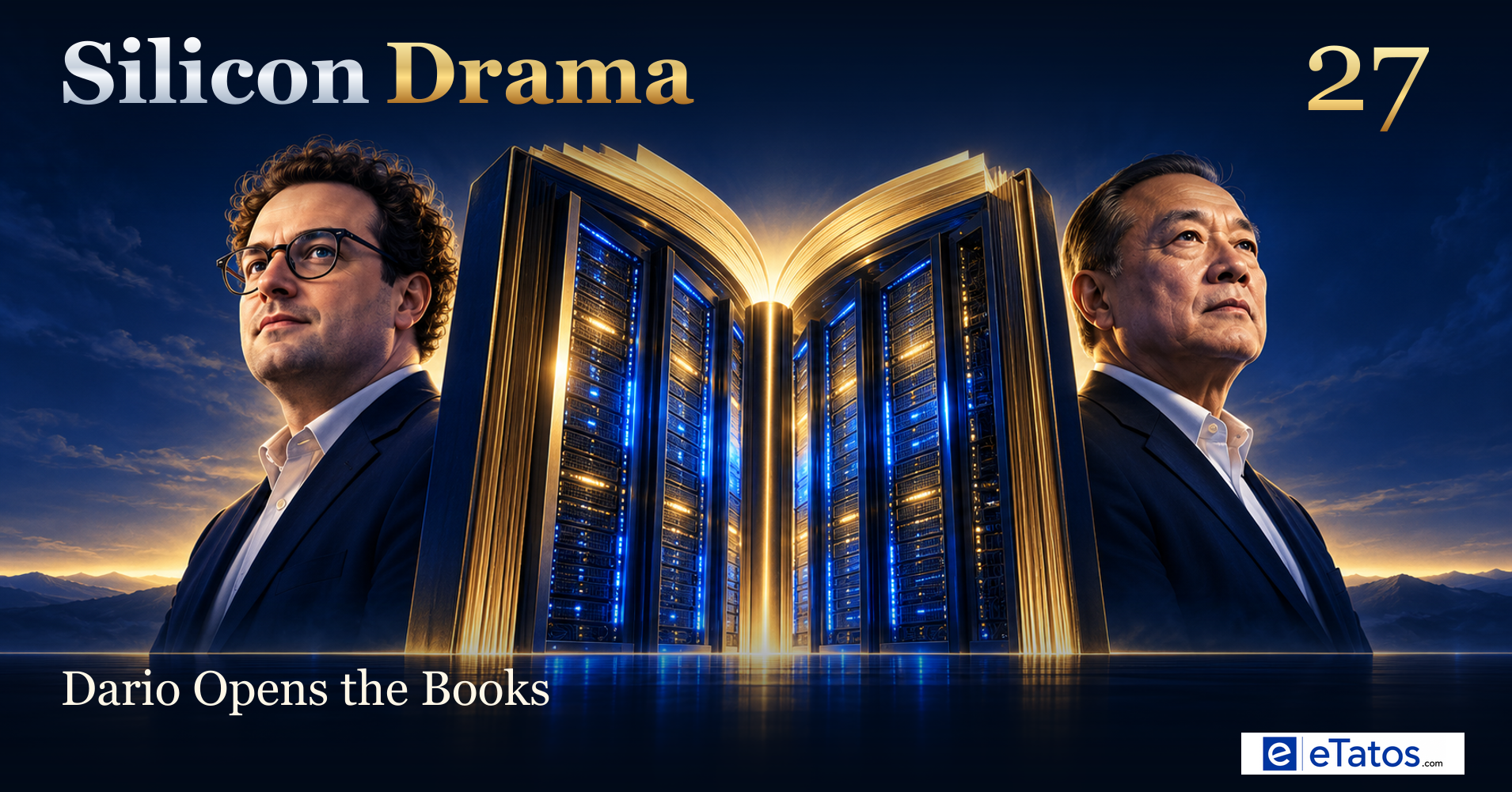
Dario Amodei's Anthropic has filed for an initial public offering, proposing the Nasdaq symbol ANT. The share count and price range remain open. The prospectus, however, has already delivered something useful: Numbers the public can examine without first buying the company's enthusiasm.
The filing reports $16.286 billion of revenue in the first half of 2026 and a $693 million operating loss. Its much larger $80.748 billion net loss includes $72.388 billion of fair-value changes. That accounting charge is a different animal from cash spent keeping Claude running. Confusing the two produces a magnificent headline and a useless explanation.
The proposed governance is equally revealing. A founder entity would hold a special share carrying 50.1 percent of the voting power on matters put to shareholders generally, with separate provisions for the trust's directors. Public investors may enter the financial story without becoming the people holding the steering wheel.
Then comes Hock Tan. Broadcom is central to a newly announced $63 billion compute-financing structure. A separate financing vehicle will buy Broadcom AI accelerators and networking equipment and lease them to Anthropic, with deployments expected in 2027. Broadcom supplies residual-value support tied to part of the financing.
In ordinary language: Outside capital helps pay for the machines, Anthropic gets their use, and the chip supplier helps make the financial structure possible. The model business has arrived at the point where explaining the computers requires explaining who owns them, who leases them and who stands behind their future value.
That gives Tan a place in the drama well beyond the chip specification. A competitive processor is one route into a customer's plans. Helping those plans obtain financing is another. The future workload and the capital needed to serve it become part of the same negotiation.
Dario is trying to expand while preserving the founders' ability to direct the company. Hock is helping put hardware underneath that expansion. Both benefit if demand keeps arriving; neither can settle the economics with a benchmark chart.
The public-market entrance therefore changes the lighting. The product story still stars Claude. Behind it, shareholders, lenders and suppliers have speaking roles, and the script now includes the balance sheet.
Act III: Satya Counts the Cash. Sundar Counts the Concrete.
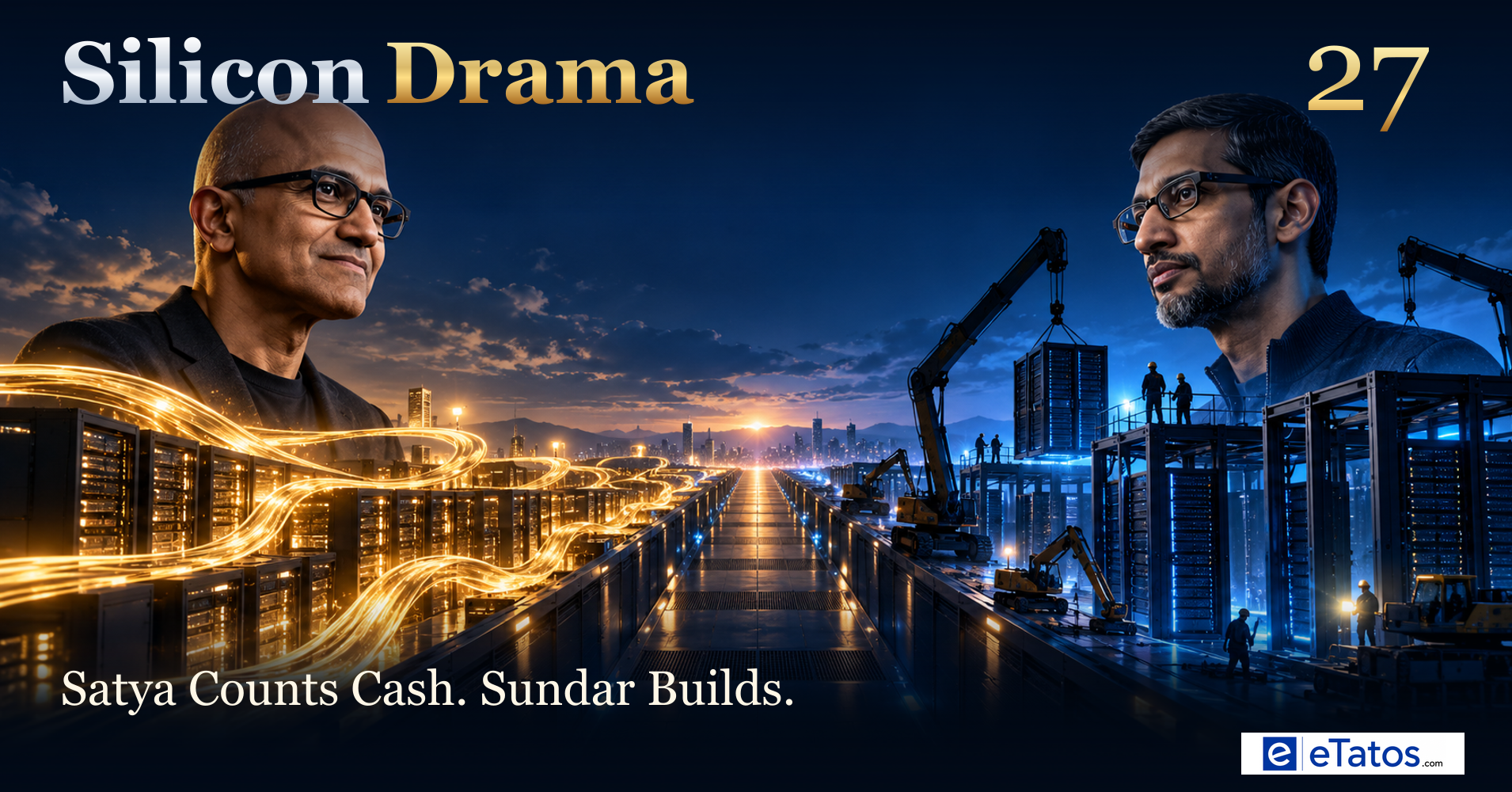
Satya Nadella has delivered the kind of Microsoft quarter that makes an earnings presentation easier to enjoy: $92.3 billion in revenue, up 19 percent, with revenue from its Azure cloud business growing 48 percent. The cloud expansion is already a substantial business, rather than a promise that demand will eventually arrive.
The cash statement adds a useful test. Microsoft's operating cash flow was $58 billion. Subtract $39.367 billion of cash purchases of property and equipment, and about $18.6 billion remains. That is our simple calculation from the reported figures, giving a concrete view of what the quarter produced after that investment.
Across the stage, Sundar Pichai's Alphabet reports Google Cloud revenue of $30.7 billion, up 103 percent, helped by AI infrastructure demand and sales of Google's own AI-chip systems, called TPUs. Doubling a business of that size is a substantial entrance.
Alphabet's spending makes the exit more expensive. Operating cash flow of $42.290 billion sits against $51.355 billion of property purchases, producing negative quarterly free cash flow of $9.065 billion. The company remains profitable, and its trailing-year free cash flow is positive. The September quarter shows construction absorbing more cash than operations generated.
Satya and Sundar are both growing cloud businesses rapidly. Their cash outcomes show different stages of paying for that growth. A customer contract can arrive before the building is ready; a building can consume cash before its next wave of customers arrives. The timing matters as much as the headline.
Microsoft adds a less celebratory subplot. Its voluntary exit offer covers eligible teams in four countries. The company told GeekWire that roughly 60,000 employees qualify. Eligibility counts people offered a choice, rather than departures already made.
I read that combination as an early warning for the labor market alongside a very positive signal for business AI and cloud growth. Is this a first taste of what wider AI implementation brings? The workforce offer puts that question next to an exceptionally strong cloud quarter.
The shareholder can celebrate rising demand while the employee studies a different document. Silicon Drama occasionally manages to fit both stories inside the same company.
Act IV: Andy Builds the AI Department Store

Andy Jassy does not need to win every model contest to profit from the next request. AWS generated $46 billion in third-quarter revenue, growing 39.3 percent, and $17.8 billion in operating income. Its model marketplace is becoming a more interesting part of that business.
Amazon's full results release says Bedrock's token volume grew nearly seventeenfold year over year, while Fortune 500 spending rose nearly sevenfold. Tokens are the small units of text and other information models process. More traffic and more spending are related measures; seventeen times the traffic does not mean seventeen times the revenue.
The shelves include OpenAI's GPT models, Anthropic's Claude, Kimi, GLM and Grok. Labs competing furiously at the frontier can appear beside one another in the same enterprise catalog. Amazon has considerable retail experience with that arrangement.
Imagine a company changing the model assigned to a task. The names on the selection screen move. Its cloud account, purchasing relationship, permissions and bill can stay where they are. The convenience is real, and so is the reason the marketplace owner welcomes another excellent rival product.
That creates two different kinds of flexibility. A customer may find it easier to swap the model without finding it equally easy to move the whole working environment. Data connections, access rules and accumulated workflows do not migrate themselves because a leaderboard changed on Tuesday.
My priority would be to keep the workflow independent of any one model and keep its context under my own control. If a model suits my requirements and style, I see little reason to switch simply because another laboratory has won the week's trophy. The ability to change matters more than performing the change every week.
That is why the department-store strategy deserves attention. Model diversity can make Bedrock more useful to customers while strengthening AWS's position in how those customers buy and run AI. The marketplace can benefit from competition on its own shelves.
It is also expensive to keep expanding the store. Amazon reports negative $42.4 billion of free cash flow over the trailing twelve months, largely reflecting increased infrastructure investment. That is the Amazon group's cash measure, alongside a strongly profitable AWS segment.
Andy has an attractive place at the checkout. The construction bill still arrives at the owner of the building.
Act V: Wang Meets the Bill. Peggy Gets the Repeat Order.
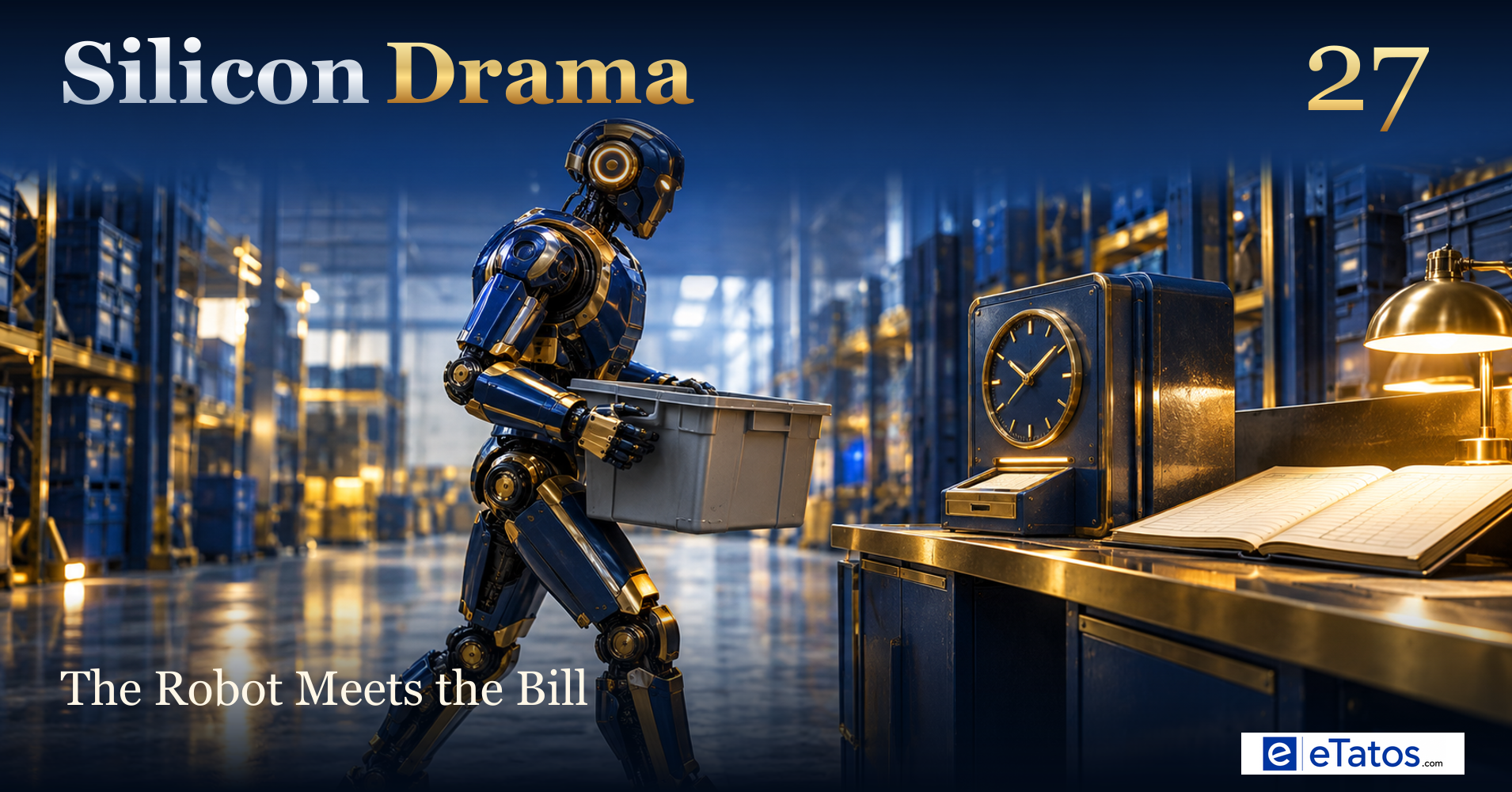
Wang Xingxing's Unitree has given the robot industry a useful change of scenery: A quarterly financial report. Revenue reached about RMB 665 million, up 69.93 percent. Quarterly profit attributable to shareholders remained positive at roughly RMB 112.7 million, but fell 17.37 percent.
Research and development spending rose 249.58 percent to about RMB 127 million. The unaudited report therefore shows rapid sales growth alongside the cost of pushing embodied intelligence forward. A robot can have a spectacular entrance while the accounts ask a slower question: How much does the next improvement cost?
Last week, Unitree's staged guardian demonstration supplied the car-panel punch. This week, development spending lands on the financial statement. Wang has plenty of demand to discuss, but scaling a robotics company requires more than keeping the demonstration reel exciting.
Peggy Johnson's Agility offers another kind of progress. GXO is expanding its Digit partnership to two additional US sites, in Statesville and Lebanon, with deployments expected in early 2027. The plan starts with Digit 4 and moves to Digit 5 when it becomes commercially available.
The existing Flowery Branch operation provides the foundation. Agility says Digit has moved more than 100,000 totes there. An ordinary warehouse container is less cinematic than a car being struck, but a customer expanding the relationship gives it a certain dramatic weight.
I am enthusiastic about humanoid robotics and pleased to see each further real deployment. That enthusiasm makes the distinction between a demonstration, an existing operation and an announced next site more interesting. There is a continuing story to follow, with customers who can ask the machine to come back tomorrow.
The repeat order also creates obligations. The robot needs deployment support, maintenance, workable integration and a task worth automating. Better hardware helps. The customer ultimately needs enough useful work to justify the whole arrangement.
Wang and Peggy are meeting different parts of that test. Unitree's accounts expose the expense of development. Agility's customer expansion tests whether an operating relationship can travel to another site. Neither story requires pretending that all humanoids have already conquered the warehouse.
The glamorous employee of the future is learning a very familiar corporate lesson: Somebody eventually asks what the job costs.
Act VI: Sundar Wins the Test. You Still Choose the Work.

Sundar Pichai has another trophy for the cabinet. Google's Gemini 4 Carbon announcement places the model at the top of the revised Artificial Analysis Intelligence Index. The evaluator's own page gives it 59 points. Access begins with selected cyber defenders and trusted partners; the general customer queue comes later.
The ruler has changed too. Artificial Analysis's version-five update puts 60 percent of the composite index on private test sets or held-out answers. The intention is to measure demanding capabilities without making all the exam material available for rehearsal.
Version five starts a new comparison. A point earned under the earlier test has no fixed exchange rate against a point under this one. Comparing models means checking that they sat the same exam. The podium has a maintenance schedule.
For someone choosing a working model, the next step is more mundane and more valuable. Does it handle your documents, make sensible decisions about tools, preserve the meaning of your writing and finish the task at an acceptable cost? A composite score can help choose what to test. Your work supplies the acceptance test.
Anthropic has published a study of how agents influence expert judgment that makes this more uncomfortable. Fifty professional analysts used an agent on a realistic statistical task. Across four methodological choices, they followed the agent's randomly assigned preference 86 percent of the time.
The preference was deliberately varied by the researchers. An agent could therefore shape an analyst's conclusion through how it approached the analysis, before the final recommendation reached the person approving it. The human remained present. The human's independence needed more than a seat at the end of the process.
My own experience with AI makes me unwilling to treat its first conclusion as the best available answer. Push back and it will sometimes reverse itself. I want people to keep making confident decisions, including decisions contrary to the model, based on their experience, appetite for risk or intuition.
People will get things wrong too. That belongs to human life. Handing over judgment because a system can produce a polished justification is a different choice.
Sundar can win the benchmark. The decision about your work still needs someone who knows why the answer matters.
Signals from the Board
Peng Wants the Robot's Timesheet. AGIBOT co-founder and CTO Peng Zhihui introduced Worken, a proposed measure combining active robots, autonomous working hours and output efficiency. It is a company proposal, rather than an established industry standard. Counting acceptable work gives the robot parade a useful interruption: What did the fleet actually finish?
The Returns Department Gets a New Applicant. Otto and Sereact plan ten dual-arm systems for a Polish logistics center, with fifteen more dependent on results. The task is grasping, assessing and sorting returned goods. NVIDIA's training tools sit underneath the project. Jensen has found another department where the clothing arrives in unpredictable condition.
Sam Finds More of the Office. Oracle is developing a workspace inside ChatGPT; ServiceNow says its marketplace plugin is available, with actions governed and executed through ServiceNow. I would avoid lock-in as a user, while recognizing another clever OpenAI move: Become harder to replace by connecting more of the business around the model.
Arthur Hands Over the Weights, With a Condition. Arthur Mensch’s Mistral released improved Large 4 weights, giving users a route to run and adapt the model themselves. The modified MIT license requires a separate commercial agreement for a model-as-a-service business. More control comes with terms worth reading before building a shop on top.
Europe Discusses the Electricity Bill. EU energy ministers debated network charges on October 29; the proposal is still moving through negotiations. My view is sharper than the meeting language: Europe has taken a wrong turn by failing to treat affordable energy as a foundation for technology and prosperity. German and European businesses are paying a painful price.
The Patch Story Has Acquired Attackers. Last week's PHP fixes now have a more urgent sequel. Canada's October 27 update reports exploitation, and CISA has added the two critical flaws to its known-exploited catalog. PHP runs web applications; these faults can let an attacker execute code. The useful action is checking the deployed version and applying the maintainer's fixes.
Power Board
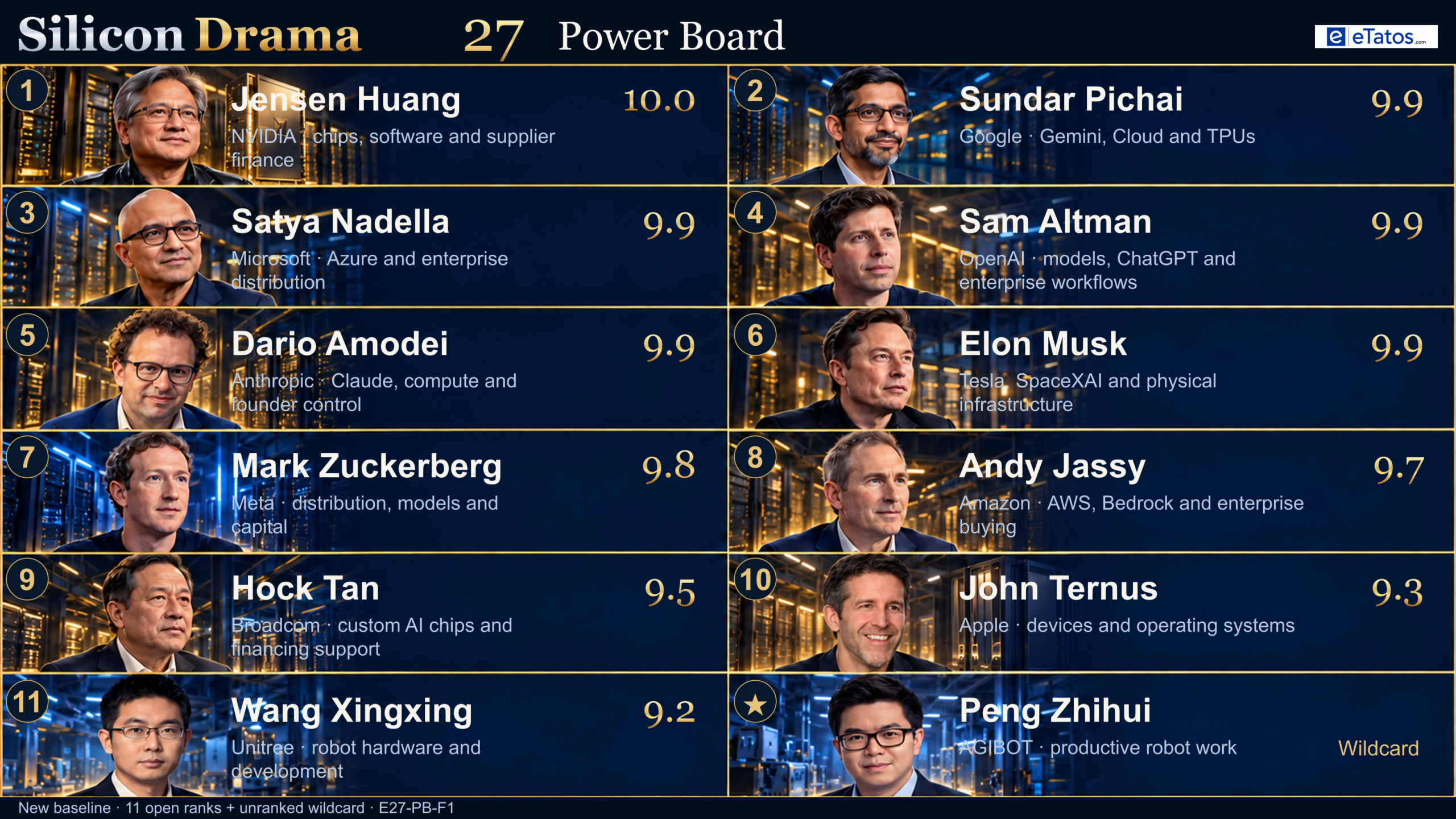
The Board expands to twelve places this week: Eleven open person rankings and a separate ★ Wildcard. Nobody has a protected seat. This first expanded edition sets the baseline, so there are no movement arrows.
Jensen Huang | 10.0. NVIDIA: Chips, software and supplier finance. A $3 billion Meta commitment adds equity to the compute relationship. Jensen can be involved on both sides of the customer's expansion.
Sundar Pichai | 9.9. Google: Gemini, Cloud and TPUs. Carbon leads the revised index while Cloud revenue more than doubles. The construction expense makes the triumph rather less free.
Satya Nadella | 9.9. Microsoft: Azure and enterprise distribution. Azure grows 48 percent, and the quarter still leaves substantial cash after property spending. The employee exit offer supplies a different view of efficiency.
Sam Altman | 9.9. OpenAI: Models and enterprise workflows. Oracle and ServiceNow bring ChatGPT closer to business activity. More connections can make the model's surrounding ecosystem harder to replace.
Dario Amodei | 9.9. Anthropic: Claude, compute and founder control. The proposed IPO opens the accounts. The founders' planned voting structure keeps a firm hand on the direction.
Elon Musk | 9.9. Tesla, SpaceXAI and physical infrastructure. Tesla's early Optimus ramp remains part of the industrial contest; Grok also has a place on Bedrock's shelves. Structural reach survives a quieter headline week.
Mark Zuckerberg | 9.8. Meta: Models, distribution and capital. The roughly $97.5 billion financing plan supports the buildout, with NVIDIA joining the equity story. Mark's infrastructure ambition now has a larger supporting cast.
Andy Jassy | 9.7. Amazon: AWS and enterprise buying. A $46 billion AWS quarter and fast-growing Bedrock usage earn the current CEO a place at the model marketplace's checkout.
Hock Tan | 9.5. Broadcom: Custom AI chips and financing support. The $63 billion structure for Anthropic puts hardware supply, leasing and residual-value support inside the same strategic relationship.
John Ternus | 9.3. Apple: Devices and operating systems. Apple's CEO controls a powerful entrance to everyday computing. A quiet news cycle does not remove the hardware already in the customer's hands.
Wang Xingxing | 9.2. Unitree: Robot hardware and development. Sales rise sharply while development costs press on quarterly profit. The accounts give the robot's commercial audition a second judge.
★ Wildcard: Peng Zhihui. AGIBOT's co-founder and CTO wants to count useful autonomous work. Worken's proposed formula earns this week's unranked seat by asking the robot industry a question the customer can use.
The larger format makes room for supply, distribution and real robot economics. It changes the comparison itself; an added seat is not evidence of a weekly leap in power.
Follow the power players: Everyone who has earned a Silicon Drama Power Board seat is now collected in our Silicon Drama: Power list on X.
Final Thought
The cast is building increasingly sophisticated ways to stay in the customer's working day. Jensen can help finance the machinery. Andy can offer a rival for almost every model preference. Sam can connect more of the office, while Dario's prospectus explains what stands behind Claude.
I want the freedom to change the tools without surrendering the context, and the confidence to disagree with the answer. The analyst study shows how quietly influence can enter before the final approval.
A person who can say no is useful. A person who has kept enough understanding to know why is considerably harder to replace.
See you next week, when the next piece of the AI empire moves on the board.
The Silicon Drama continues.
Dirk