
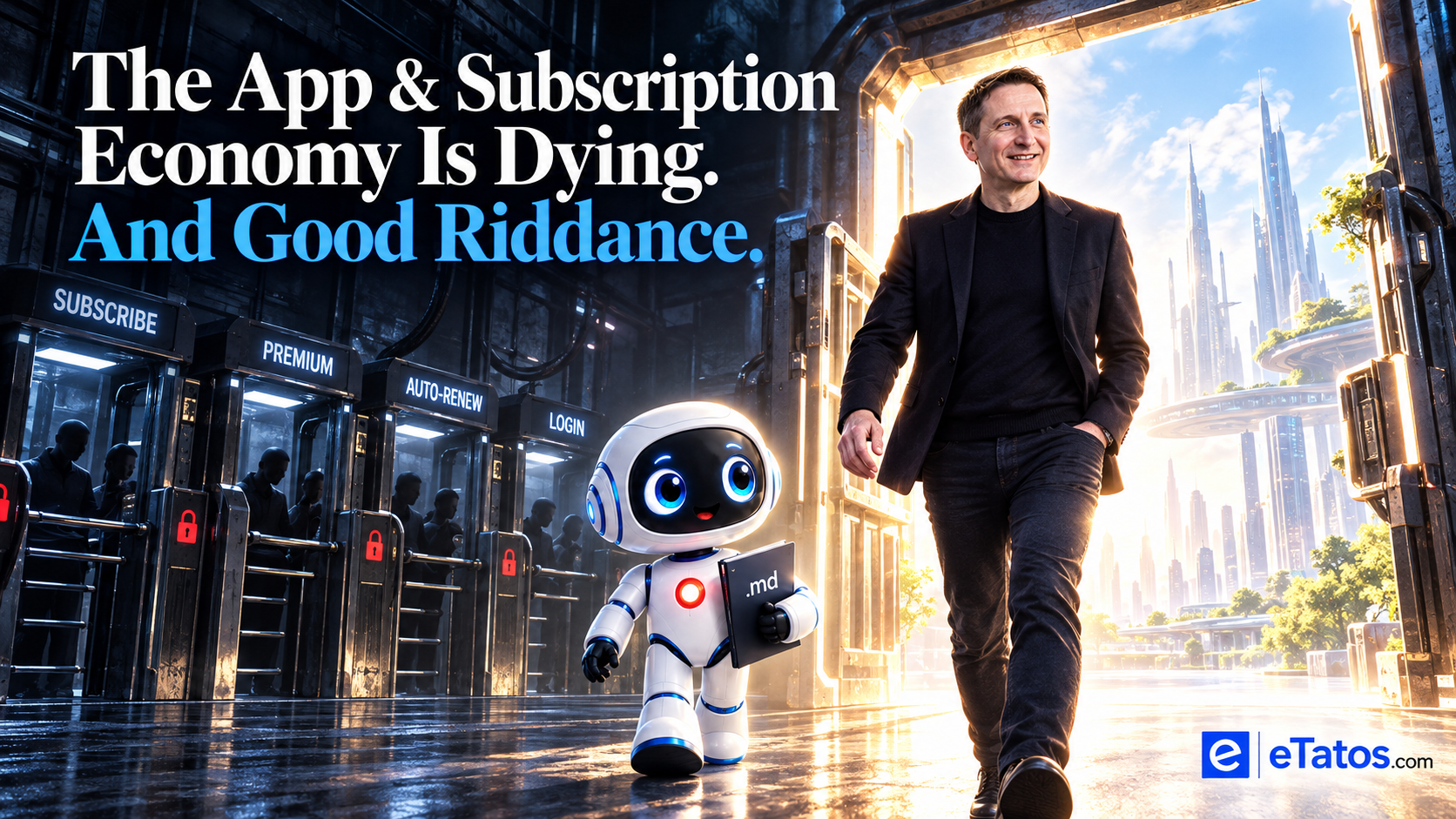
AI agents are challenging the business model of an entire software industry. I’ve already started cancelling subscriptions and I suspect I’m far from alone.
At some point, we apparently decided that even a simple timer on our smartphones deserved its own monthly subscription.
A timer.
Something that counts down seconds.
I don’t remember agreeing to this particular vision of the digital future.
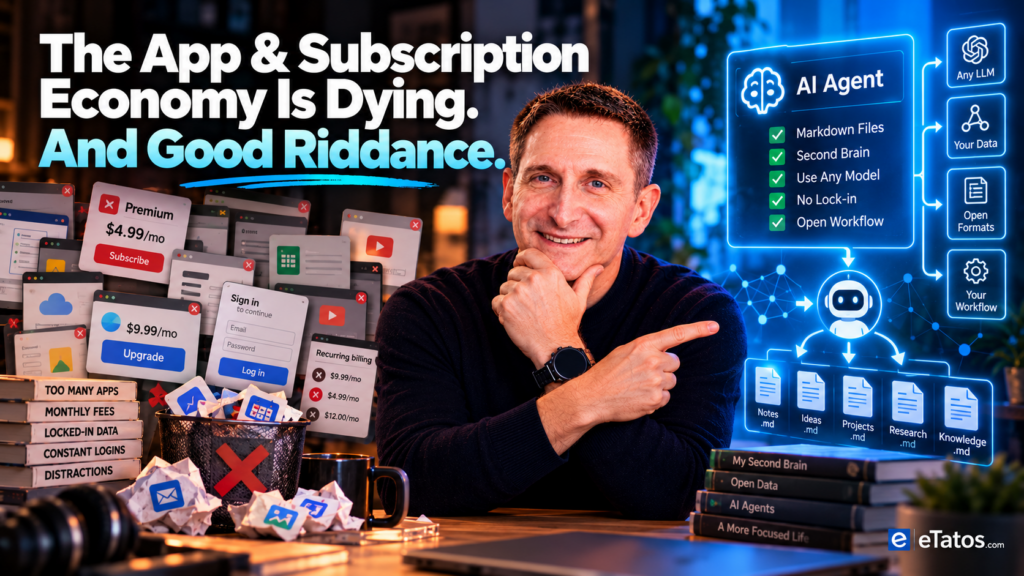
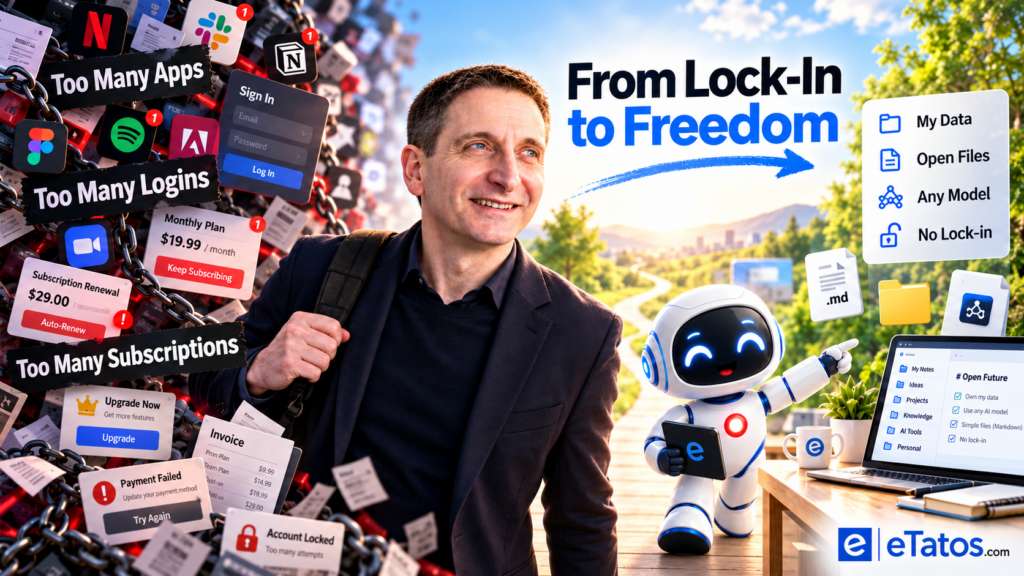
Yet here we are, surrounded by apps that want us to create accounts, choose subscription plans, accept recurring payments and occasionally upgrade to a premium tier just to unlock a handful of additional features.
The subscription economy has become ridiculous.
And after years of watching it expand into practically every corner of our digital lives, I’m beginning to see a way out.
Ironically, the technology that might finally put an end to much of this madness is the same technology that software companies are currently rushing to integrate into their products.
Artificial intelligence.
How We Ended Up Renting Everything
There was a time when buying software meant actually buying software.
You paid for an application, installed it and used it. Perhaps you purchased an upgrade a few years later if the new version offered something worthwhile.
The shift toward Software as a Service changed that relationship.
Subscriptions made sense for many products. Cloud infrastructure costs money. Software requires maintenance, security updates and continuous development. Businesses also benefit from predictable costs and services that stay current.
But the model proved so attractive to software companies that it spread far beyond applications where recurring payments were easy to justify.
Today, almost every conceivable digital activity seems to have an associated subscription.
Writing notes. Editing PDFs. Managing passwords. Converting files. Tracking habits. Organizing tasks. Creating graphics. Removing backgrounds from images.
Some of these products are excellent. Others offer remarkably little for their monthly fees.
And the subscriptions accumulate.
Five euros here. Ten euros there. Another annual plan that renews automatically because you forgot you even had it.
Individually, the amounts seem harmless. Collectively, they have created an entire economy built around keeping customers subscribed.
I increasingly find myself questioning how many of these applications I actually need.
The CD That Changed My Perspective
Recently, I wrote about a rather unexpected experience.
My wife and I had created music with Suno, and I wanted to burn some of our songs onto an old-fashioned audio CD.
Windows Media Player refused to cooperate. After several failed attempts to fix the problem, I handed the task to Codex.
Eventually, Codex bypassed the application and used Windows’ disc-burning interfaces directly.
The result was a perfectly playable CD.
That experience led me to write about the potential end of the traditional app economy.
Because it demonstrated something that I believe will become increasingly important: AI agents can accomplish tasks without requiring us to operate a dedicated graphical application.
And once you’ve experienced that firsthand, you start looking at your software subscriptions differently.
I’ve Already Started Cancelling
One of the subscriptions I’ve recently cancelled is Craft.
I actually like Craft. It’s beautifully designed, polished and pleasant to use.
But I’ve been rethinking how I want to manage my personal knowledge in an AI-driven world.
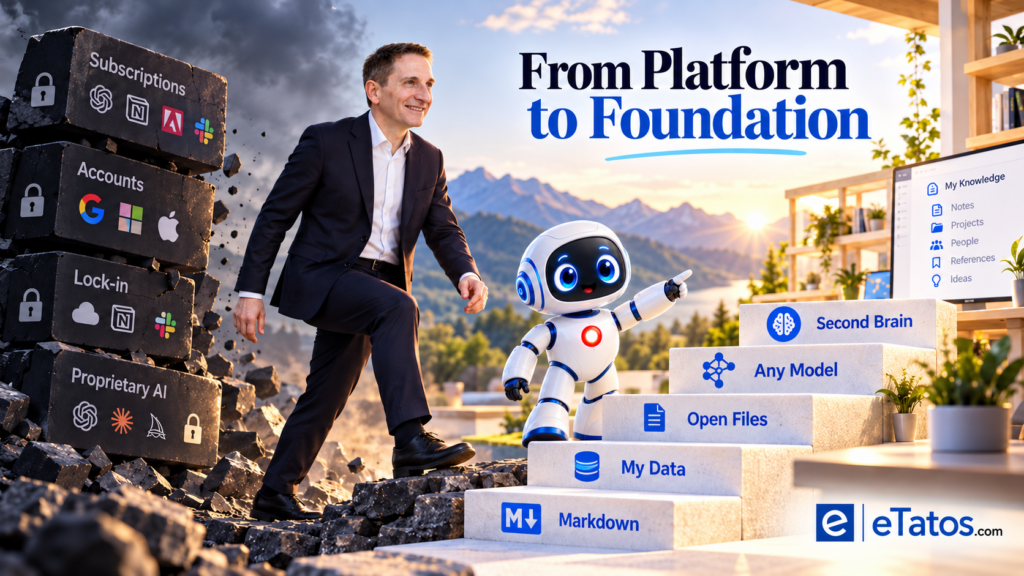
I’ve moved toward an Obsidian-based Second Brain built around ordinary Markdown files.
My notes are stored in a format I control. I can organize them locally, search them, edit them and make them available to AI agents without depending on a particular company’s interface or built-in AI assistant.
I can work with ChatGPT, Claude, Gemini or whatever models and agents become available in the future.
My knowledge doesn’t have to move every time I change tools.
I’m also considering gradually leaving Notion and transferring the information I’ve accumulated there into the same Second Brain, with AI helping me through the migration.
There’s something satisfying about this approach.
I don’t have to wonder whether my notes will become less accessible because a company changes its pricing, introduces another premium tier, or decides that its own AI features should be the center of my workflow.
Of course, Obsidian is an application too. But the underlying Markdown files remain usable independently of Obsidian. That’s the crucial advantage.
I’m beginning to prefer software that works with my data over platforms that want to become the permanent home of my data.
And cancelling Craft felt surprisingly good.
The Problem With Selling Access Instead of Results
For decades, software companies have packaged functionality into applications.
If you wanted to accomplish a particular task, you needed the appropriate program.
You learned its interface, adapted to its workflow and paid for access.
Sometimes that meant buying a license. Increasingly, it meant subscribing.
AI agents are beginning to challenge this arrangement.
Imagine needing to convert twenty documents, clean up a spreadsheet, prepare a presentation, organize a collection of photographs or extract information from hundreds of files.
Traditionally, you might have needed several applications, each with its own interface, learning curve. And potentially another subscription.
An AI agent can increasingly coordinate these activities by using existing system capabilities, scripts, APIs and specialized tools.
Sometimes it can even create the missing functionality on demand.
The user simply describes the desired outcome.
This changes the economic equation for software whose primary value lies in making relatively simple functions accessible through a graphical interface.
Why subscribe to a dedicated utility when an AI agent can perform the same task using tools already available on your computer?
Why pay for another AI-powered note-taking application when your preferred AI agent can work directly with your existing files?
Why learn another interface for a task you might perform twice a year?
Those questions will become increasingly uncomfortable for parts of the software industry.
An Industry Built Around Capturing Our Workflows
The global software industry has spent decades building increasingly sophisticated ecosystems.
Applications became platforms. Platforms became subscriptions. Subscriptions became bundles. And many companies discovered that keeping customers inside their ecosystems was commercially valuable.
Once you’ve invested years in organizing your notes, documents, projects and workflows inside a particular platform, switching becomes difficult.
That difficulty has economic value.
Companies can increase prices, adjust subscription tiers and introduce new paid features while knowing that leaving may be inconvenient.
AI could weaken that advantage.
Agents can help users export information, transform formats, reconstruct workflows and connect systems that were never designed to work together.
A migration that once required weeks of manual effort might eventually become a routine instruction.
The same agents could make the underlying applications less important by working directly with the information they contain.
This is particularly threatening to software businesses that rely heavily on customer lock-in rather than genuinely differentiated functionality.
And it raises an interesting question for investors.
How should we value a software company when AI agents are steadily reducing the importance of its interface, its proprietary workflow and the effort required to switch to a competitor?
Recurring revenue looks attractive when customers have strong reasons to stay.
It becomes less attractive when those reasons begin to disappear.
Wall Street Is Already Pricing in the Threat
Apparently, I’m not the only one questioning the future of traditional software subscriptions.
Wall Street has started doing the same.
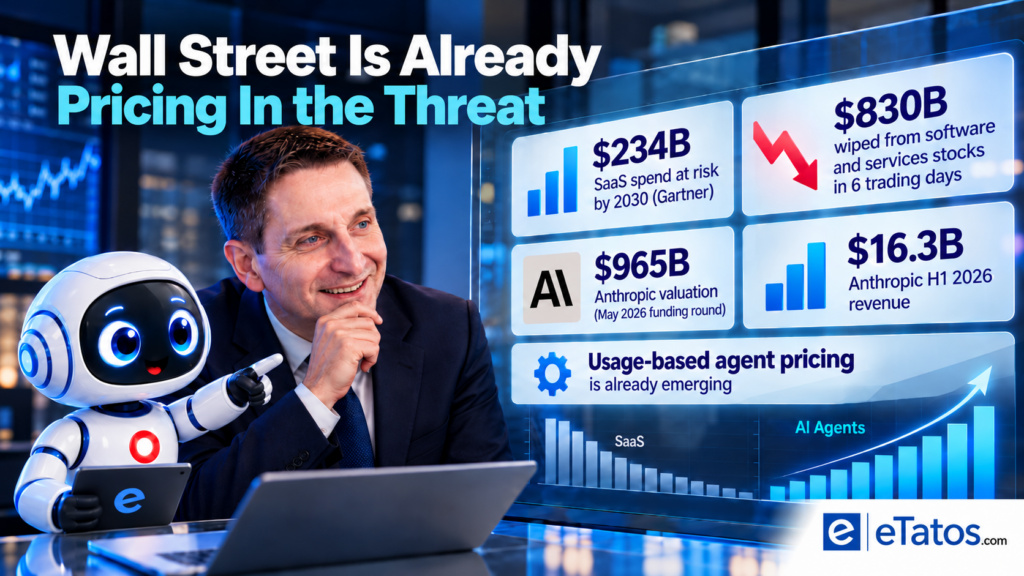
In February 2026, a selloff wiped approximately $830 billion from software and services stocks in just six trading sessions, according to Reuters.
One of the triggers was Anthropic expanding Claude’s capabilities into business workflows traditionally handled by specialized software.
Investors began questioning whether the competitive advantages of established SaaS companies were as durable as previously assumed.
And there’s an interesting number behind that concern.
In July 2026, Gartner estimated that up to $234 billion in enterprise application spending could be exposed to disruption from AI agents by 2030, representing roughly 20% of SaaS spending in that category.
Gartner calls the mechanism agentic arbitrage: AI agents complete tasks across different systems, reducing the need for people to interact directly with numerous applications.
That’s remarkably close to what I experienced on a much smaller scale when Codex bypassed Windows Media Player to burn my CD.
Meanwhile, the financial expectations surrounding the AI companies themselves have reached extraordinary levels.
Anthropic, the company behind Claude, was valued at $965 billion in its May 2026 funding round. By October, investors were discussing potential IPO valuations between approximately $1.5 trillion and $2 trillion.
Its newly published IPO prospectus reports $16.3 billion in revenue for the first half of 2026. The company is growing extraordinarily fast, although its enormous computing costs show that AI has its own demanding economics.
Of course, stock-market expectations aren’t proof that existing SaaS businesses are doomed. Investors can overreact and many established software companies possess valuable data, customer relationships and infrastructure.
But the pricing models are already changing.
Take Salesforce, one of the companies most closely associated with the modern SaaS economy. Its Agentforce pricing includes usage-based billing, with standard AI-agent actions priced at approximately ten cents each, alongside traditional user licenses.
That’s a revealing development.
A company that helped popularize subscription-based enterprise software is increasingly offering customers a way to pay for the work its AI agents perform.
I suspect we’ll see much more of this.
And it raises a difficult question for the entire software industry: If customers increasingly pay for completed work, how many separate applications and subscriptions will they still need?
The SaaS Industry Won’t Vanish Overnight
I don’t expect every software company to disappear.
There are excellent reasons to use dedicated applications, particularly in professional environments.
Complex engineering tools, enterprise resource planning systems, regulated financial software, industrial platforms and sophisticated creative applications offer capabilities that cannot simply be recreated with a few AI-generated scripts.
Security, reliability, compliance, collaboration and accountability matter.
And AI agents themselves require infrastructure, computing resources and maintenance. Some of those services will undoubtedly be sold through subscriptions.
We may even see the subscription economy reinvent itself around AI agents.
But I expect the market to become much less forgiving.
A beautiful interface and a collection of ordinary functions may no longer be enough to justify a recurring payment.
Software companies will have to demonstrate why their products deserve to exist as independent services when increasingly capable agents can accomplish the same tasks through other means.
Some will adapt by exposing their functionality through APIs and agent-friendly interfaces.
Others may become infrastructure providers whose capabilities are used invisibly by AI systems.
And some will discover that their products have become unnecessary.
That is how technological disruption works.
It rarely eliminates an entire industry in one dramatic moment. It changes where value is created and who gets paid for providing it.
The Next Software Economy May Look Very Different
I can imagine a future in which people maintain a relatively small collection of trusted tools, personal data stores and AI agents.
Instead of constantly searching app stores for another specialized utility, they ask their agents to accomplish something.
The agents decide which tools, services and system capabilities are needed.
Sometimes they use commercial software. Sometimes they call an API. Sometimes they write a short script or a little tool.
The customer doesn’t necessarily need to know.
For developers, this could open new opportunities. Useful software capabilities might reach customers through agents without requiring an elaborate consumer-facing application.
For established software vendors, however, it could mean losing something they’ve relied on for years: The direct relationship between the user and the application.
If an AI agent becomes the primary interface, the app itself risks becoming an interchangeable component.
And interchangeable components face very different pricing pressures than platforms with loyal, captive users.
That could have profound consequences for software margins, subscription revenue, customer acquisition and the valuations of companies built around traditional SaaS economics.
The industry won’t disappear. But I suspect a significant portion of today’s standalone app market will struggle to justify its current business model.
And Good Riddance
I don’t dislike software. Quite the opposite.
I’ve spent much of my life working with technology, exploring new tools and appreciating well-designed applications.
But I’ve grown tired of the assumption that every useful digital function deserves its own account and recurring payment.
I’ve grown tired of companies trying to turn simple utilities into lifelong customer relationships.
And I’ve grown tired of moving my information between platforms that each want to become the center of my digital life.
That’s why I’m genuinely enjoying the process of reducing my subscriptions and building a more open, AI-friendly personal environment.
I want my files to remain mine.
I want to choose which AI models and agents work with them.
And I want to pay for software and services when they provide meaningful value, rather than because my information or workflow has become dependent on them.
The app economy gave us extraordinary tools.
The subscription economy made many of those tools convenient, accessible and continuously updated.
But somewhere along the way, the business model started serving the vendors a little too well.
AI agents may finally give customers enough flexibility to push back.
And if that means fewer unnecessary subscriptions, fewer locked-in workflows and fewer apps demanding monthly payments for trivial functions, I won’t be mourning their disappearance.
I’ll be cancelling another subscription.