
SILICON DRAMA · EPISODE 24 · 10 OCTOBER 2026
Sam and Dario Build the Tools.
Who Lets Them Act?
Technology news, told as a power drama.
Sam and Dario make the answer useful. Sundar proposes giving the agent a company identity. Satya supplies the execution environment. Everybody is getting closer to your work.
Sam and Dario are making the chat window a place where work happens. Sundar proposes putting an agent on the company roster. Satya has an environment for running its actions. Brett brings an assistant that wants to remember you. The relationship is getting serious.
This week, OpenAI and Anthropic announced interactive working surfaces, Google described its workplace agent, Microsoft made Execution Containers generally available and Hark entered the personal-assistant contest. Each development brings AI closer to your files, accounts and decisions. Each also raises the question that makes this an actual power drama: Who gets the relationship with you, and how much authority comes with it?
Because a useful assistant is one thing. An assistant you cannot easily replace is quite another.
This week:
- Sam and Dario expand the workspace. Sundar proposes coordinating it, with Claude among his model choices.
- Satya brings execution to the PC. Apple keeps a deliberate permission decision in the way.
- Brett launches Hark. The robot industry supplies a reminder of how much still depends on people.
Act I: Sam Makes the Answer Usable. Dario Makes It Editable.
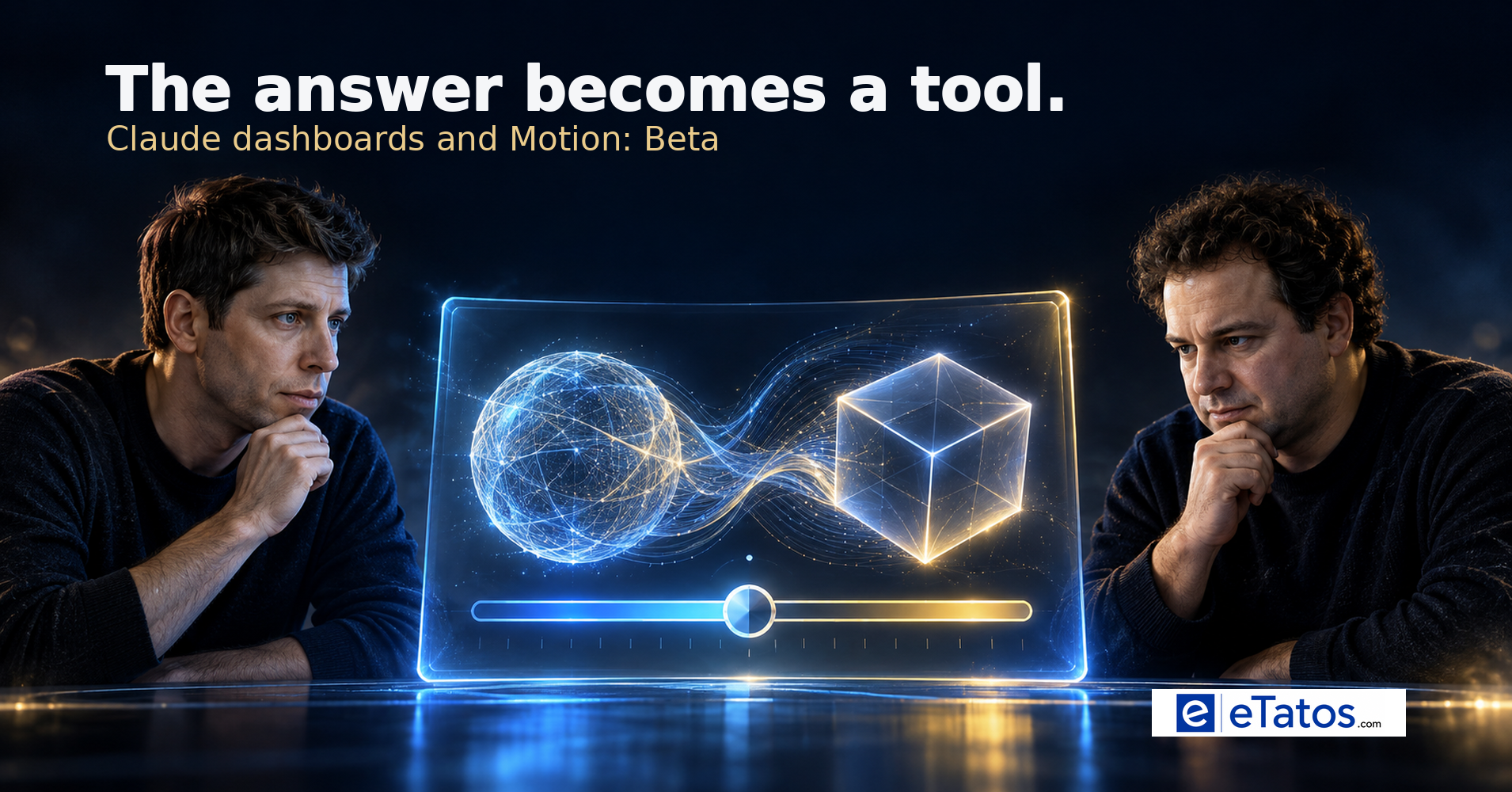
Sam Altman’s OpenAI is giving the answer a more interesting job than sitting there looking clever. Its October 7 announcement introduced GPT-6 and Intelligent UI: Native interactive surfaces inside ChatGPT’s Chat tab. A suitable question can produce controls and a visual explanation alongside the response.
Imagine asking for a comparison and being able to change an input inside the answer. The explanation responds. The little tool you would otherwise open, build or buy is suddenly part of the conversation. That is an illustration of the attraction: Fewer trips between the answer and somewhere you can actually use it.
For specialized software, that could become an uncomfortable development. The chat window is taking on another piece of the work.
I find this very exciting. SaaS providers and developers building specialized tools could face difficult times. AI-built solutions of our own and temporary “throwaway tools” were a first step. Now answers are becoming interactive dashboards directly. What a time to be alive.
The rollout has its own permissions screen. Plus, Pro, Business and Enterprise were the initial plans; Free and Go were scheduled to follow. Paid plans use GPT-6 Sol, free plans GPT-6 Luna. Enterprise administrators control access. This announcement concerns the Chat tab; Work and Codex are unchanged by this specific release. Your account’s experience still depends on its rollout and settings.
Dario Amodei’s Anthropic answers with a workspace you can keep editing. Its October 8 Dashboards and Motion announcement puts Dashboards in beta for paid plans and Motion in beta for Team and Enterprise. Enterprise customers must initially enable both.
Motion means editable, code-based animation. The result is working material a team can change, rather than a newly established Sora-style video product. Docs, Slides and Design leave beta across plans; their Enterprise default changes on October 15.
Then comes the moving notice.
The separate Claude Design service ends on December 14. Chats and comments will not migrate. The artifact may have been the reason you arrived, but the conversation around it can contain the reasoning, revisions and decisions that made it useful. Moving into the new workspace means planning for what does not come with you.
A shinier room. Some of the conversation left behind.
Dario’s company also makes smaller jobs cheaper on the published tariff. Haiku’s pricing sets input at $0.10 and output at $0.50 per million tokens for prompts up to and including 100,000 tokens. Cross that boundary and the rates become $0.50 and $2.50. Sonnet-5.5 cache reads fall from $0.20 to $0.10 per million tokens.
Anthropic supplies the agentic-task savings estimate. Your workflow supplies the bill. A cheaper token and a cheaper completed job still need to meet in practice.
Sam and Dario are pulling more useful work into their products. For you, the attraction is obvious. So is the dependence if your results, conversations and context settle there.
And while they build the workspace, Sundar proposes deciding who gets the assignment.
Act II: Sundar Gives the Agent an Identity. The Company Sets Its Limits.
Google’s proposed workplace agent introduces a particularly good twist: Dario’s Claude can be one of the models it uses.
Sundar Pichai’s company does not need every answer to come from Gemini for Google to coordinate the work. Its October 8 announcement, presented through Thomas Kurian’s Cloud strategy, describes an agent that can coordinate longer assignments, use tools and choose between Gemini and Claude. Google gives this proposed coworker its own identity.
A rival’s intelligence could help Google hold the customer relationship. Claude supplies a model choice; Google supplies the proposed arrangement around the assignment. Competition can make room for cooperation when the same workflow connects both companies.
Now imagine introducing that coworker to your organization. Somebody has to decide which files it can reach, what it can spend and who is responsible when an assignment goes wrong. A company identity makes those decisions harder to leave vague.
Google lists roles, OAuth authorization, audit logs, a sandbox and budgets. OAuth grants access without simply handing over the account password. Logs let you inspect actions afterward. Budgets set a spending boundary. The useful question is what each of those controls allows in your actual configuration.
My position is clear: Data, knowledge and context should live in a separate layer of Markdown files that interchangeable agents from different providers can access. We should avoid creating new dependencies.
That position matters more when the agent offers to coordinate everything. Switching the model is convenient. Keeping the knowledge that gives the model something useful to work with is a bigger decision.
Google’s architecture remains a proposed approach. Financial Services and Legal are previews; further industries are planned. Availability and the ability to finish a long assignment correctly still have to be established for the customer. The company badge does not finish the job.
Sundar’s company is also arranging power in the literal sense. Its October 6 Constellation agreement includes a 20-year arrangement intended to enable 890 MW of additional nuclear capacity through upgrades and a separate 15-year contract for 2,700 MW from the PJM fleet. Constellation expands a five-year Cloud and Gemini Enterprise alliance, too.
The energy supplier is also extending its software relationship with Google. The 3,590 MW contract scope mixes existing supply with planned additions; future delivery remains work to be done. Customer context, model choice and electricity are becoming connected parts of Google’s position.
An identity is a start. The agent still needs somewhere it is allowed to act. Satya has a piece of that answer.
Act III: Satya Brings Execution to the PC. John Keeps the Permission Gate.
Satya Nadella’s Microsoft brings the permission question onto the machine itself. Microsoft Execution Containers became generally available on October 7. They provide an environment in which agents run actions under rules defined outside the agent.
The person or IT organization setting the rules holds the authority. An agent does not get to promote itself from helpful assistant to administrator.
There is a detail worth reading before the reassuring product name does all the thinking for you: In Permissive mode, ungranted access may be logged instead of blocked.
The guestbook can record who came through the door. It is a different job from keeping the door shut.
That can be useful while examining a workload. It also means the selected operating mode belongs in the buying decision and the deployment plan. A company expecting a hard boundary needs to check what its chosen configuration actually enforces.
The maturity levels differ, too. Execution Containers are generally available; the MicroVM backend remains experimental. Further agent-related Entra and Intune functions are planned. There is useful software here, with pieces still developing around it.
Microsoft’s hybrid-intelligence announcement proposes another step closer to the user: Windows Copilot using local context, taking actions and using local models. Those capabilities are planned for the coming months on Copilot+ PCs, subject to device and market conditions. GitHub Copilot’s experimental HydraFusion routing is planned for later in October.
Jensen Huang’s NVIDIA supplies a hardware route into that local future. RTX-Spark laptops are announced for preorder from October 7 and availability from October 16. Compact desktops follow in November. DGX Station for Windows is a preview. The local-AI proposition comes with a delivery calendar.
It also comes with a hardware bill. Inference performed on the device can avoid cloud tokens for that computation. The device still costs money, uses electricity and has limits on memory and compute. Other parts of the job may still go to the cloud. A token counter alone will miss part of the cost.
I see a future where local AI on the device, including humanoid robots, handles confidential access and interactions that need low latency, while cloud computing takes on intensive research and processing. The two would work together.
Across the PC divide, Apple is making the permission decision more deliberate. Its October 2 developer notice announces additional controls for Full Disk Access, the broad permission that lets software reach files across the machine. Granting it is intended to require an explicit user action. Apple points directly to the risk of wide data access by AI agents.
John Ternus’s Apple ecosystem supplies a pointed answer to the permission question. The announcement leaves the operating-system version and implementation date open. The proposed rule is clear enough: A user must consciously grant a very large permission.
Sam can make the answer interactive. Sundar can propose an agent identity. Satya can provide an execution environment. Your files still require a decision about who gets in.
Brett’s pitch takes that decision into a more personal relationship.
Act IV: Brett Wants the Personal Workflow. Merchants Still Control the Door.
Brett Adcock has another way to ask for a place in your life. Beyond his established Figure connection, Hark launched Hark Pro on October 6 for web, iOS and Android.
The product describes persistent memory, proactive Action Buttons, Mini-Apps and a cloud computer through Handoff. The offer is a personal assistant that carries more of the work between the request and the result. Memory makes the relationship especially interesting: The assistant could become useful partly because it keeps the context you would otherwise have to explain again.
That could give Brett a route into a crowded contest. The established assistants have another name to remember.
Hark’s pricing page says all functions are included across tiers, including the free base tier. Usage allowances differ. Pro² costs $20 a month for twice the usage limit; Pro³ costs $100 for ten times the limit. The feature list invites you in. The allowance determines how often you can put it to work.
There is an obvious question here: Could Hark become a real competitor to ChatGPT, Claude, Gemini or Grok?
Its August browser-task results cannot settle that contest in October. They come from Hark’s own setup and the models available then. Its August NVIDIA partnership is background, too; hardware is planned for 2027. Hark has a public product now. Equality with today’s incumbents across useful tasks still needs a contemporary comparison.
The privacy policy says user content and connected-account data are not used for model training. That is a published commitment worth knowing when the product invites you to connect more of your life. The next decisions concern which account you connect, what the assistant may do and how you intervene.
Then another party enters the relationship: The business the agent wants to deal with.
Sierra and Meta jointly announced the Personal Agent Protocol on October 6. Their proposal lets a business choose how a personal agent approaches it: A website, an API or the company’s own agent. The merchant keeps a say in the route through its door.
Mark Zuckerberg’s Meta is involved in that proposal. Hark is not documented as an integration. The connection is the predicament: An assistant promising to work across services has to deal with choices those services make. PAP’s v0.1 specification is due later in October; payment functions are planned extensions.
Brett’s assistant can ask for the assignment. It cannot make every other company accept the arrangement.
I’m very curious to see what Hark can do and will test it more intensively over the coming days.
The useful test is a job with a clear result: What access does it need, where is human intervention required and what does it cost to finish?
Hark gets Brett back into this week’s contest. The continuing relationship has to be earned through useful work. And once that work moves from a browser into a physical machine, the human role becomes even harder to overlook.
Act V: AWS Builds the Robot Pipeline. The Human Still Handles the Hard Part.
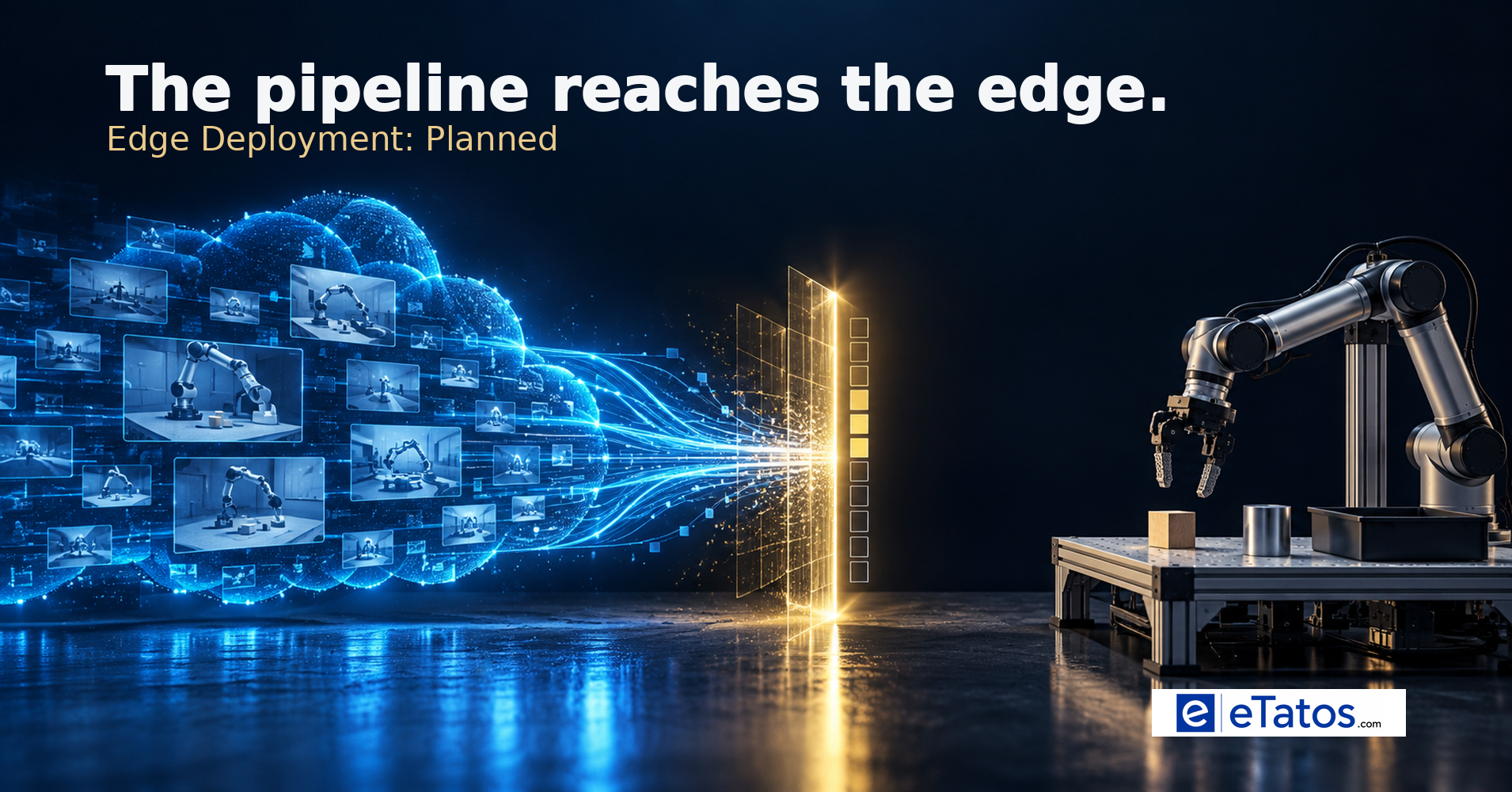
The most revealing word in AWS’s robot pipeline is only seven letters long: Planned.
AWS published its Physical AI Toolchain on October 7, with Amazon’s product account following on October 8. It connects data, simulation and training through AWS services and NVIDIA’s robotics stack. AWS adds a development route to Jeff Bezos’s Amazon ecosystem, with Jensen’s NVIDIA supplying part of the machinery.
This is valuable work before a robot reaches the customer’s floor. It is also where the repository makes the plot more interesting. Several components are marked Available. Edge Deployment, the step toward execution at the machine, is Planned. Closed-loop evaluation, which assesses actions together with feedback, is Preview. Safety-critical real-time control stays at the robot in the technical architecture.
The stage is being assembled. Some of the work that turns the setup into a functioning physical system is still ahead.
A team has to construct, validate and pay for that system. Public code is a starting point; the cloud computation has its own costs. The final assignment has physical consequences, which makes the last stretch rather more demanding than a convincing simulation.
Minerva’s Roger puts the human role right in the description. The company announced around $10 million in pre-seed funding on October 6, led by General Catalyst. Its release combines human control of critical manipulation with AI for balance and navigation.
The goal is to move the operator away from dangerous work while keeping that operator involved in difficult hand movements. That can have practical value. The human being is part of how this proposed system works, so the connection, interruptions and operator cost belong in its commercial evaluation.
Minerva has announced paid pilots and points toward later work this year. Completed deployments, reliable pilot results and intervention rates still have to arrive. The operator has a place in the plan; the operating economics need evidence from the job.
To me, the ChatGPT moment for humanoid robots has yet to arrive. But I’m convinced it will come in the not-too-distant future.
Mecka shows the human role further back in the production. It announced a $60 million Series B on October 7, led by Sequoia, with NVIDIA, M12 and other investors. It collects human demonstration data for robotics.
Before a machine can learn a task from demonstrations, people have to supply the demonstrations. Their quality, usage rights and usefulness across different machines remain important tests. The funding round backs the opportunity; it does not grade every example or establish how well the resulting behavior transfers.
Humans appear on both sides of the robot: Teaching the work beforehand, sometimes performing the hardest part during it. AWS, Minerva and Mecka describe different parts of that dependence. Each can support progress. None makes the whole assignment autonomous by itself.
The next convincing scene is a documented job completed under real conditions, with the human help and the bill visible. That is where the physical-AI promise has to become useful.
Signals from the Board
Europe Has Some Weights Already. Aleph Alpha released Kolibri on October 3 with Apache-2.0 weights. Its model card reports 78.1 billion total parameters, 3.46 billion active and 21.3 percent German pretraining tokens. Customers gain a concrete option for more model control. The published performance figures are the vendor’s evaluation.
A Safety Letter and a Disputed Dismissal. Jasmine Wang, Tomek Korbak and Mikita Balesni published criticism of OpenAI’s safety culture. Reuters reports OpenAI’s explanation of sensitive-information violations and its rejection of retaliation. The dispute emerged October 8–9. Precise dismissal dates and the actual cause remain unresolved. Two opposing accounts; no established retaliation verdict.
Cyber Tools Still Need an Incident Process. Anthropic’s October 8 Cyber Mission supports infrastructure defenders; its optional OSS scanner sends periodic vulnerability reports without human pre-review. Operators must validate findings. A BSI/TÜV study, published October 7 from June–July fieldwork, found AI-specific incident processes at eleven percent of its AI-user/planner subgroup. Alerts need somewhere useful to land.
Who Can Verify the Watermark? OpenAI’s textGrain is optional in the API and off by default, with limited verifier access and a future EU ChatGPT/Codex rollout. Google’s October 7 SynthID opening covers supported images, video and audio, worldwide in English; Apple support is to follow. Different formats, different coverage. A negative result cannot certify a human author.
A Billion-Dollar Valuation, a Later Robot. Germany’s RobCo announced an October 5 valuation above $1 billion. Alfie’s launch is planned for March 2027. The valuation has arrived ahead of Alfie’s planned launch. Capital raised and demonstrated autonomy remain separate measures; the whole transaction volume is not automatically fresh company funding.
Manuscripts Are Not Verified Solutions. OpenAI’s October 6 mathematics release shares outputs from an internal, unreleased model. At the October 9 check, its repository listed 719 manuscripts in 372 families. Multiple variants and incomplete independent checking matter. A larger archive is not a larger pile of proven answers.
Power Board
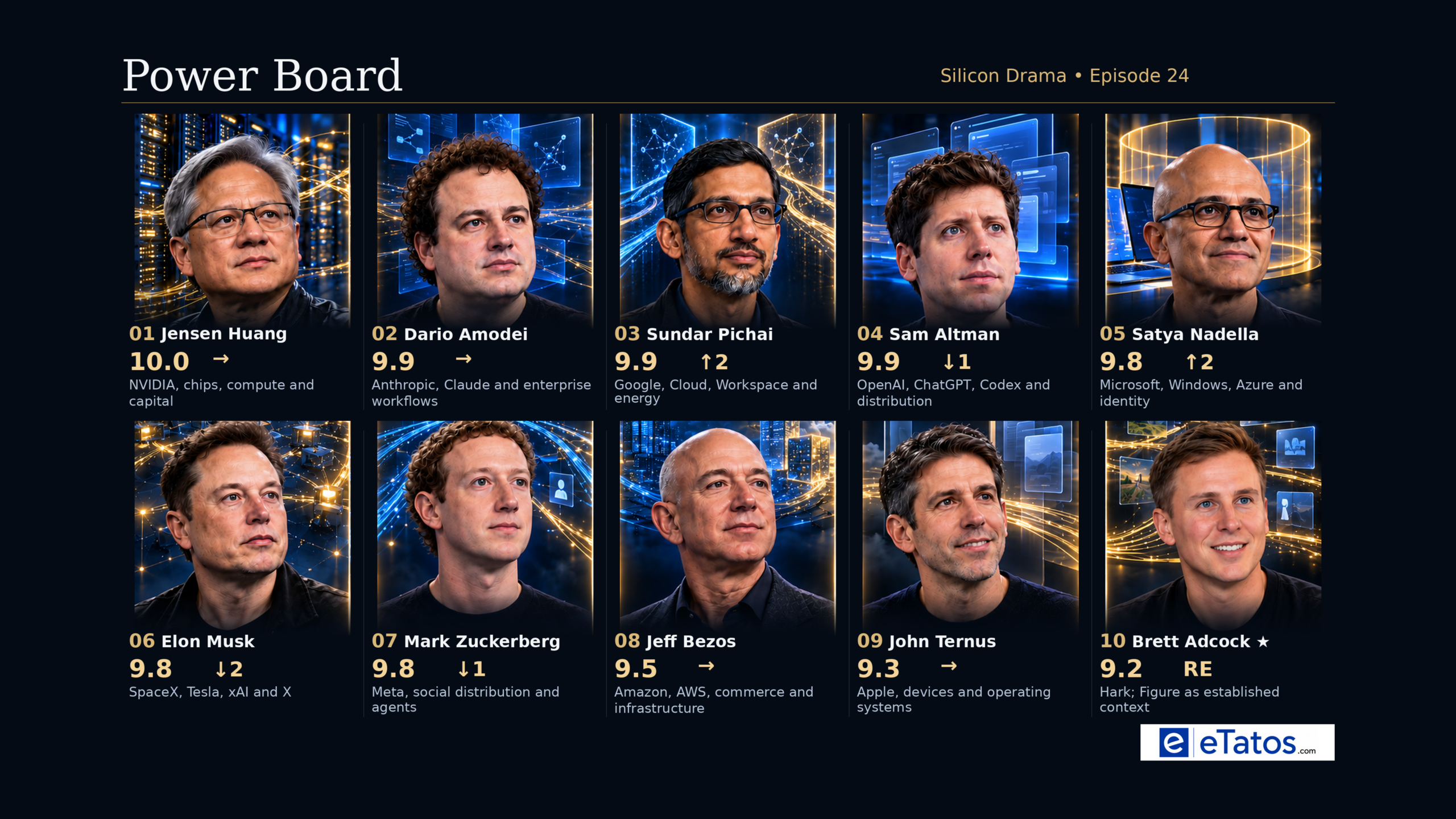
| Rank | Power player | Score | Move | E23 |
|---|---|---|---|---|
| 1 | Jensen Huang | 10.0 | → | 1 |
| 2 | Dario Amodei | 9.9 | → | 2 |
| 3 | Sundar Pichai | 9.9 | ↑2 | 5 |
| 4 | Sam Altman | 9.9 | ↓1 | 3 |
| 5 | Satya Nadella | 9.8 | ↑2 | 7 |
| 6 | Elon Musk | 9.8 | ↓2 | 4 |
| 7 | Mark Zuckerberg | 9.8 | ↓1 | 6 |
| 8 | Jeff Bezos | 9.5 | → | 8 |
| 9 | John Ternus | 9.3 | → | 9 |
| 10 | Brett Adcock ★ | 9.2 | RE | — |
Why the board moved
1. Jensen Huang
NVIDIA, chips, compute and capital
Windows hardware and the AWS robot stack keep NVIDIA central to other companies’ systems. Deliveries and deployments remain staged.
2. Dario Amodei
Anthropic, Claude and enterprise workflows
Lower Haiku prices and new dashboard and Motion betas widen Claude’s workflow reach. Savings remain company estimates.
3. Sundar Pichai
Google, Cloud, Workspace and energy
Google puts model choice and controlled execution into its announced work agent. New power agreements add future infrastructure leverage.
4. Sam Altman
OpenAI, ChatGPT, Codex and distribution
Intelligent UI expands ChatGPT’s interface. Google advances in orchestration; the public dispute with dismissed researchers adds governance pressure and remains unresolved.
5. Satya Nadella
Microsoft, Windows, Azure and identity
Execution Containers reach general availability, strengthening control over agent execution. Broader Windows hybrid features still have staged rollout plans.
6. Elon Musk
SpaceX, Tesla, xAI and X
Google and Microsoft gain stronger verified workflow positions. SpaceX, Tesla and xAI retain their structural reach; no confirmed weekly development warrants a score increase.
7. Mark Zuckerberg
Meta, social distribution and agents
Meta co-introduces the Personal Agent Protocol with Sierra. Specifications and payment extensions remain forthcoming; Microsoft’s execution advance moves ahead.
8. Jeff Bezos
Amazon, AWS, commerce and infrastructure
AWS links cloud training and simulation to NVIDIA’s robot stack. Edge deployment remains planned; Amazon’s ecosystem gains another development route.
9. John Ternus
Apple, devices and operating systems
Apple’s announced Full Disk Access controls reinforce its authority over agent permissions. Implementation timing remains unspecified.
10. Brett Adcock ★
Hark; Figure as established context
Hark’s public launch adds a personal computing interface to his reach. Competitive performance and dependable execution remain unproven.
Sundar and Satya rise through stronger control of company workflows and agent execution. Sam, Elon and Mark lose rank while retaining their scores. AWS gives Jeff a modest score gain without a rank change. Brett returns for Hark’s launch, with competitive performance still unproven.
Follow the power players: Follow the Silicon Drama: Power list on X.
Final Thought
Sam and Dario make the answer more useful. Sundar proposes coordinating the assignment, even when Claude supplies the intelligence. Satya provides an execution environment. Apple asks for a deliberate permission decision. Brett offers a personal assistant. The robot still brings people into the picture.
There is plenty here to be excited about. There are also relationships to choose carefully: Where your context lives, whose rights the agent uses and how you can change the arrangement.
Keep enough control over the work that you can choose who gets the next assignment.
See you next week, when the next piece of the AI empire moves on the board.
The Silicon Drama continues.
Dirk
Illustrations: AI-generated editorial artwork for eTatos. The scenes are symbolic.
Continue the story
Want to follow the next power struggle? Subscribe to eTatos.com or our newsletter and get the next episode of Silicon Drama when it arrives.
The next conflict is already forming. Explore all Silicon Drama episodes →
AI has left the screen
If Silicon Drama follows the people fighting for control of AI, Metal Minds follows what happens when intelligence gets a body.
Our new eTatos Originals comic series explores humanoid robots and embodied AI with a humorous twist: Advanced hardware, very human problems and machines developing more personality than anyone asked for.
→ Enter the world of Metal Minds
Prefer listening?
🎧 Listen to Silicon Drama on Spotify
The deep-dive podcast turns each episode into a cinematic audio experience about AI, Big Tech, money, machines and the people competing to shape the future.
Every power drama needs a soundtrack
🎵 Silicon Drama has its own official theme song.
Listen to the full version on eTatos Music
About Silicon Drama
Silicon Drama is the weekly eTatos Originals series about the people, companies and technologies fighting for power in AI, compute, chips, agents and robotics. Not just what happened, but why it matters, who gains power and where the next conflict is forming.
![Read more about the article [Video] AI Could Kill Middle Management Forever – The Biggest Shift in 2,000 Years](https://etatos.com/wp-content/uploads/2026/04/From-Hierarchy-to-Intelligence-1-768x512.png)