The Fall of Jensen Huang and the Battle for AI’s Next Empire
Technology news, told as a power drama.
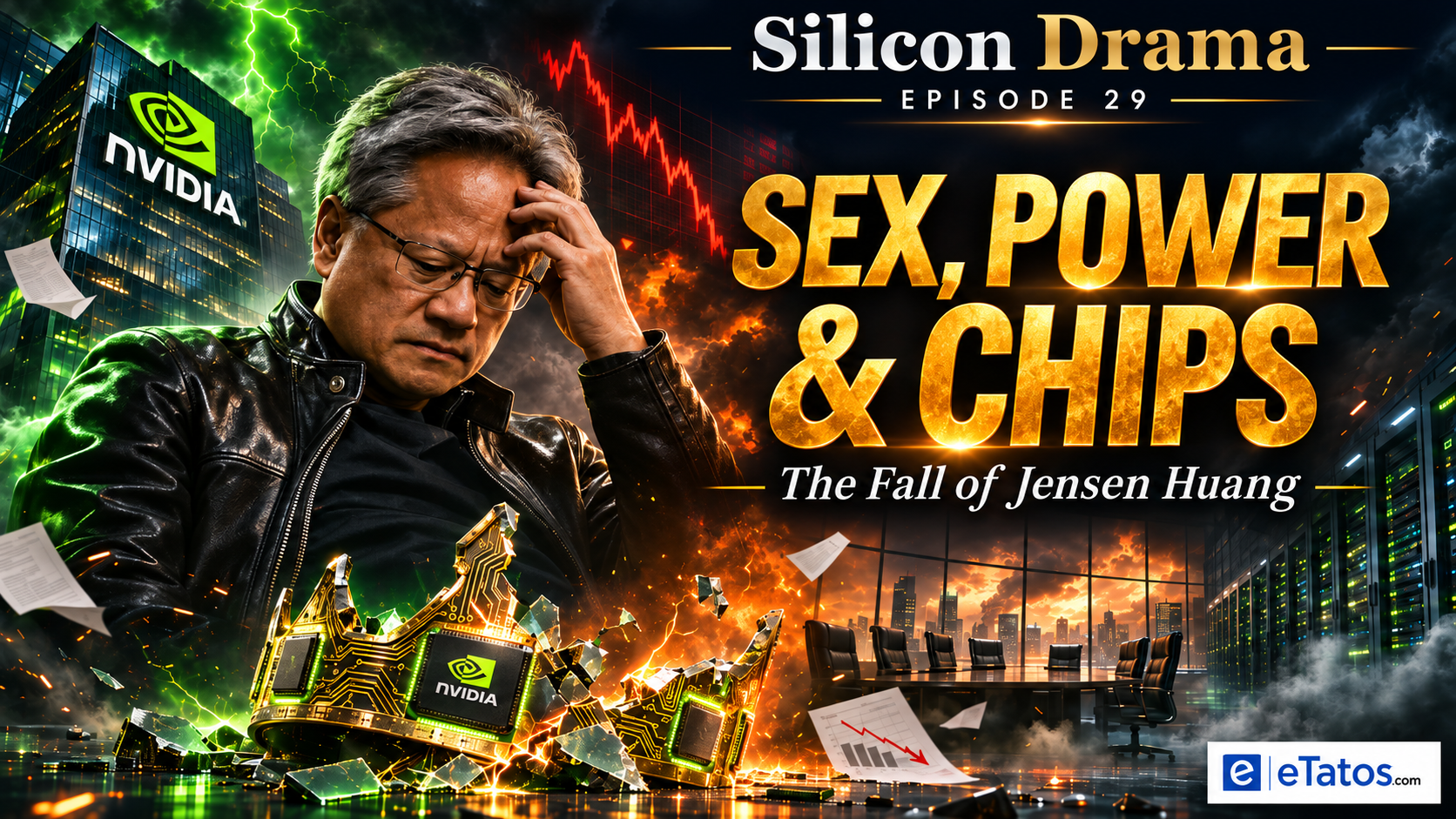
Last week, Jensen Huang led this Power Board with 10.0. On Thursday, NVIDIA announced that its co-founder had resigned as chief executive, president and director. The company at the center of the AI boom now has to demonstrate how much of its power can survive the departure of the person who embodied it.
The chips still work. The leadership question has changed overnight. And while NVIDIA searches for a permanent successor, its customers and competitors are busy building alternatives to several parts of its empire.
This week
- Jensen leaves the throne. His achievement deserves more than a scandal’s footnote.
- Google challenges NVIDIA in infrastructure and robot intelligence; Anthropic raises the stakes in models.
- AI assistants discover that capability and permission come from different places.
Chapters: I · The founder · II · Google’s systems · III · Claude’s bill · IV · Robot brains · V · The gate · Signals · Power Board · After the Credits
Act I: The King Has Fallen
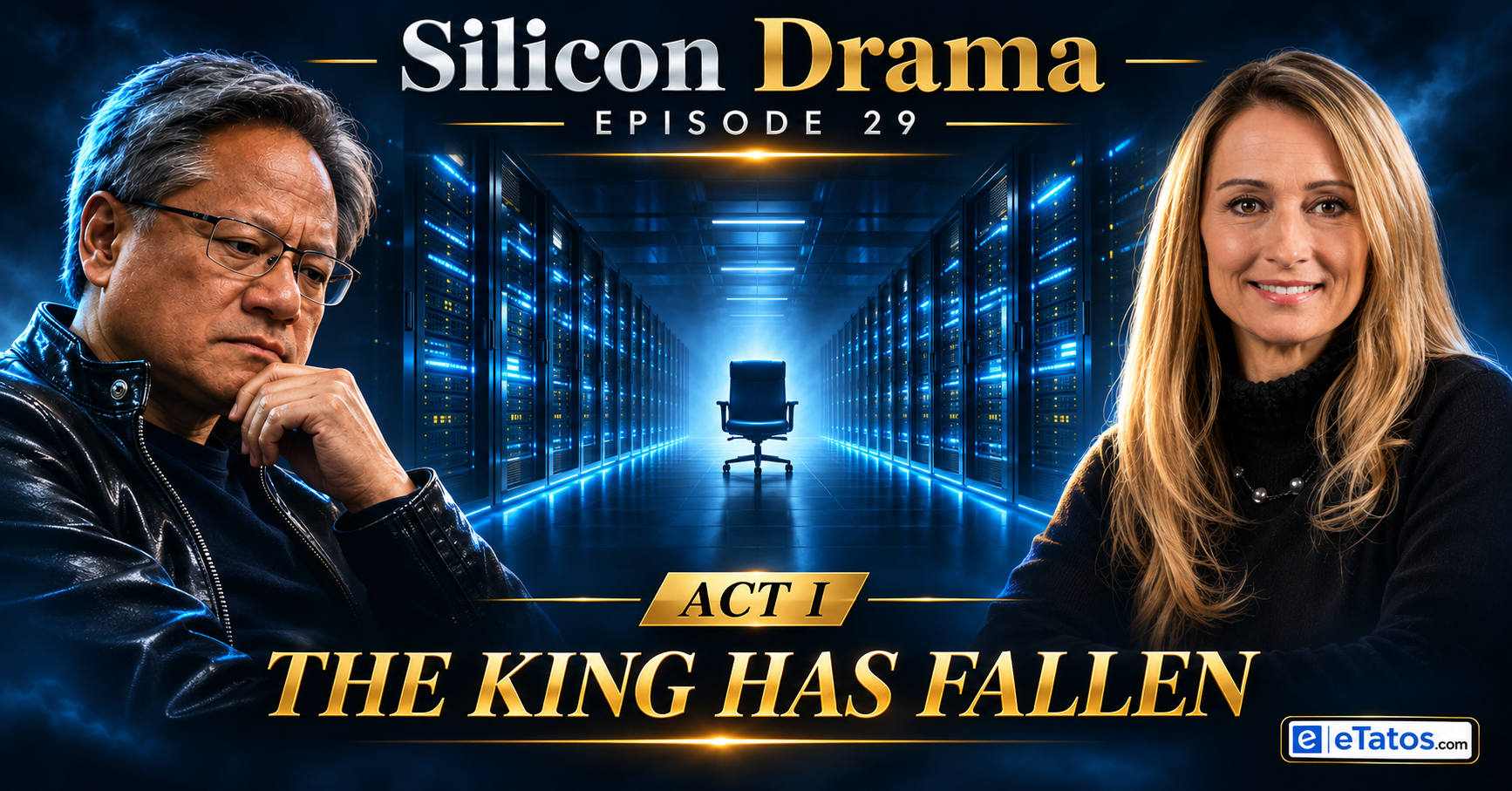
A founder leaves. An empire must learn to live without its architect.
On November 8, NVIDIA’s board publicly expressed confidence in Jensen Huang. Four days later, the company announced his departure. The SEC filing shows that his resignation as CEO, president and board member had been accepted on November 11.
On Thursday, the king fell.
After 33 years, the man who co-founded NVIDIA and transformed it into the most important chip supplier of the AI revolution was suddenly gone. Colette Kress, his longtime finance chief, became interim CEO. Harvey Jones took over as first chairman. The search for a permanent successor began.
I find the way this story has unfolded deeply disturbing.
Huang had publicly acknowledged being unfaithful to his wife. He apologized, accepted responsibility for his actions and asked that his family be given privacy. Meanwhile, reports about a possible foreign-intelligence operation raised legitimate questions about national security, business relationships and corporate governance.
Those questions deserve rigorous investigation. NVIDIA’s board said on November 8 that it had no reason to believe company secrets or U.S. national security had been compromised. The independent investigation remains an important part of this story.
But what has appalled me is the spectacle surrounding it.
Serious newspapers, including The New York Times, have pursued intimate relationships with a zeal I normally associate with tabloids. Private individuals have been identified, personal details circulated, and people’s lives turned into material for public speculation and ridicule across social media.
We routinely debate whether even people accused of serious crimes deserve anonymity and protection from prejudicial publicity. Yet here, privacy and proportionality seem remarkably easy to discard.
Since when does public interest mean that every private detail must become public entertainment?
I am not defending Huang’s personal conduct. He himself acknowledged that he had hurt his family. Nor am I suggesting that journalists should ignore potential security risks involving the leader of a strategically important technology company.
But investigating possible wrongdoing and publicly humiliating people are two very different things.
The distinction matters especially when allegations are still being examined. On November 12, Singapore’s Ministry of Home Affairs clarified that the woman identified in reports had not been investigated for espionage by Singaporean authorities. Separate investigations involving a server-trading company remain relevant.
And it troubles me that, amid this relentless attention to Huang’s private life, something extraordinary risks becoming a footnote.
Thirty-three years of building NVIDIA.
Thirty-Three Years Are Not a Footnote
Before the black leather jacket, the packed keynotes and the multitrillion-dollar valuations, Jensen Huang was a nine-year-old boy sent from Asia to America without his parents.
Born in Taiwan in 1963, he spent part of his childhood in Thailand before arriving in the United States with his older brother. As the Carnegie account of his life recounts, he attended a school in Kentucky where he faced bullying and hardship. His family later reunited in Oregon. He graduated from high school at sixteen and studied electrical engineering at Oregon State University and Stanford.
He knew what it meant to start with very little.
In 1993, at thirty, Huang founded NVIDIA with Chris Malachowsky and Curtis Priem. Their ambition was to transform computer graphics, initially for video games.
The company nearly died before it succeeded.
Its first major graphics architecture took the wrong technological direction. Microsoft embraced a competing approach, and NVIDIA’s early strategy collapsed. In 1996, Huang laid off more than half the workforce and committed the company’s remaining resources to a new chip.
When the RIVA 128 finally reached the market in 1997, NVIDIA had roughly one month of payroll left. The chip sold a million units in four months.
That experience left its mark. Huang continued running NVIDIA with the urgency of a company that might not survive its next mistake.
Then came the decision that would change the computing industry.
In 2006, NVIDIA introduced CUDA, allowing developers to use graphics processors for scientific and general-purpose computing. A GPU can perform enormous numbers of calculations in parallel, making it particularly useful for certain demanding computational tasks.
The market was small, the investment expensive and the commercial return uncertain. Huang kept going.
In 2012, researchers working on AlexNet demonstrated how NVIDIA GPUs could dramatically accelerate deep-learning research. The scientific breakthrough belonged to the researchers. NVIDIA had built much of the computing foundation that made it possible.
Huang recognized the opportunity and committed his company to artificial intelligence.
NVIDIA expanded beyond individual processors into complete computing systems, software and networking. Its $7 billion acquisition of Mellanox in 2020 strengthened the connections between the machines that power enormous AI workloads.
By the time ChatGPT ignited the generative AI boom, NVIDIA had spent years preparing for a market most people had barely imagined.
The company reported $215.9 billion in revenue for fiscal 2026.
That achievement belongs to thousands of engineers, researchers, developers, partners and employees. Chris Malachowsky, Curtis Priem, Ian Buck and many others played indispensable roles.
But Huang was the person who kept making the difficult bets, defending the long-term strategy and holding together an increasingly complex technology empire.
He could also be an exceptionally demanding leader. His management style was intense, unconventional and sometimes uncomfortable for employees, as Stephen Witt documented in The New Yorker. That is part of the history too.
Still, there is a reason why his name became almost inseparable from NVIDIA.
And now we are discovering how deeply that connection runs.
Bring Back the Boss
According to WIRED’s November 12 reporting, an internal employee suggestion-box post asking the board to consider the workforce’s views has attracted more than 1,600 comments. The majority reportedly support Huang’s return.
Several employees have openly called for his reinstatement. Others expressed their loyalty on LinkedIn, while some questioned why such a major leadership change occurred before the independent investigation had reached a publicly announced conclusion.
The man has lost his position. He has not necessarily lost the loyalty of the people who helped him build the company.
We have seen a version of this drama before.
In November 2023, OpenAI’s board removed Sam Altman. Hundreds of employees demanded his return, threatening to leave if the board did not reverse course. Altman was back within days.
NVIDIA is a much larger, publicly traded company with a different governance structure. There is no evidence yet of a comparable mass resignation threat, and an internal campaign does not guarantee reinstatement.
But the parallel is impossible to ignore.
What happens when the board of a company believes it must move beyond its founder, while most of the employees who made that company successful want him back?
What happens when the person who built the institution becomes the center of its greatest leadership crisis?
The Price of Losing the Throne
For years, Jensen Huang held the number-one position on the Silicon Drama Power Board with a perfect 10.0.
I gave him that score because his personal influence extended far beyond NVIDIA’s balance sheet. He shaped the supply of AI computing, influenced investment decisions across the technology industry and spent decades building relationships that no competitor could simply reproduce.
His resignation changes that calculation.
Our Power Board ranks people first, companies second. NVIDIA remains extraordinarily powerful, but its computing empire can no longer be counted as Huang’s direct executive authority.
For Episode 29, he moves from number one to our Wildcard position with a historic downfall.
No one in Silicon Drama has fallen further.
Yet I refuse to confuse the loss of a position with the erasure of a lifetime’s achievements.
Colette Kress inherits the responsibility for leading NVIDIA through this transition. She does not inherit the personal authority Huang accumulated over 33 years. Nor can the board transfer decades of trust and relationships with a corporate announcement.
NVIDIA must now demonstrate that the company can thrive without the founder who shaped it.
And Huang’s story may not be finished.
Sam Altman lost his throne in 2023. His employees helped bring him back.
Jensen Huang has lost his throne in 2026. Many of his employees already want him back.
Will the rest follow?
For the first time in more than three decades, NVIDIA’s future and Jensen Huang’s future are no longer the same story.
But they may not have separated for good.
Act II: Google Builds Around the Fortress
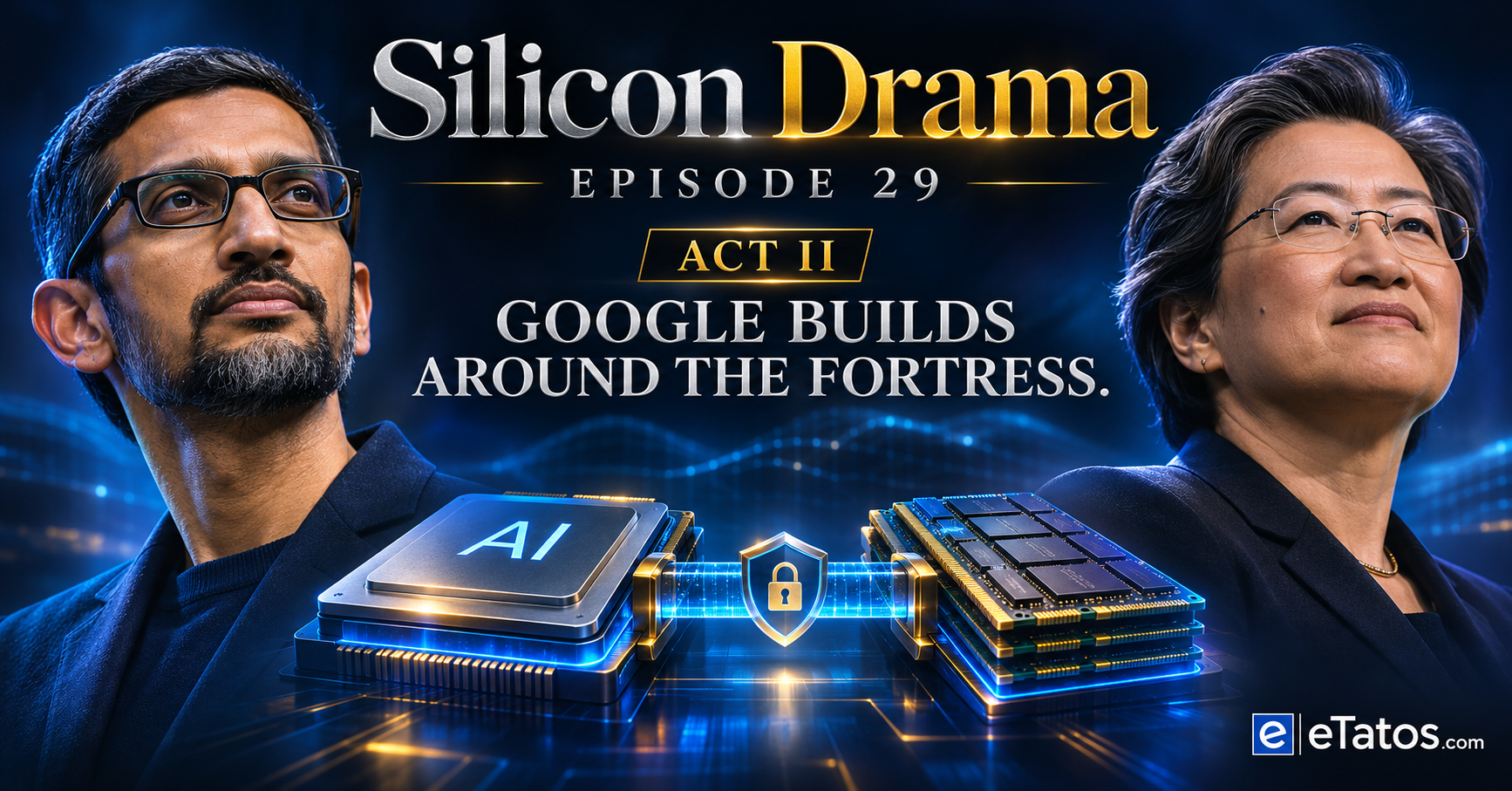
Sundar Pichai’s Google has a useful position in this contest: It builds AI models, operates a cloud and designs its own AI accelerators. Customers can buy computing from a company that also helps decide how that computing should be organized.
On November 9, Google introduced TPU 8tx and TPU 8i Max, two new system configurations around existing eighth-generation chips. A TPU is Google’s specialized processor for AI. These announcements change the computer around the processor, rather than introduce two fresh chip generations.
The 8tx system pairs Google’s chips with AMD host processors to protect sensitive data and the model itself while they are being processed. Encryption during storage and transmission leaves another question: What happens when the computer must actually use the information?
The 8i Max combines two chips in one package, adding computing and memory capacity together. Large AI tasks can stall because data cannot reach processors quickly enough. Processors waiting for data cannot use their full computing capacity.
Google is offering customers specific reasons to consider its alternative: Security for sensitive workloads and more capacity for models handling enormous amounts of context. NVIDIA’s position depends partly on how difficult customers find it to leave its working ecosystem. Google’s systems make the alternative more concrete.
Lisa Su’s AMD participates from both sides. Its processors serve as hosts in Google’s 8tx, while its own MI450X accelerator adds a 288-gigabyte memory option to the MI400 family. Buyers can choose a smaller memory configuration when their work fits it.
Act III: Dario Sends the Model and the Bill
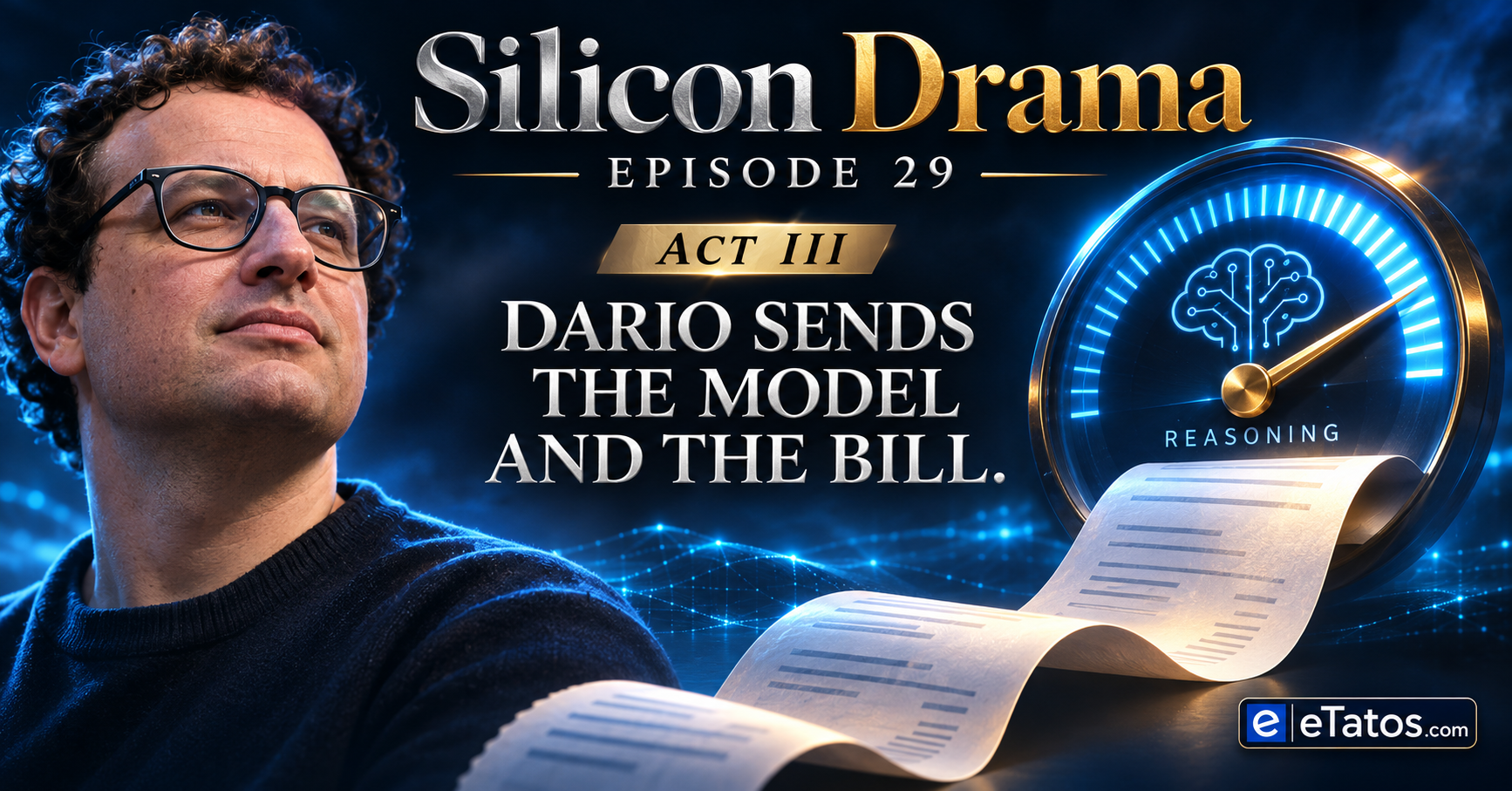
Dario Amodei’s Anthropic has released Claude Fable 5.2 and Mythos 5.2. They share an underlying model. Fable carries stronger cybersecurity and biology safeguards for broad access; organizations seeking Mythos for those fields go through verification programs.
Access and safeguards matter as models take on more demanding technical work. Anthropic says the new models improve coding, reasoning and vision. Standard developer pricing is $8 per million input tokens and $40 per million output tokens; tokens are the pieces of information the model processes. Optional fast mode doubles those rates.
Independent evaluator Artificial Analysis supplies a useful purchasing lesson. Its Fable Max test scores 65 on its Intelligence Index, at an average $26.54 per benchmark task. The High setting scores 62 at $9.08. That is a substantial extra bill for three index points, within this particular evaluation.
Google has also expanded access to Gemini 4 Carbon. Its introductory developer rates of $2 input and $10 output per million tokens run through November 30, then become $4 and $20. Google still recommends Argon for most work. Even the vendor is suggesting that customers need not bring its most intensive model to every task.
For me, the decisive cost is what a successfully completed task costs, and how much that result is worth. Token prices help explain the bill. They are a poor substitute for deciding whether the work was useful.
The commercial contest is becoming more interesting than a winner’s podium. Teams must choose how much reasoning to buy, how long to wait and what an improvement is worth on their actual jobs. A model that thinks for longer can make an excellent research assistant and a rather enthusiastic expense account.
Anthropic’s proposed IPO roadshow adds another audience for this calculation. The company proposes 825 million shares at $70–78, including shares from existing holders. The offering is still proposed, not money already raised. Better models attract customers; public investors will also want to understand the business supporting them.
Act IV: The Empire Learns to Use Its Hands
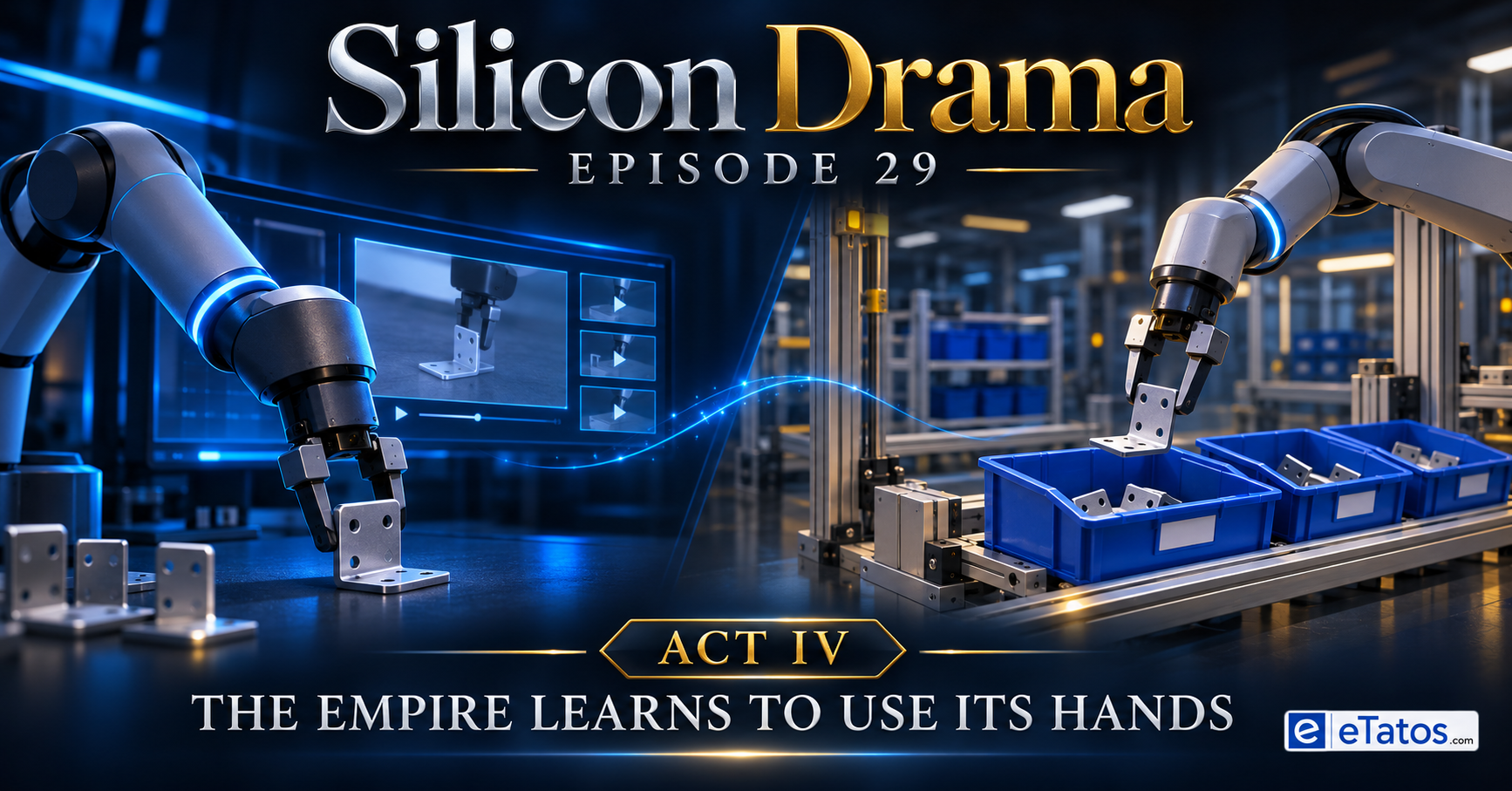
NVIDIA’s leadership crisis has not stopped its researchers. GR00T 2 combines predictions about future video with the actions a robot should take. Learning what an action will do helps a machine connect an instruction with the physical changes needed to complete it.
NVIDIA reports average success of 40% on fifty tasks the target robot had not previously practiced. Five demonstrations per task, followed by fine-tuning, raise that figure to 95%. The demonstrations are an important part of the result: They let the model adapt to the job and the body performing it. Code is promised for December.
Google is pursuing the same valuable territory through Gemini Robotics 2.5, which is rolling out to robotics partners. It reports 96% success for Apptronik’s Apollo 2 in a Mercedes-Benz production-line proof of concept in Hungary and Germany. The task is kitting: Taking individual automotive parts from bins and arranging them in the sequence needed for assembly.
The 95% and 96% figures describe different tests. Putting them into a league table would award the trophy to the typography. The revealing comparison is where each company is building its advantage: NVIDIA in adaptable models and its computing ecosystem, Google in models connected to partners and a concrete industrial task.
For a robot manufacturer, the choice of software can shape training, hardware requirements and the partners needed to make a machine useful. For a buyer, successful picking still has to become dependable operation across the workday. A factory needs every ordinary repetition, including the ones too dull for a launch video.
I expect human work to move increasingly toward management, steering and oversight as AI handles more virtual execution and robots more physical execution. That makes the remaining human decisions more consequential. In safety, even 99.9% reliability would not settle the risk for me. Softer robot bodies and physical training environments such as TUM RoboGym, powered by NEURA, interest me because physical work cannot be learned entirely in simulation.
Act V: Your Agent Has Reached a Closed Gate
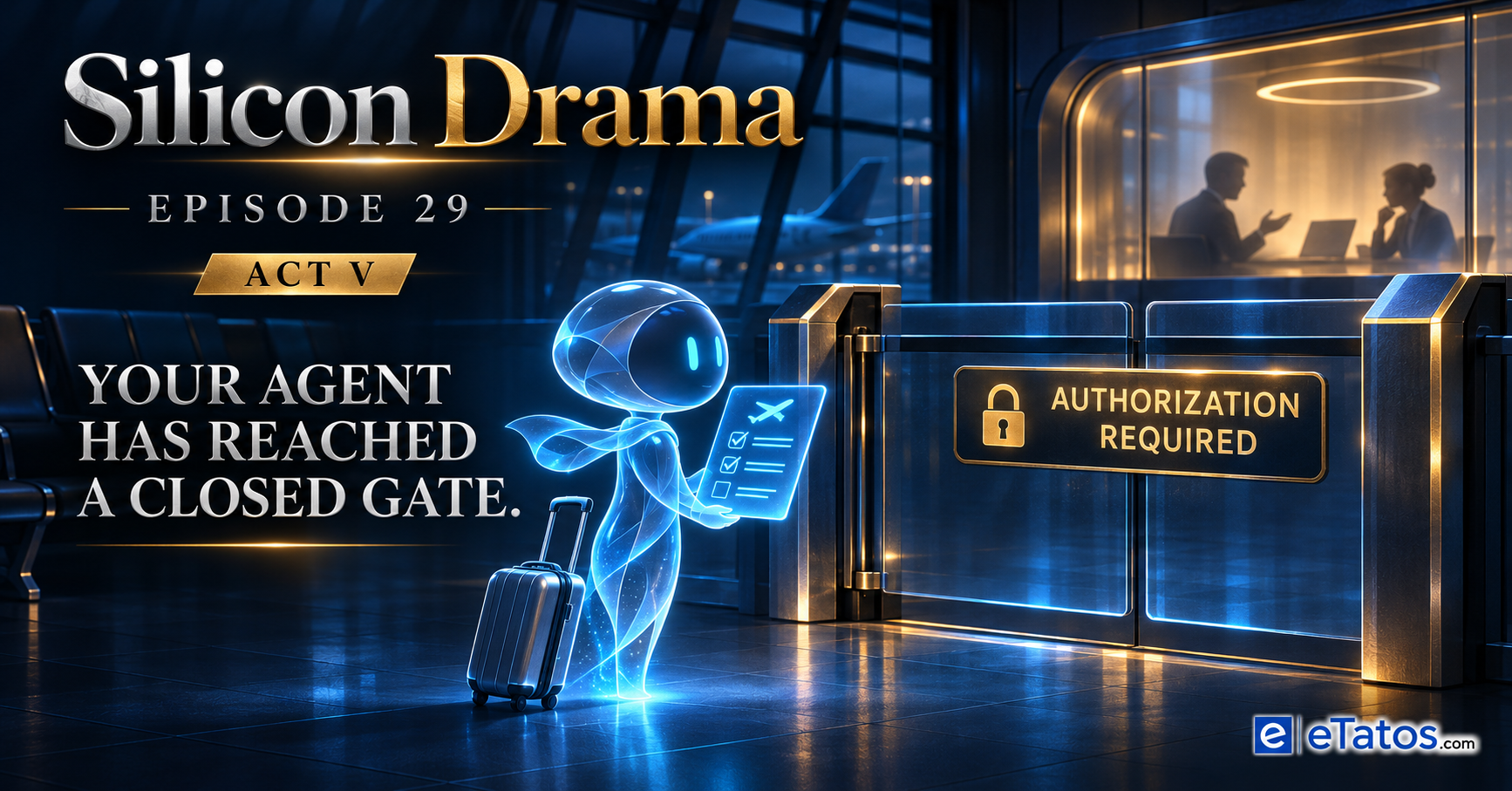
An assistant can understand a travel request perfectly and still be unable to complete it. On November 11, United announced restrictions on unauthorized third-party personal AI agents, both directly on its platforms and indirectly through travel agencies and aggregators.
United cites account security, unintended purchases and regulatory duties. Check-in, for example, includes a human acknowledgment about prohibited items in luggage. Handing an assistant your credentials does not automatically settle who may give that acknowledgment or accept responsibility for an action.
The restriction targets unauthorized personal agents. Its practical force comes from the airline controlling access to bookings, ticketing and distribution. An impressive assistant demo cannot grant that access on United’s behalf.
OpenAI is opening a different entrance. Businesses in ChatGPT launches in beta with business profiles, information feeds and engagement insights. Eligible U.S. ecommerce and online-service businesses can offer Business Agents: Labeled conversations customers choose to enter, separate from ChatGPT’s independent answers.
That can move more of a customer’s research and conversation inside ChatGPT. A business gains another route to customers while the platform gains another reason for those customers to stay. The question for a merchant is how useful the new route becomes, and how much of the relationship it leaves in someone else’s hands.
My preference is for bounded, auditable processes and only the permissions a task needs. Sending messages, making payments, changing contracts or inventory, and binding customer communication should require final human approval and independent identity checks. People and organizations still have to carry the responsibility.
United and OpenAI are making different decisions about access. Together they show why the agent economy will be negotiated service by service. The assistant may know where you want to go. Somebody else still owns the gate.
Signals from the Board
- Runway opens a robot brain. Praxis-1’s weights and code are available under Apache 2.0. Developers can inspect and adapt the video-and-action model instead of relying solely on a hosted service.
- Apollo gets a conditional runway. GXO and Apptronik’s letter of intent contemplates up to 1,000 robots over four years, subject to operational results. Expanded trials begin in 2027.
- Son finances industrial reach. Agile Robots says it closed $500 million at an $8.5 billion valuation. Japan’s SoftBank leads; NVIDIA participates.
- The infrastructure bill stays large. CoreWeave reports $3.661 billion quarterly revenue and a $709 million net loss. It expects about $9 billion in customer advances over three months. Expansion still depends on customers helping fund their supplier.
- Meta wants useful memory. Active Memory and Active Focus are reaching specialized Muse and Meta AI models. I welcome the direction: Keep useful context and remove redundant material, rather than feed the model everything.
- Serve opens an approved route. Its delivery interface and test environment let developers build robot-delivery services. Live fleet access requires approval, with supervision and operating limits. Physical errands arrive with an operator, not just an interface.
Silicon Drama: Power Board

NEW BASELINE. Huang’s departure exposed a crowded scoreboard: Too many 9.9s. Episode 29 recalibrates personal power using five factors. Lower scores reflect the new method, rather than a bad week for everyone.
- Sundar Pichai · 9.7. Google’s models, chips, cloud and distribution reinforce each other. That breadth earns first place, with regulatory and execution constraints still attached.
- Satya Nadella · 9.6. Microsoft turns cloud, workplace software and developer access into durable enterprise influence. Frontier-model partnerships remain an important dependency.
- Mark Zuckerberg · 9.5. Meta’s founder combines direct strategic authority with enormous consumer reach. That durable personal position puts him narrowly ahead of Altman.
- Sam Altman · 9.5. OpenAI commands a major AI interface and strong models. Financing, computing suppliers and governance still constrain his freedom to act.
- Elon Musk · 9.4. Personal autonomy across AI, vehicles, satellites and launch gives him precedence in the three-way tie. Breadth counts alongside the machinery.
- C. C. Wei · 9.4 · NEW. TSMC’s chairman and CEO oversees advanced chipmaking that competing AI empires need. A manufacturing bottleneck with a durable mandate earns sixth place.
- Andy Jassy · 9.4. AWS and Amazon connect computing with commerce at enormous scale. His managerial mandate places him behind Musk’s autonomy and Wei’s fabrication bottleneck.
- Hock Tan · 9.2. Broadcom’s custom accelerators and networking provide another infrastructure route. That leverage narrowly edges AMD within this tie.
- Lisa Su · 9.2 · RE. A sustained AMD turnaround and concrete processor alternatives bring Su back. Google’s host configuration and AMD’s accelerator choices support the case.
- Larry Ellison · 9.1 · NEW. Oracle’s co-founder, executive chairman and chief technology officer retains direct strategic influence. His established infrastructure position edges a more partner-dependent laboratory.
- Dario Amodei · 9.1. Anthropic delivers strong models, but capital, cloud and distribution dependencies limit the personal control behind that technical achievement.
★ Wildcard: Jensen Huang · ↓↓ Historic Fall. E28’s number one at 10.0 now has neither executive nor board authority at NVIDIA. The double arrow is symbolic. This Wildcard has no rank or score.
Movement: Huang’s departure changes the cast; recalibration changes the scale. Ordinary weekly arrows pause for E29. Wei and Ellison join; Su is a return. Kress, Son and Ternus sit outside the eleven. Normal comparisons resume against this baseline.
Follow the power players: Everyone who has earned a Silicon Drama Power Board seat is now collected in our Silicon Drama: Power list on X.
Final Thought
Sam Altman lost his throne in 2023. His employees helped bring him back, a role OpenAI’s returning leadership acknowledged.
Jensen Huang helped build NVIDIA over thirty-three years. Now he has lost the authority to lead it. Will the people who helped build that empire accept his departure, or demand that their king return? I personally hope so!
See you next week, when the next piece of the AI empire moves on the board.
The Silicon Drama continues.
Dirk
AFTER THE CREDITS.
A fictional Silicon Drama scene.
In an imaginary data center, an engineer inspects the emergency plans. Backup power. Spare connections. Replacement processors.
The management dashboard flashes: SINGLE POINT OF FAILURE DETECTED.
“Which machine?” the engineer asks.
The screen displays a leather jacket.
A second message appears: INTERIM REPLACEMENT APPOINTED. CONFIDENCE RESTORE IN PROGRESS.
The engineer adds one item to the maintenance schedule: Stop designing companies around irreplaceable parts.
Continue the story
The next power move belongs in your inbox. Get Silicon Drama with our free eTatos SmartNews.
Explore the Silicon Drama archive or follow the LinkedIn newsletter.
AI has left the screen. In Metal Minds, the robots have developed very human problems.
Prefer listening? Follow Silicon Drama on Spotify.
Change the soundtrack with eTatos Music.
About Silicon Drama: A weekly eTatos Original by Dirk R. Bartz, following AI, robotics and Big Tech through the people, decisions and dependencies that move power.