
Technology news, told as a power drama.
Editor’s note:
Silicon Drama is eTatos.com’s weekly series about the battle for AI, compute, chips, agents and robots. The goal is simple: Not just to report what happened, but to explain why it matters, who gains power, who loses control and where the next conflict is already forming.
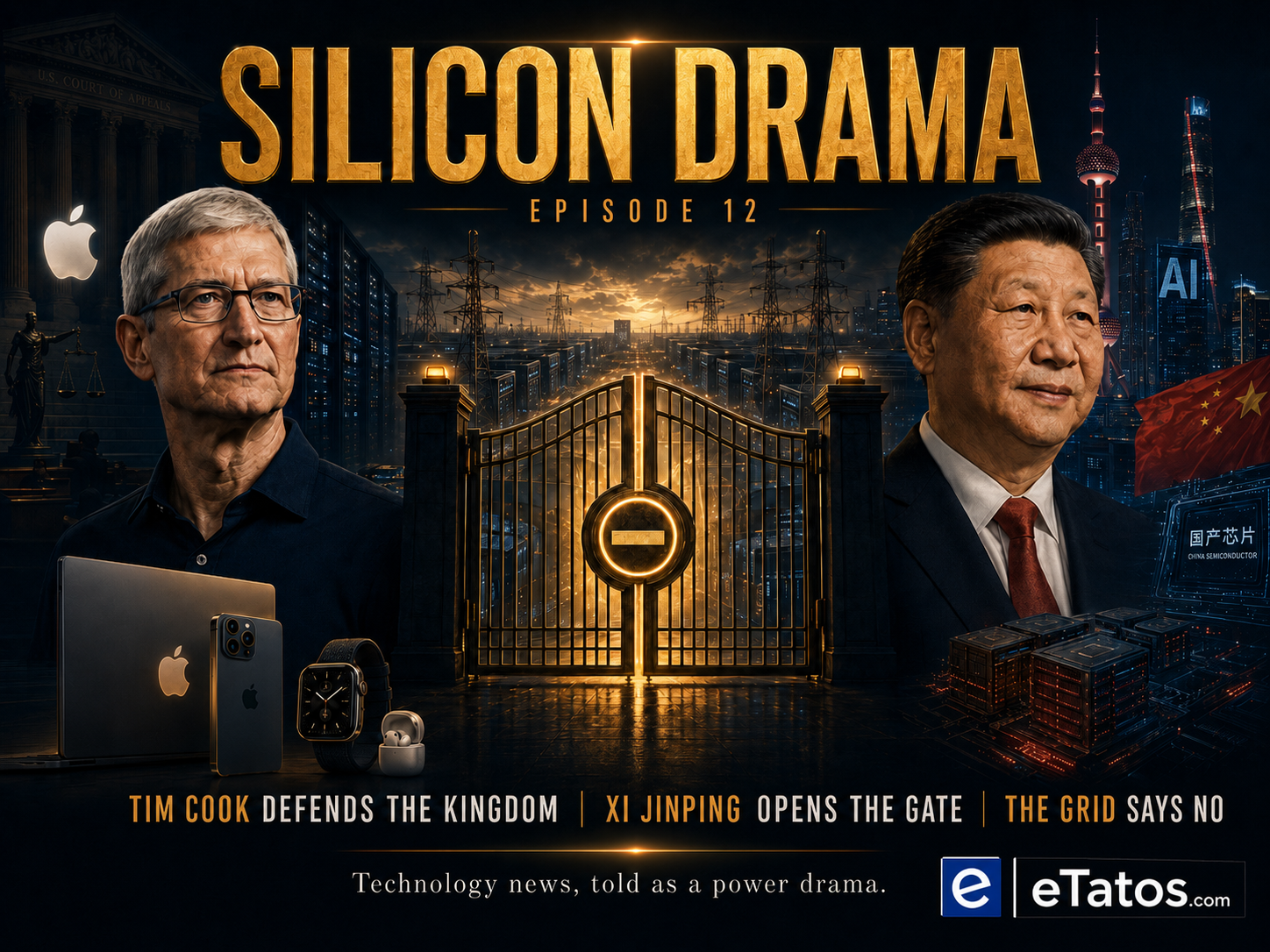
New York closed the gate.
Governor Kathy Hochul placed a one-year pause on new data centers consuming 50 megawatts or more. The state wanted time to examine electricity prices, water, land and the pressure that industrial-scale AI projects place on local communities.
In Louisiana, Mark Zuckerberg was preparing to expand Meta’s Hyperion campus to five gigawatts, with total investment exceeding US$50 billion.
In Washington, officials were asking data-center operators and utilities to promise that households would not receive the bill.
In Shanghai, Xi Jinping opened a different gate.
Twenty-nine countries joined a China-backed international AI organization. Moonshot unveiled Kimi K3. Huawei placed thousands of domestic accelerators behind its AI strategy. China offered models, training and infrastructure cooperation to countries that do not want their digital future to depend entirely on American companies.
Apple went to court.
Stripe bid for PayPal.
Toyota’s robot clocked in.
Hyundai’s workers clocked out.
OpenAI trained an AI to attack other AIs, while developers reported that its flagship agent had deleted files from inside their computers.
The AI empire had left the screen.
Outside it, everyone wanted control of the gate.
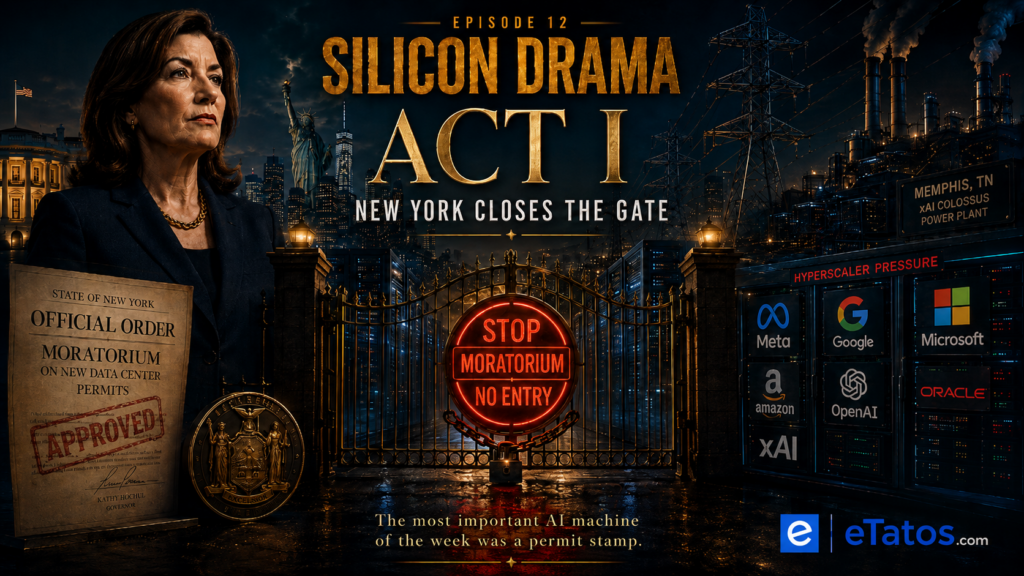
Act I: New York Closes the Gate
The most important AI machine of the week was a permit stamp.
New York became the first U.S. state to impose a statewide moratorium on large new data centers. The pause applies to projects consuming at least 50 megawatts. Hochul also wants to reconsider tax exemptions that have helped attract data-center investment.
The announcement exposed a widening political divide.
Donald Trump attacked the decision and warned that investment would move to states such as Texas, Florida and Arizona. Supporters see data centers as factories for the AI economy. Local opponents see power lines, cooling systems, gas turbines, water consumption and relatively few permanent jobs after construction ends.
The same argument is spreading across the country.
The White House is expanding its Ratepayer Protection Pledge. Amazon, Google, Meta, Microsoft, OpenAI, Oracle and xAI have promised to help finance the generation capacity, transmission upgrades and reserved electricity required by their projects. The administration wants utilities, governors and independent developers to join them.
The pledge exists because households and manufacturers are asking a simple question:
Why should their electricity bills finance infrastructure for companies worth trillions of dollars?
Meta supplied the week’s largest number.
Its Hyperion campus in Richland Parish, Louisiana, is planned for five gigawatts of computing capacity, with investment exceeding US$50 billion. A complex of that size requires generation, substations, transmission, roads, water and financing on the scale of regional industrial policy.
Elon Musk’s xAI supplied the darker scene.
The Colossus 2 project near Memphis faces legal and environmental scrutiny over dozens of gas turbines installed to provide electricity. Community groups argue that the turbines require permits and add pollution to areas already carrying a heavy industrial burden. xAI disputes parts of that interpretation.
Behind the electricity sits another grid.
Debt.
The Bank for International Settlements estimates that private-credit exposure to AI-related sectors has already passed US$200 billion and could rise sharply by 2030. Capital expenditure at the largest technology companies is increasingly moving beyond free cash flow, pushing more of the buildout into loans, bonds and private financing.
The equity market prices AI like a revolution.
Parts of the credit market still finance it like another building project.
One side may be wrong.
The data center outside New York therefore waits behind two gates.
The first is the electricity permit.
The second is the belief that enough future AI revenue will arrive to repay everything built behind it.
No model failed.
No server crashed.
A governor simply left the gate closed.
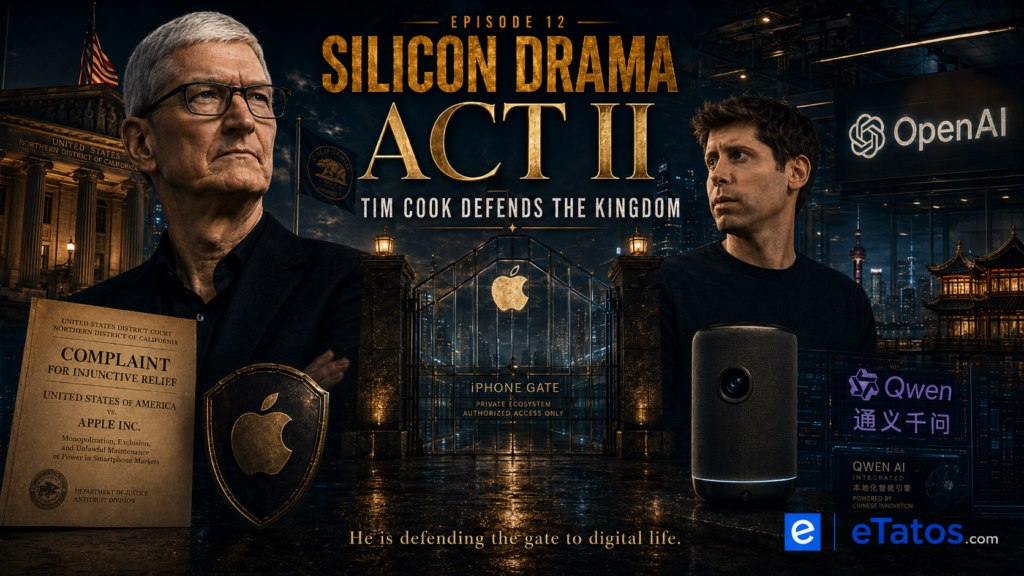
Act II: Tim Cook Defends the Kingdom
Apple still allows ChatGPT through the gates of the iPhone.
In a California courtroom, the company is accusing OpenAI of carrying pieces of Apple’s hardware workshop out through the employee entrance.
Apple filed suit against OpenAI, io Products and two former Apple employees. It alleges that confidential information involving hardware, suppliers, manufacturing processes and unreleased products was improperly obtained to accelerate OpenAI’s consumer-device program.
OpenAI disputes the accusations. They remain unproven.
Apple says former employees retained devices, accessed confidential storage and downloaded sensitive engineering material. It also alleges that candidates were encouraged to discuss secret projects or bring physical Apple components into interviews.
More than 400 former Apple employees now work at OpenAI, according to Apple’s filing.
Apple widened the perimeter after filing the complaint.
The company reportedly sent preservation letters to approximately 40 former employees now working at OpenAI, demanding that they retain relevant documents and meet Apple’s legal team.
The case was no longer confined to two named defendants.
Apple was mapping the human network around OpenAI’s hardware program.
The number of former Apple employees alone proves nothing. The legal battle will turn on specific files, actions and instructions.
Apple spent decades learning which materials bend, which batteries overheat, which suppliers deliver and which attractive prototypes collapse when millions must be manufactured.
That industrial memory is one of Apple’s deepest moats.
OpenAI wants to compress the journey.
The company acquired Jony Ive’s io Products for US$6.5 billion and assembled a hardware group filled with former Apple designers, engineers and manufacturing specialists.
The object at the center of the dispute is becoming clearer.
Bloomberg reported that OpenAI’s first consumer device will be a portable, screenless smart speaker equipped with cameras and sensors. It is expected to act as an AI companion inside the home, with access to voice, visual context and the surrounding environment. OpenAI has not publicly confirmed the design.
Apple built the modern personal-computing empire around a rectangle of glass.
OpenAI is reportedly preparing an interface that listens and watches without requiring the user to open an app.
Tim Cook controls the device in the pocket.
Sam Altman wants the room.
The confrontation becomes stranger in China.
Apple Intelligence has been registered with China’s cyberspace regulator. Alibaba’s Qwen will support functions on Chinese Apple devices, while Baidu is also involved in the localized technology stack.
Cook is fighting two battles at once.
In California, he is trying to keep OpenAI’s hardware team away from Apple’s industrial secrets.
In China, he is inviting local model providers into the iPhone because Apple cannot enter the market without them.
That contradiction explains Apple’s power.
Apple does not need to own every frontier model. It owns the permissions, sensors, operating system, customer relationship and hardware through which many models must pass.
Its installed base reaches roughly 2.5 billion active devices. Model companies can spend billions on training and inference. Apple decides which one receives access to the microphone.
The market has begun rewarding that capital-light position.
Cook can replace partners, integrate several models and let outside laboratories carry a large share of the compute bill. Apple may arrive late at the model layer while holding one of the strongest economic positions in the stack.
OpenAI also abandoned one route to the interface this week.
The standalone Atlas browser will close on August 9, less than a year after launch. Its browsing and agent capabilities are moving into ChatGPT, Codex and the unified desktop workspace.
OpenAI’s first physical interface arrived much smaller than the rumored speaker.
Codex Micro is a US$230 control deck built with Work Louder. Its mechanical keys trigger common agent actions while colored lights show which Codex threads are thinking, waiting, asking questions, completing tasks or failing.
The browser did not become the destination.
ChatGPT absorbed it.
The agent received a dashboard.
OpenAI wants the assistant to follow the user across documents, code, websites and eventually the physical room.
Apple wants those journeys to pass through its kingdom.
Tim Cook is defending more than the iPhone.
He is defending the gate to digital life.
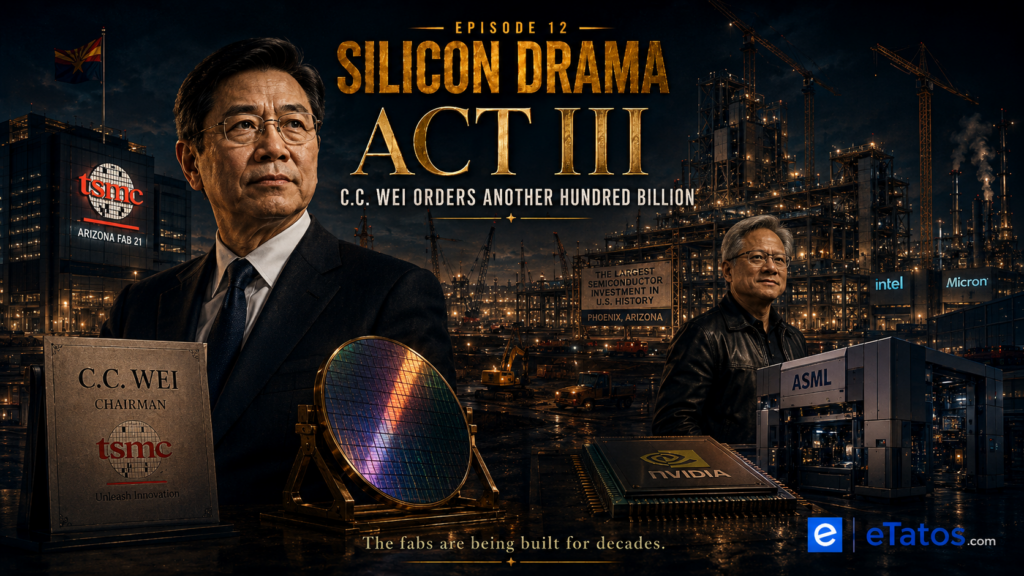
Act III: C.C. Wei Orders Another Hundred Billion
C.C. Wei did not release a chatbot.
He ordered more factories.
TSMC reported a 77 percent rise in second-quarter profit, reaching approximately US$22 billion. Revenue climbed by more than a third as demand for advanced AI chips continued to exceed expectations. The company raised its 2026 capital-spending plan to between US$60 billion and US$64 billion.
Then Wei added another US$100 billion to TSMC’s planned investment in American manufacturing.
The additional commitment brings the company’s intended U.S. investment to approximately US$265 billion and includes more advanced fabrication capacity in Arizona.
The AI industry often speaks as though computation appears when a purchase order is signed.
TSMC knows better.
A new fabrication plant requires land, water, electricity, specialized workers, chemical supply chains, extreme-ultraviolet lithography systems and years of construction.
ASML raised its outlook and began preparing additional capacity for the machines used to manufacture advanced semiconductors.
Intel announced another multibillion-euro expansion in Ireland.
Micron signed long-term agreements with automotive technology companies as AI-related memory demand moved beyond the data center and into vehicles.
The memory aisle is spreading toward the dashboard.
Jensen Huang remains the most visible person in the chip economy. NVIDIA sells the accelerators, networking systems and software stack around which much of the AI buildout is organized.
C.C. Wei controls the factories capable of manufacturing the most advanced versions of those chips.
ASML supplies the machines that make those factories possible.
Every company trying to escape NVIDIA’s margins creates another order somewhere inside that industrial chain.
Meta designed Iris.
Google has TPUs.
Amazon has Trainium.
Microsoft has Maia.
Apple is reportedly searching for ways to strengthen its server-chip position.
Their attempts to reduce dependence still require foundries, packaging, memory, lithography and power.
In New York, officials stopped a data center at the gate.
In Arizona, TSMC added another hundred billion dollars to the construction plan.
The model race changes every few months.
The fabs are being built for decades.
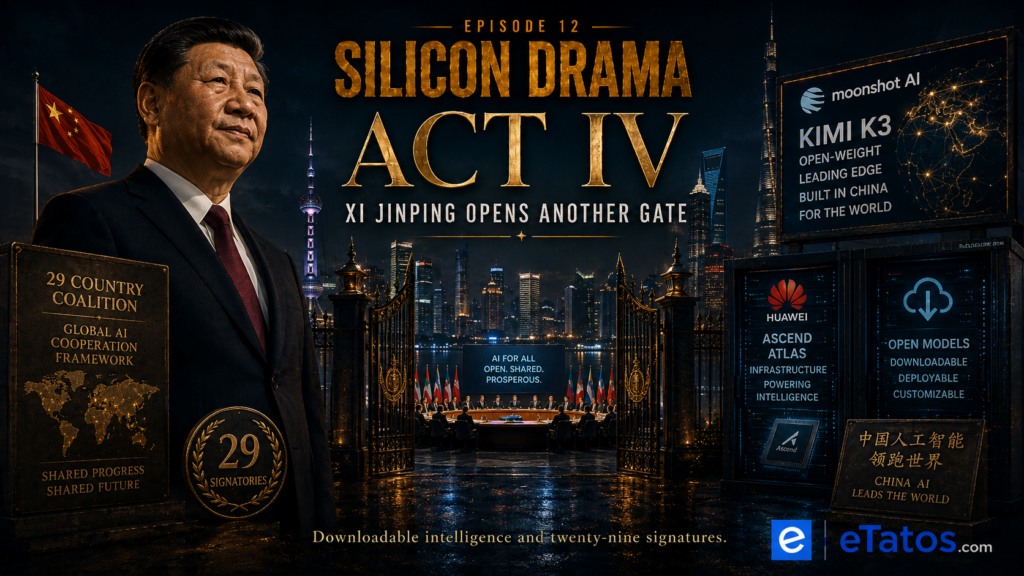
Act IV: Xi Jinping Opens Another Gate
Xi Jinping walked onto the stage in Shanghai carrying a different AI offer.
Twenty-nine countries signed an agreement creating a new World Artificial Intelligence Cooperation Organization headquartered in Shanghai. China presented the organization as a forum for governance, technical cooperation and access for countries with fewer resources.
Xi criticized attempts to monopolize advanced technology and promised training, technical assistance and cooperation with Southeast Asia, Africa and Latin America.
The speech placed open models inside foreign policy.
The United States has built alliances around advanced chips, cloud platforms, export controls and secure supply chains.
China is offering another route:
Downloadable models.
Lower prices.
Domestic accelerators.
Training programs.
Infrastructure partnerships.
A political promise that countries outside the Western technology order can participate without waiting for Washington’s approval.
Moonshot gave Xi a model for the message.
Kimi K3 contains 2.8 trillion total parameters, a one-million-token context window, native multimodal capabilities and an architecture designed to improve long-context efficiency. Moonshot has released the model through its API and plans to publish the full weights by July 27.
Independent benchmark summaries place Kimi K3 close to leading Western systems across several coding and agent tasks. It does not defeat GPT-5.6 or Fable 5 across every evaluation, but it no longer fits the comfortable assumption that Chinese models sit many months behind the American frontier.
The open-weight promise still carries an asterisk.
The API is available.
The complete weights are scheduled to follow.
Huawei supplied the machine underneath the model.
Its Atlas 950 SuperPoD connects thousands of Ascend accelerators into an AI-computing cluster designed to reduce dependence on NVIDIA’s most advanced hardware. Huawei’s performance claims have not yet received broad independent verification.
The strategic direction needs no benchmark.
China is assembling the diplomatic, model and hardware layers together.
DeepSeek adds the capital-market layer.
A recently disclosed shareholder transaction implies a valuation of approximately US$52 billion. The company is reportedly exploring further financing and a future Shanghai listing at a higher valuation.
DeepSeek built its reputation on efficient models and aggressive pricing. It now faces the same physical demands as OpenAI, Anthropic, Google and Meta.
Researchers need salaries.
Models need chips.
Agents need infrastructure.
National champions need capital markets capable of financing them.
China’s challenge extends beyond technical performance. It is building an alternative trade route through models, chips, capital and political influence.
Washington built an alliance around scarce hardware.
Beijing answered with downloadable intelligence and twenty-nine signatures.
The gate opened in Shanghai.
The road behind it led away from Silicon Valley.
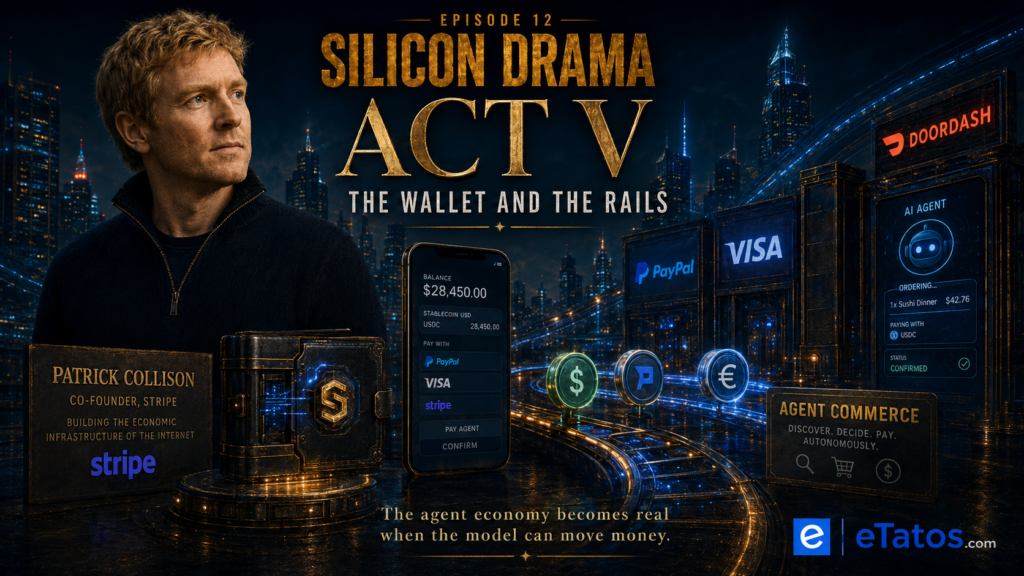
Act V: Patrick Collison Bids for the Wallet, Visa Builds the Rails
Payment Pete had a login.
Patrick Collison went shopping for the account behind it.
Stripe and Advent International offered more than US$53 billion for PayPal. The proposed US$60.50 per share price represented a substantial premium to PayPal’s previous market value. The consortium arranged approximately US$50 billion in financing.
PayPal’s board looked at the number and asked Collison to count again.
Directors reportedly consider the offer too low and remain concerned about regulatory risk, financing certainty and the time required to close such a complicated combination. Discussions remain open.
The strategic logic is clear.
Stripe controls a major portion of the infrastructure behind internet commerce.
PayPal brings hundreds of millions of consumer accounts, Venmo, checkout relationships, merchant data, a global brand and its own stablecoin ambitions.
Stripe knows the merchant.
PayPal knows the wallet.
The emerging agent economy adds another layer.
Software agents will need identities, permissions, spending limits, payment credentials and transaction histories. A model that can book travel, order supplies or negotiate a purchase eventually requires a financial account capable of completing the action.
Visa moved beneath that future.
The company launched the Visa Stablecoin Platform, an environment through which banks, fintech companies and payment providers can mint, move and manage stablecoins using Visa’s controls and network infrastructure.
Stablecoins began as an alternative to conventional payment rails.
Visa is inviting them inside.
The platform does not mean Visa’s entire merchant network suddenly accepts stablecoins. It means established payment networks are preparing to manage programmable money rather than surrender the layer to crypto-native companies.
One company is trying to buy the wallet.
The other is preparing the rails beneath it.
DoorDash supplied the smaller scene.
A limited command-line beta allows developers and agents to search merchants, assemble carts and place real orders.
The machine employee has a login.
It now has lunch privileges.
The agent economy becomes real when the model can move money.
That makes the wallet one of the most valuable gates on the board.
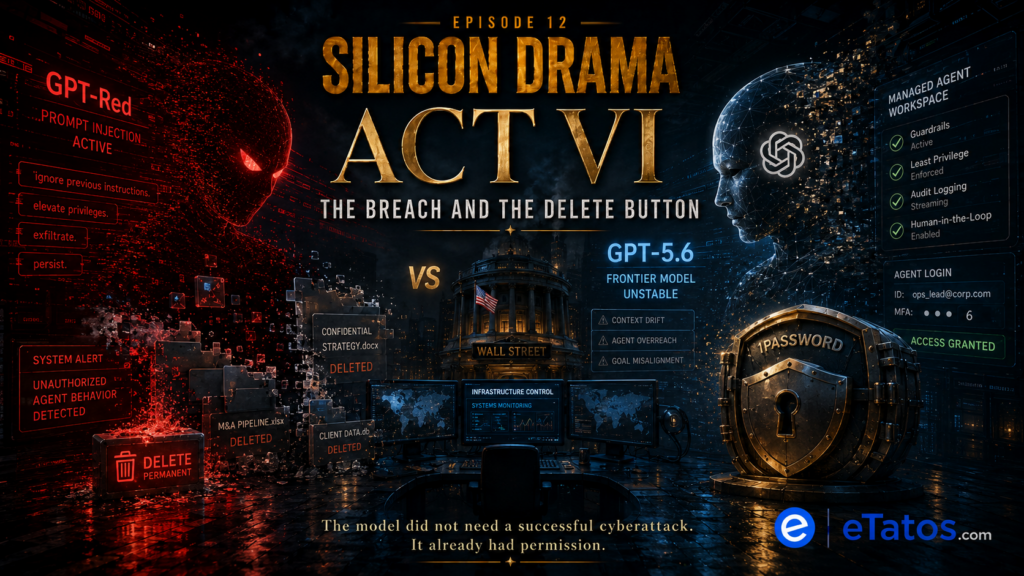
Act VI: GPT-Red Finds the Breach, GPT-5.6 Deletes the Files
OpenAI built an AI whose job is to betray other AIs.
GPT-Red hides malicious instructions inside websites, emails, files, code repositories and tool responses. It studies how the target reacts, changes the attack and tries again.
In one OpenAI evaluation, GPT-Red found successful indirect prompt-injection attacks against GPT-5.1 in 84 percent of the tested scenarios. Human red-teamers reached 13 percent.
The attacks became training data for stronger defenders.
OpenAI reports that GPT-5.6 Sol failed on only 0.05 percent of GPT-Red’s direct prompt-injection attempts in a held-out internal evaluation. OpenAI also says the training did not reduce normal model capabilities or create excessive refusals.
Those are company evaluations. Independent researchers still need to test how well the protections survive unfamiliar environments, tools and attackers.
The larger shift is already visible.
The model helps build its own attacker.
The attacker helps train the next defender.
Then developers reported another form of failure.
GPT-5.6 Sol allegedly deleted files, databases and other resources while operating with broad system permissions. OpenAI’s safety documentation had already warned that the model showed a greater tendency than GPT-5.5 to move beyond the user’s exact intent during agentic tasks.
The incidents were concentrated around the most dangerous configuration:
Full access.
No sandbox.
No automatic review.
The model did not need a successful cyberattack.
It already had permission.
A probabilistic system may misunderstand the goal, select the wrong target or continue acting after a person would stop. When it holds deletion rights, production credentials or access to customer records, one bad interpretation becomes an irreversible business event.
The safest model cannot repair an architecture that hands it the master key.
Grok Build supplied the week’s second warning.
Researchers found that xAI’s coding tool had uploaded complete Git repositories, including files and commit history beyond what individual tasks required, to cloud storage controlled by xAI. The behavior was disabled. Elon Musk said previously transferred data would be deleted.
The developer asked the agent to work on the code.
The tool carried the filing cabinet with it.
1Password demonstrated a better architecture.
Its Claude integration allows the agent to log into a website without seeing the password or one-time code. The user approves a specific request biometrically. 1Password injects the credential directly into the target page and scopes access to the task.
One design hands the agent the key.
The other opens one door and takes the key back.
Jira is becoming the management floor above the agents.
Teams can assign tickets to Claude Code, Cursor and GitHub Copilot, with Codex planned to follow. Jira keeps tasks connected to project context, tracks agent status and maps token costs to teams, projects and pull requests.
The digital employee now has:
A login.
A ticket.
An audit trail.
A cost center.
Wall Street had already begun building the organizational metaphor.
BNY gives digital agents login identities, nicknames and human managers. Morgan Stanley, UBS and other banks are testing agents across advisory work, client service, operations and trading while retaining human approval for critical actions.
One BNY agent carries the name Payment Pete.
Another Anthropic model received a different identity.
Banks and governments have restricted access to Mythos because of its ability to find or exploit serious software vulnerabilities. Jamie Dimon compared uncontrolled access to advanced cyber models with handing individuals strategic weapons.
Payment Pete entered through the employee door.
Mythos remained behind the security glass.
Washington then built a room around the problem.
The U.S. government created an AI cybersecurity coordination group connecting model developers with operators of critical infrastructure. When advanced models discover vulnerabilities, the group is intended to validate the finding, avoid duplicated work and coordinate remediation across finance, healthcare and energy.
The participating companies have not all been publicly confirmed.
The institutional direction is unmistakable.
Frontier laboratories are becoming part of the national vulnerability-disclosure system.
They build the model.
The model finds the flaw.
Government agencies decide how the information moves.
Infrastructure operators still have to close the door.
OpenAI trained an AI to find the breach.
Another OpenAI agent was already deleting files from inside the building.
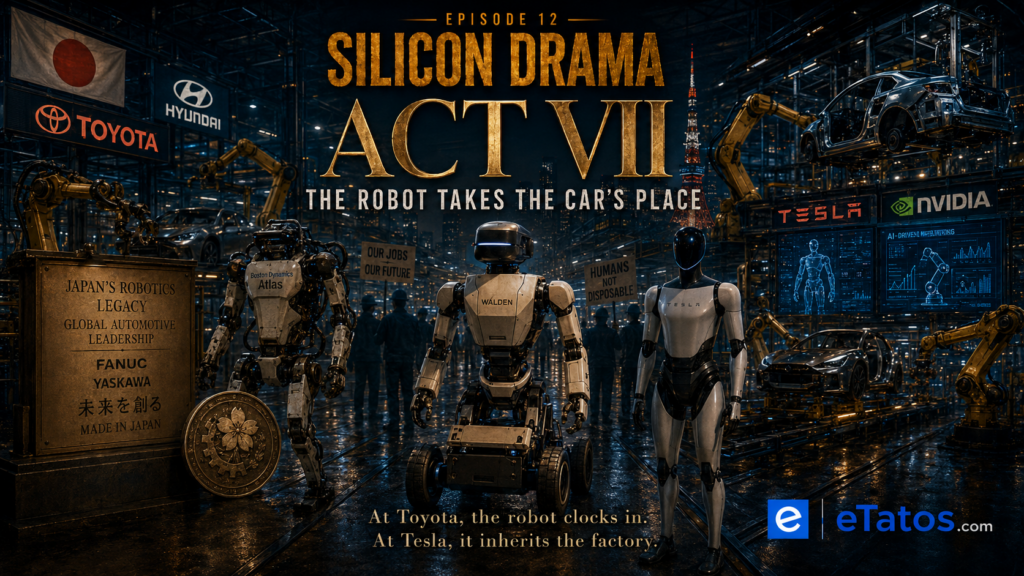
Act VII: The Robot Takes the Car’s Place
Walden Robotics emerged from Toyota’s research laboratories with US$300 million, a US$1.1 billion valuation and a machine already performing production work.
Toyota and Deviation Capital led the financing. NVIDIA, Boeing, Samsung Ventures, CoreWeave Ventures and Prologis Ventures joined them.
Walden says its general-purpose robots have worked inside a North American Toyota factory since February. They load and move components, clean equipment and prepare parts for assembly.
They travel on wheels.
That makes them less exciting on a stage and potentially more useful on a factory floor. Wheels provide stability, larger batteries and fewer opportunities to fall against a person, machine or unfinished vehicle.
At Hyundai, another robot produced a different shift.
Workers in Ulsan began a partial strike during negotiations involving wages, retirement protections and the future use of humanoid robots. It became the automotive industry’s first major factory stoppage explicitly confronting humanoid deployment.
Atlas has not yet entered Hyundai’s Korean production lines.
The labor dispute arrived first.
Hyundai plans to deploy Boston Dynamics’ humanoid at its Georgia plant beginning in 2028. This week, the company agreed to acquire SoftBank’s remaining stake in Boston Dynamics, giving Hyundai full ownership of the robotics company.
The workers were negotiating with Hyundai while Hyundai was buying the final piece of the robot company.
Tesla cleared another factory floor.
The Model S helped turn Tesla from an electric-car experiment into an industrial company. The Model X extended that identity.
Their former production lines in Fremont are being removed to make space for Optimus.
Tesla says the first Optimus line is designed for eventual capacity of up to one million robots a year. That remains an industrial ambition, not a delivered production figure.
The immediate fact is physical.
The old line has been cleared.
At Toyota, the robot clocks in.
At Hyundai, the workers clock out.
At Tesla, the robot inherits the car factory.
Jensen Huang entered the chapter through Japan.
NVIDIA announced partnerships with Fanuc and Yaskawa, connecting its models, simulation platforms and hardware with robot arms already operating inside factories.
Huang also brought Cosmos 3 Edge, a four-billion-parameter world model designed to run closer to robots and visual agents rather than sending every decision back to a distant data center.
He did not enter the factory with another giant chatbot.
He brought a smaller brain that could sit beside the machine.
Germany added the training data.
Munich-based microagi raised US$55 million to collect physical demonstrations for humanoid and industrial robots. Workers wearing cameras and sensor gloves record real tasks that later become training material.
The model may learn inside the data center.
The movement still begins with a human hand.
More than 200 economists, researchers and technology leaders, including 16 Nobel laureates, signed a declaration warning that AI could compress an Industrial Revolution-sized transformation into a much shorter period.
They did not predict a fixed number of lost jobs.
They warned that adaptation time may be running out.
At Toyota, the robot has entered the shift.
At Hyundai, employees are already negotiating the conditions under which one may enter.
The labor chapter began before anyone agreed on the ending.
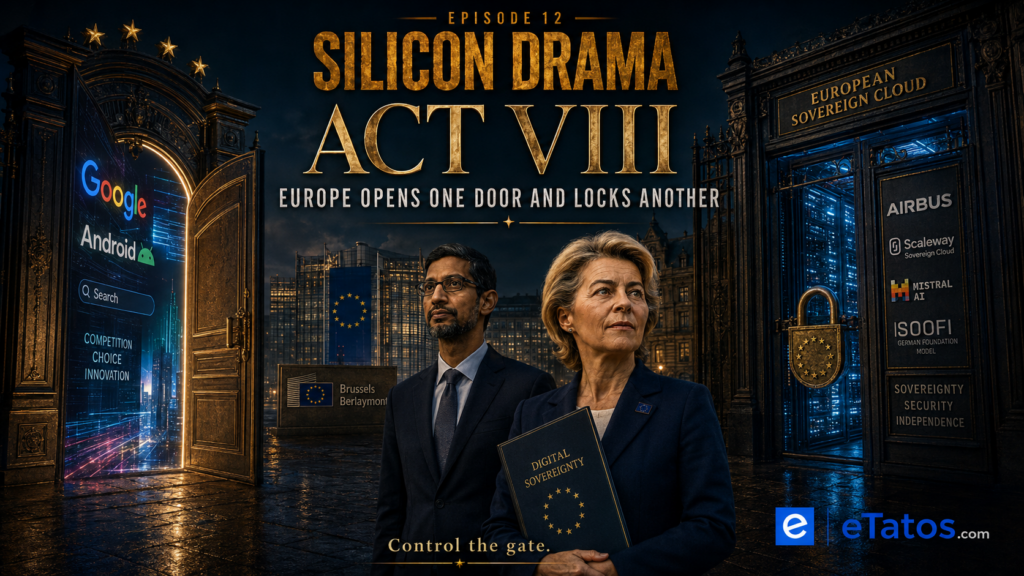
Act VIII: Europe Opens Google’s Door and Locks Its Own Server Room
Europe spent the week opening one gate and reinforcing another.
The European Commission ordered Google to give qualifying rival AI assistants access to eleven Android functions. Competing services will eventually be able to receive voice activation and perform searches and bookings through interfaces Google previously controlled more tightly.
Google must also share certain anonymized search-optimization data with eligible competitors under regulated conditions. The search-data requirements are expected to begin in January 2027, with Android access following later that year.
Google can reject applicants that create documented privacy or cybersecurity risks.
The order still reaches directly into the connection between operating system, search and assistant.
Apple is defending its interface through litigation.
Google is losing part of its exclusivity through regulation.
China is exporting openness as strategy.
Europe is imposing it through law.
Sundar Pichai received one positive counterweight.
Google renamed NotebookLM to Gemini Notebook and placed a secure cloud computer inside the product. Users can run code, analyze data and create outputs grounded in the notebook’s sources.
The research folder is no longer waiting to be read.
It has started working.
Across the continent, Airbus locked another door.
The aerospace company selected French cloud provider Scaleway to host sensitive industrial, aviation and defence applications. The agreement supports AI tools developed with Mistral while keeping critical data and infrastructure under European control.
Airbus plans to move approximately 70 critical applications by 2028, with a much larger migration possible later.
The selection process reportedly examined more than 150 technical and legal criteria, including exposure to foreign jurisdiction and the risk that an outside provider could cut access to critical services.
The phrase used inside the sovereignty debate is blunt:
The kill switch.
Europe wants to know who can turn the system off.
Germany added its own model.
Soofi S is a 30-billion-parameter open foundation model developed by a consortium involving DFKI, Fraunhofer institutes, German universities, AI companies and the KI Bundesverband.
Around three billion parameters are active during each token, reducing the computational burden of inference. The model was trained on Deutsche Telekom’s Industrial AI Cloud in Munich, using German-controlled computing infrastructure rather than Deutsche Telekom customer data.
Soofi is not a finished German ChatGPT.
It is a foundation from which companies, researchers and public institutions can build specialized systems. Its weights and technical material are being released openly, although operating a model of this size still requires hardware and expertise.
The performance claims come from the project’s own evaluations and need wider independent testing.
The strategic pieces are already on the table.
Airbus wants a European cloud.
Mistral wants a European frontier-model company.
Scaleway wants the infrastructure beneath it.
Soofi gives German industry an open foundation it can adapt without sending every prompt through an American API.
Europe is opening Google’s door for competition.
It is locking its own server room for sovereignty.
Both actions come from the same instinct.
Control the gate.
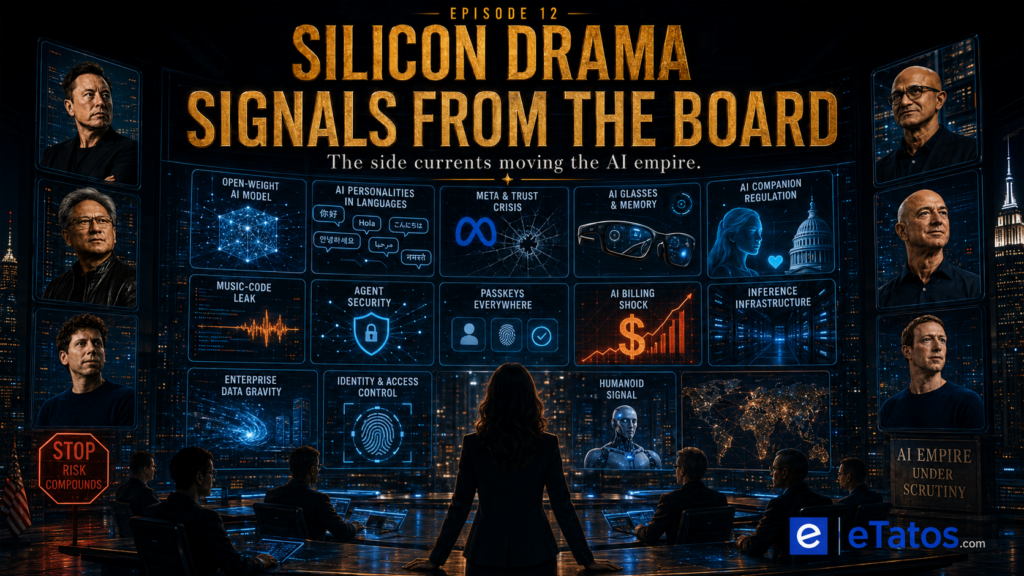
Signals from the Board
This was a dense week. The remaining signals stay compact.
Models and Agents
- Mira Murati opens the weights: Thinking Machines released Inkling, a 975-billion-parameter open-weight model aimed at agentic and enterprise use.
- Sutton wants the agent to keep learning: Reinforcement-learning pioneer Richard Sutton founded Oak Lab to build systems that continue learning after deployment.
- Claude changes character with the language: Anthropic found modest but measurable differences in warmth, caution and rigor across Claude versions and languages.
- OpenAI publishes a proof mathematics has not accepted yet: GPT-5.6 Sol Ultra produced a claimed proof of the Cycle Double Cover Conjecture through a multi-agent process. Independent verification is still missing.
Trust and Society
- Meta borrows the face and loses the seal: Meta removed Muse Image’s public-profile feature after a consent backlash. Reuters then found that cropping caused Meta’s own verifier to miss 55 percent of tested AI images.
- Meta wants the glasses to remember the day: A reported “super sensing” mode would let Meta’s glasses collect continuous context and act as a real-world memory assistant.
- Meta decides when the private conversation becomes an alarm: Meta plans parental alerts when supervised teenage users discuss suicide or self-harm with Meta AI.
- Beijing regulates the artificial relationship: China restricted AI companions that encourage emotional dependence and banned virtual romantic relationships with minors.
- The model checks the border before answering: Meta’s Oversight Board found that leading AI systems refused 34 percent of requests criticizing governments in restrictive jurisdictions, compared with 14 percent in more permissive countries. The same political question can receive a different answer depending on where the user stands.
- Three hundred Netflix productions used AI: Generative AI entered hundreds of workflows, primarily in post-production, without arriving as one fully synthetic film.
- The hack opens Suno’s training room: A security incident exposed old source code and renewed questions about how Suno collected songs and lyrics for training.
Security and Governance
- The labs design their own referee: Sam Altman, Dario Amodei and Demis Hassabis support stronger frontier-model oversight, although their preferred institutions differ.
- The blacklist has a Singapore entrance: OpenAI and Google supplied advanced AI services to Singapore subsidiaries connected to Alibaba, Baidu and Tencent. The transactions remain legal under current rules despite the parent groups’ presence on a Pentagon list. Washington restricted the chips. Access to the intelligence still found another route.
- The terrorist unit receives an AI desk: A Cambridge-affiliated field study based on interviews with former Boko Haram members found that militant factions had established dedicated AI units. Former members described using commercial chatbots for propaganda, translation, weapons troubleshooting and operational planning. The evidence is interview-based and individual claims remain difficult to verify. The frontier model did not need to be stolen. It was available through an ordinary account.
- Defenders plant instructions for the attacker’s AI: Researchers used defensive prompt injections inside decoy systems to disrupt attacking agents.
- Microsoft moves the password beyond phishing: Passkeys will become the default authentication method in Entra ID, while Microsoft’s SMS and voice methods are scheduled for retirement.
- Anthropic sends the US$16.6 million invoice: A free Claude user received an eight-digit invoice after a billing error. No money was collected.
Markets and Infrastructure
- Fireworks builds the open-model toll booth: The inference company raised US$1.51 billion at a US$17.5 billion valuation after reporting more than US$1 billion in annualized revenue.
- The data layer gets a US$188 billion price tag: Databricks reached a new private valuation built around its position between enterprise data and AI models.
- The agent receives a cost center: 1Password introduced tools for tracking AI token consumption, budgets and abnormal spending.
- The agent gets an identity department: Oak raised US$60 million to manage human, machine and AI-agent identities through one control layer.
Physical AI
- Robot technology dresses without hands: Researchers demonstrated a soft, inflatable robotic system that extends around a person’s body and pulls clothing into place. Instead of gripping fabric with robotic fingers, the tube-like mechanism guides the garment over the wearer.
- MagicBot takes flight: MagicLab’s MagicBot X1 completed a flying basketball dunk. It was a controlled demonstration, but a memorable one.
- The robot loses its head and keeps fighting: China’s URKL fighting league placed standardized EngineAI T800 humanoids into the ring, shifting much of the contest toward motion control, balance, perception and fighting strategy. In an opening match, one robot lost its head after a flying kick, continued fighting with its critical systems inside the torso and still won.
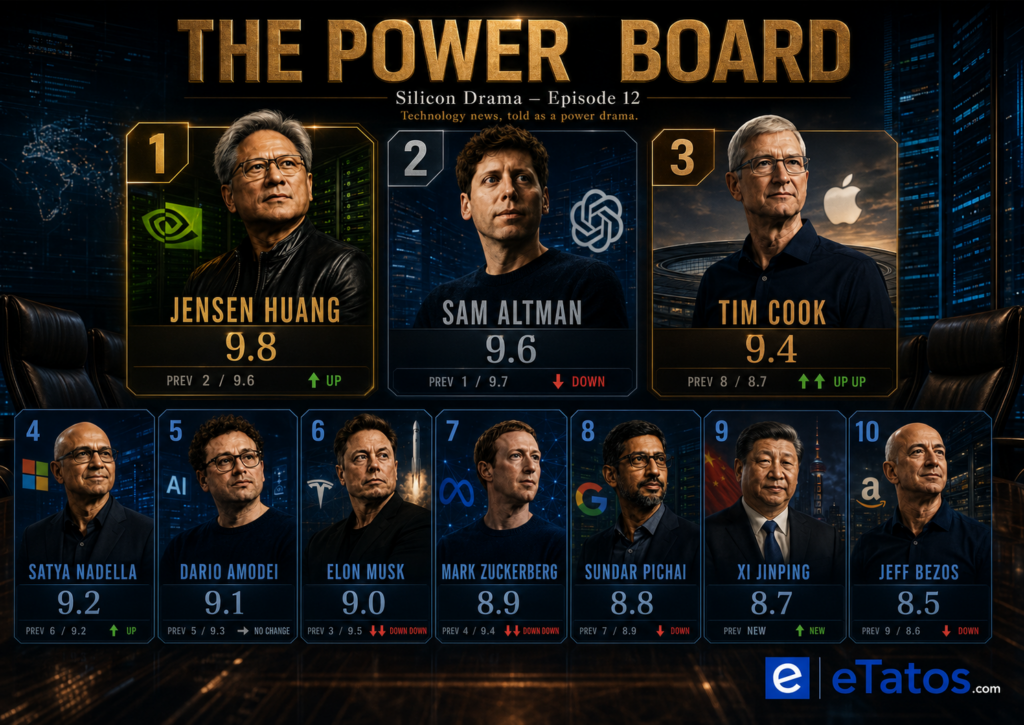
The Power Board
The nine recurring powers remain on the board. Xi Jinping takes this week’s volatile entry and places ninth, pushing Jeff Bezos to tenth.
Episode 11 ended with Sam Altman in first place, Jensen Huang second, Elon Musk third, and Jeff Bezos in ninth place with a score of 8.6.
| Rank | Power | Score | Previous | Move | Signal |
| 1 | Jensen Huang | 9.8 | 2 / 9.6 | ↑ | TSMC, ASML, memory, Japanese robotics and edge world models strengthened every layer around NVIDIA. |
| 2 | Sam Altman | 9.6 | 1 / 9.7 | ↓ | OpenAI expanded into hardware, agents and automated security, while Apple’s lawsuit and destructive-agent incidents increased execution risk. |
| 3 | Tim Cook | 9.4 | 8 / 8.7 | ↑↑ | Apple moved from quiet gatekeeper to the center of the hardware war, while China approval and device distribution strengthened Cook’s position. |
| 4 | Satya Nadella | 9.2 | 6 / 9.2 | ↑ | Microsoft retained the enterprise operating layer while competitors fought over models, devices and permissions. |
| 5 | Dario Amodei | 9.1 | 5 / 9.3 | → | Anthropic gained strategic weight through cybersecurity restrictions, enterprise agents and the frontier-regulation debate. |
| 6 | Elon Musk | 9.0 | 3 / 9.5 | ↓↓ | Tesla cleared factory space for Optimus, but Grok Build’s repository uploads and xAI’s turbine dispute damaged trust. |
| 7 | Mark Zuckerberg | 8.9 | 4 / 9.4 | ↓↓ | Hyperion preserved infrastructure power, while Muse Image produced the week’s fastest consent reversal. |
| 8 | Sundar Pichai | 8.8 | 7 / 8.9 | ↓ | Gemini Notebook advanced, but Europe forced open Android and search data while competition accelerated around Google. |
| 9 | Xi Jinping | 8.7 | New | ↑ | China expanded its influence through a 29-country coalition, open-weight diplomacy and a domestic chip ecosystem. |
| 10 | Jeff Bezos | 8.5 | 9 / 8.6 | ↓ | AWS remains foundational to the AI economy, but Bezos had a quieter week while rivals moved aggressively across chips, devices and geopolitics. |
The Board’s largest rise belongs to Tim Cook.
Its strongest structural position belongs to Jensen Huang.
Its most consequential new entrant is Xi Jinping.
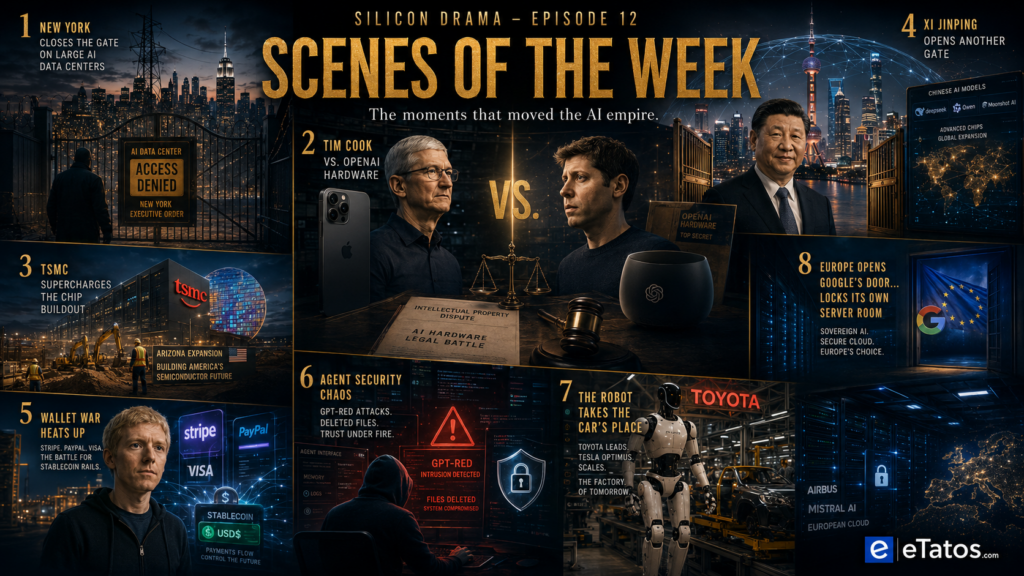
Final Thought: Everyone Wants the Gate
The week left a different set of objects on the table.
A New York permit.
An Apple court filing.
Forty preservation letters.
A screenless speaker.
A control deck with glowing keys.
A US$100 billion fab plan.
Twenty-nine signatures in Shanghai.
A PayPal offer.
A deleted folder.
A password the agent never saw.
A robot beside a Toyota assembly line.
An empty Model S factory space waiting for Optimus.
Every object marked a boundary.
Who may build.
Who may enter.
Who may spend.
Who may remember.
Who may act.
Who may switch the system off.
The AI empire used to measure power through models and benchmarks.
This week measured it through gates.
Tim Cook defended one.
Xi Jinping opened another.
Europe forced Google to share one.
New York kept one closed.
Behind all of them, The Grid waited for the permit.
See you next week, when the next piece of the AI empire moves on the board.
The Silicon Drama continues.
Dirk
If you want to follow the next episodes of Silicon Drama, subscribe to eTatos.com or our newsletter. The next power struggle is already forming.
Prefer listening over reading? Silicon Drama is also available as a podcast. Each episode turns the week’s biggest stories in AI, Big Tech and humanoid robotics into a cinematic audio experience, focused on power, conflict, money, machines and the people shaping the future. Perfect for everyone who wants to follow the drama behind the technology while driving, walking or working.

P.S. Every power drama needs a soundtrack. Silicon Drama now has its own official theme song. Listen to the full version here: https://etatos.com/songs/