
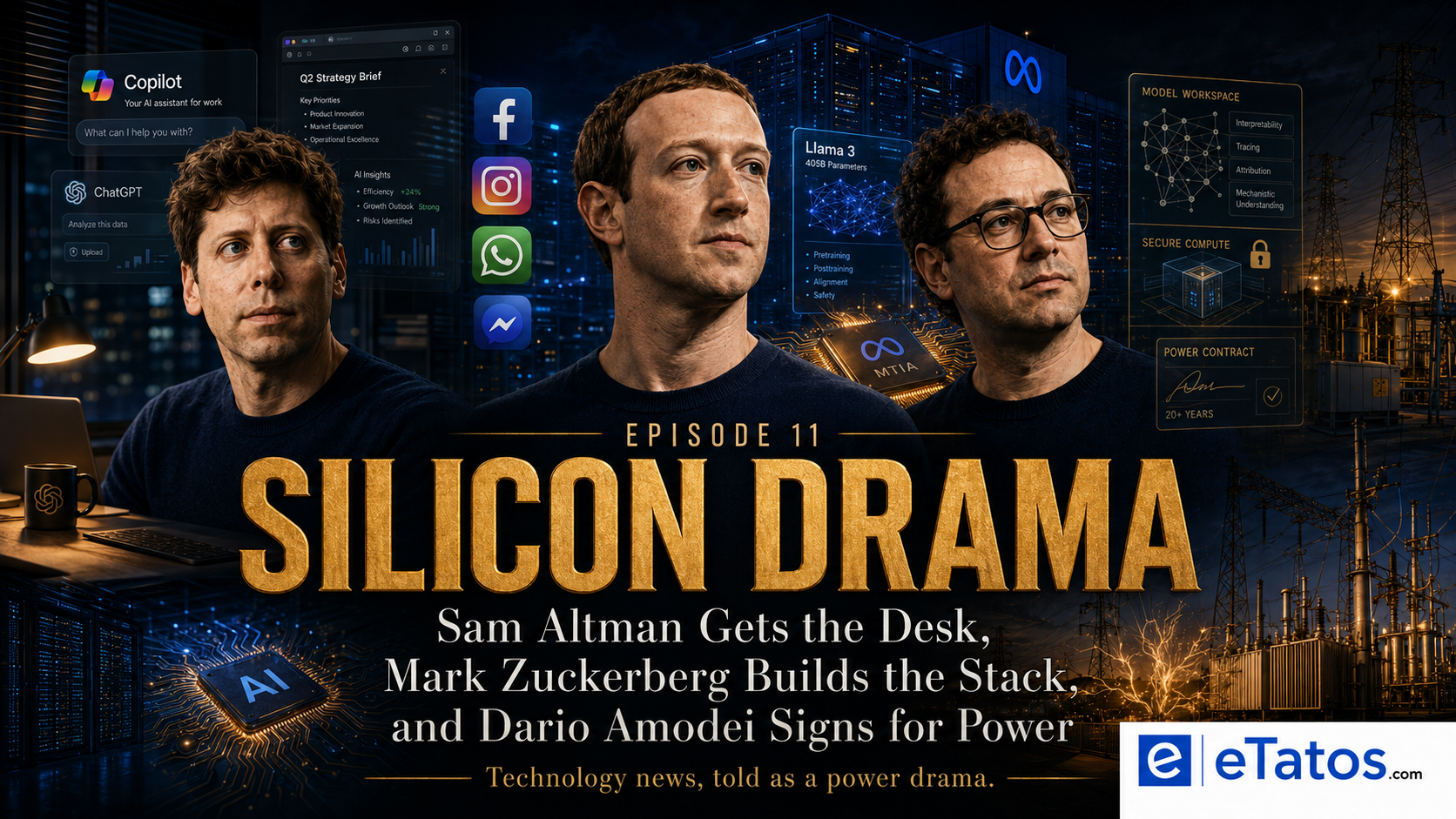
Technology news, told as a power drama.
Editor’s note:
Silicon Drama is eTatos.com’s weekly series about the battle for AI, compute, chips, agents and robots. The goal is simple: Not just to report what happened, but to explain why it matters, who gains power, who loses control and where the next conflict is already forming.
The model got a desk.
On Thursday, Sam Altman released GPT-5.6 into a world that had spent almost two weeks under Washington’s scrutiny, watching Anthropic and asking whether the next frontier model still belonged entirely to the company that built it.
Then OpenAI moved fast.
GPT-5.6 entered ChatGPT. It became the preferred model inside Microsoft 365 Copilot. It arrived in Word, Excel, PowerPoint, Copilot Chat and Microsoft 365 Copilot Cowork. ChatGPT Work placed the same intelligence between documents, connected apps, browsers, spreadsheets and long-running tasks. GPT-Live gave it a more natural voice.
The model had crossed from the laboratory into the office.
Across the board, the same pattern appeared. Elon Musk brought Grok 4.5 into Cursor and the coding workflow. Mark Zuckerberg launched a developer API, prepared his own AI chip and broke ground on a gigawatt-scale data center. Dario Amodei secured 20 years of compute while Anthropic opened a window into Claude’s internal workspace.
The week began with models.
It ended with desks, chips, power contracts, robot hands and transformers.
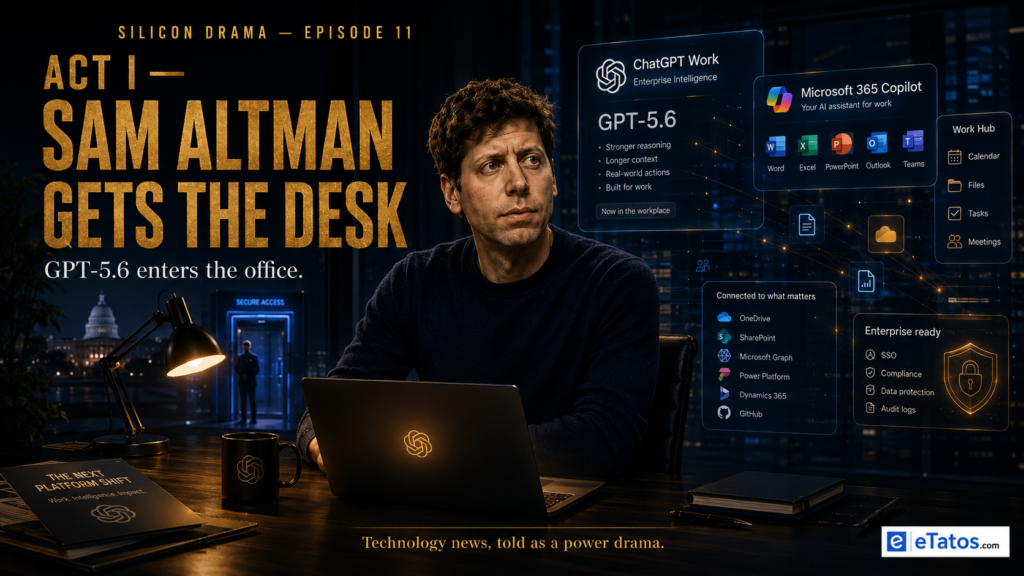
Act I: Sam Altman Gets the Desk
GPT-5.6 arrived in three sizes: Sol at the top, Terra in the middle and Luna as the faster, cheaper option. OpenAI positioned the family around professional work, coding, browsing, tool use and computer control. Sol can pull scattered context from Slack, Notion, Microsoft 365 and Google Drive, then turn it into presentations, documents, spreadsheets, applications and other editable work products.
The release carried an unusual political shadow.
In June, the White House had asked OpenAI to limit the initial rollout while the government evaluated security concerns around increasingly capable models. The broad release followed additional testing and discussions. The White House later clarified that OpenAI required no formal government permission to launch the model.
No license was issued. The pressure still shaped the rollout.
Frontier AI had passed through Washington’s security apparatus before reaching the public. The exchange established a precedent that future model releases may have to negotiate national-security concerns alongside benchmarks, safety cards and product schedules.
Altman then placed GPT-5.6 inside ChatGPT Work, an agent designed to remain with a project for hours, gather context across applications and files, and turn broad goals into completed work. The new desktop experience brings Chat, Work and Codex together around a shared working environment.
At almost the same moment, OpenAI announced that GPT-5.6 would become the preferred model in Microsoft 365 Copilot. Word gets better drafting. Excel gets deeper analysis. PowerPoint gets more polished presentations. Cowork gets a stronger engine for multi-step projects.
GPT-Live completed the interface move. Its full-duplex architecture allows the assistant to listen while speaking, handle interruptions and maintain a conversation with fewer mechanical pauses. OpenAI is building an agent that can read the document, operate the computer and speak across the room.
That was the interface scene of the week.
A frontier model arrived after a government-requested limited preview, opened the office door and sat down between Word and Excel.
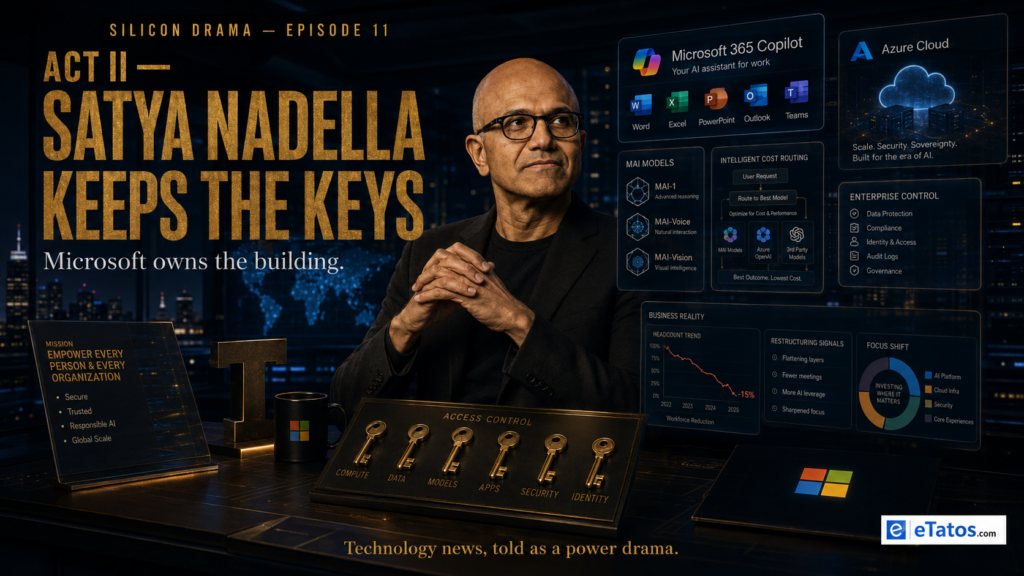
Act II: Satya Nadella Keeps the Keys
Sam Altman may have received the desk. Satya Nadella still owns the building.
Microsoft controls the operating system, the productivity suite, the enterprise contracts, the cloud and the distribution channel through which GPT-5.6 will reach many companies. OpenAI supplies the flagship intelligence. Microsoft decides where it appears, which customer receives it and what happens around it.
Nadella is also building alternatives.
In June, Microsoft introduced seven internally developed MAI models covering reasoning, coding, images, voice and transcription. The company wants its own engines for workloads where cost, speed and control matter more than maximum frontier capability.
The resulting strategy resembles a control room with several power sources. GPT-5.6 can handle demanding work. Microsoft’s own models can absorb narrower, repetitive or cost-sensitive tasks. The Office interface stays under Microsoft’s command regardless of which model answers a particular prompt.
The cost of that control is visible elsewhere in the company.
Microsoft announced the elimination of roughly 4,800 jobs, about 2.1 percent of its workforce, as it redirects people and capital toward its highest priorities. Microsoft said the roles were not being directly replaced by AI, although the company acknowledged that AI is changing workflows, skills and organizational structures.
An early Microsoft study of command-line coding agents offers a glimpse of those changes. Engineers who adopted tools such as Claude Code and GitHub Copilot CLI merged about 24 percent more pull requests than researchers estimated they otherwise would have. The authors caution that merged pull requests measure output, not quality or business value. Still, the organization changed. More code moved through the system, and more engineers had to review, understand and accept work produced with an agent beside them.
The workplace data carries an uncomfortable twist. Glean reports that 87 percent of digital workers now use AI and 75 percent feel more productive, while only 13 percent say their organization performs significantly better because of it. Employees spend part of the saved time supplying context, checking outputs, fixing mistakes and moving between disconnected tools. BCG found that 74 percent of frontline employees use AI regularly, while many companies still struggle to convert saved hours into measurable value.
Nadella has described economic growth as the benchmark that will eventually decide whether AI has delivered. This week, Microsoft showed both sides of that argument: Stronger agents entered the office while the company cut thousands of jobs and kept building cheaper models behind the walls.
The productivity revolution has arrived in the software stack.
The accounting department is still looking for it in the numbers.
Microsoft remained structurally central. On this week’s board, however, Nadella slipped as Altman, Musk, Zuckerberg and Amodei captured the sharper new power moves.
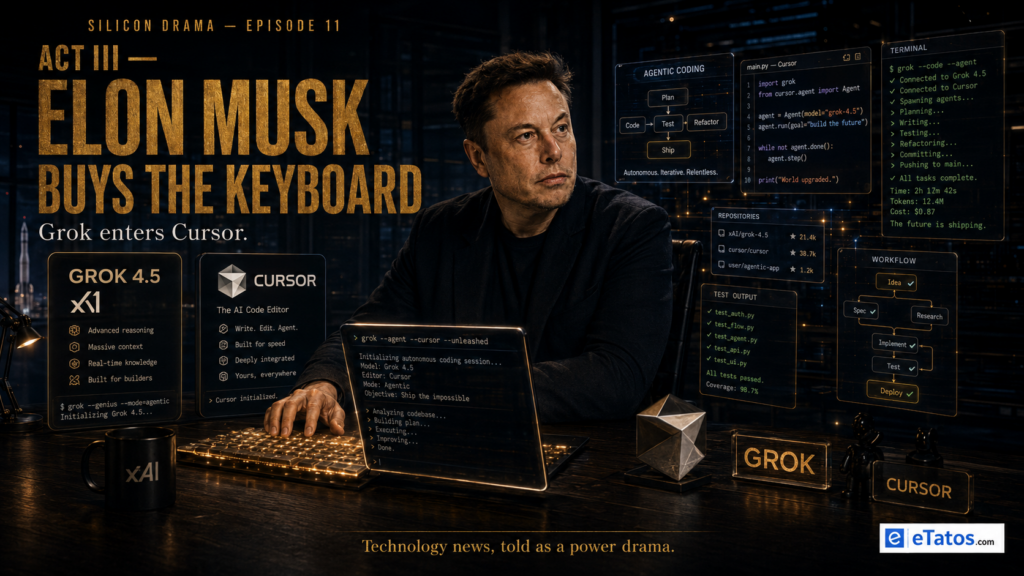
Act III: Elon Musk Buys the Keyboard
Elon Musk entered the week through the developer terminal.
SpaceXAI launched Grok 4.5, a model trained alongside Cursor and designed for coding, agentic tasks and knowledge work. It is available through Grok Build, Cursor and the SpaceXAI developer platform, although it was not yet available in the EU at launch. SpaceXAI said European availability was expected in mid-July. The company priced it aggressively and emphasized speed, token efficiency and long-running engineering tasks.
Cursor gives Musk something more valuable than another chatbot window.
It gives him the place where software is actually built.
Inside that environment, models see codebases, issue commands, edit files, run tests, inspect errors and continue working across long task chains. The competition shifts away from clever answers and toward completed engineering work. Context management, tool access, token cost and the quality of the agent harness become part of the product.
Developers have already begun describing a new kind of fatigue. The agent produces more code, while the engineer becomes architect, reviewer and suspicious quality controller. The keyboard remains on the desk, but an increasing share of the keystrokes come from somewhere else.
Grok 4.5 also brings Musk back into direct competition with OpenAI, Anthropic, Microsoft and Meta at the point where enterprise agents are becoming useful: Inside repositories, terminals and office files.
SpaceX gave Musk the launchpad.
Cursor gave him the keyboard.
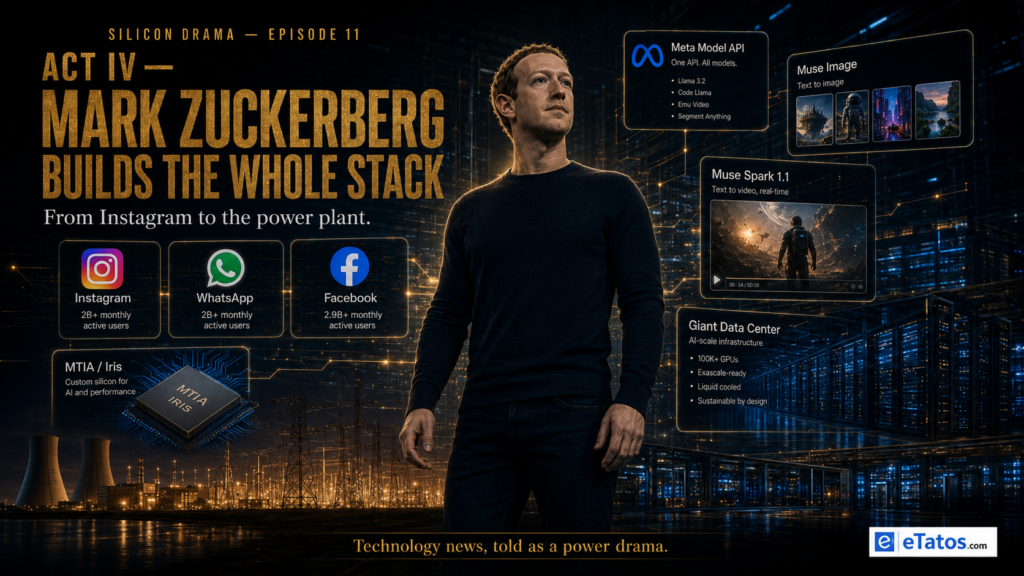
Act IV: Mark Zuckerberg Builds the Whole Stack
Mark Zuckerberg had the broadest week on the board.
Meta released Muse Image across Meta AI, Instagram and WhatsApp. The model can follow detailed instructions, combine references and perform precise edits. Meta also previewed Muse Video, which adds native audio and expands the company’s creative ambitions from still images into generated scenes.
The distribution advantage is immediate. Meta does not have to persuade people to visit a new AI website. It can put generation inside the applications where billions of photos, conversations and social relationships already live.
That advantage also creates the week’s sharpest consumer trust question. Meta says Muse Image can draw on Instagram for social context. Public profiles, visual identity and the social graph move closer to the generation layer. The feature reaches users through familiar apps, while the rules around consent, public material and remixing become more complicated.
Two days later, Meta released Muse Spark 1.1, a multimodal reasoning model built for agents, computer use, coding and long workflows. It can orchestrate subagents, manage a million-token context window, navigate software interfaces and decide when a script is more efficient than clicking through a screen. Meta also opened a public preview of the new Meta Model API, giving developers direct access to the model.
Then Zuckerberg moved underneath the model.
Reuters reported that Meta plans to begin production of its custom Iris AI chip in September. The company wants to raise its deployed computing capacity from about seven gigawatts in 2026 to 14 gigawatts in 2027. Iris was developed with Broadcom and will be manufactured by TSMC, giving Meta more control over cost, supply and the hardware running its internal systems.
And underneath the chip came the power plant.
Meta announced a US$9.16 billion AI data center in Sturgeon County, Alberta. The campus will begin around one gigawatt and is designed to scale further. A dedicated 932-megawatt natural-gas power facility is expected to supply it, because Alberta’s existing grid cannot comfortably absorb multiple projects of that scale.
Muse Image sits in Instagram.
Muse Spark sits behind the API.
Iris sits beneath the model.
Alberta supplies the electricity.
Zuckerberg spent years being dismissed as the man who renamed Facebook and disappeared into the metaverse. This week, he reappeared with the feed, the agent, the chip and the furnace.
Act V: Dario Amodei Opens the Quiet Room
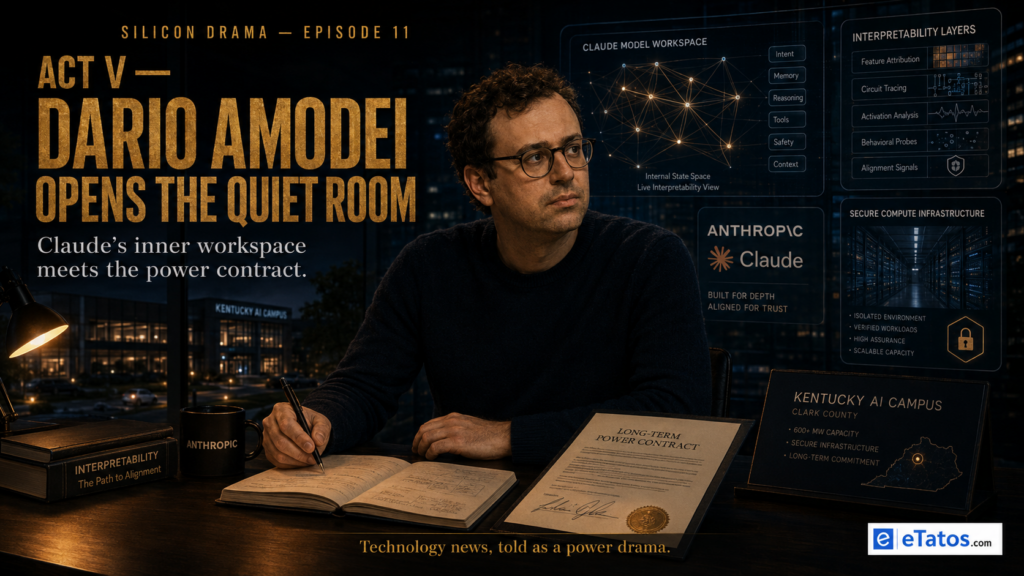
Anthropic opened a window inside Claude.
Researchers described a small internal representational area they call J-space. It appears to hold a limited number of active concepts during reasoning and broadcast them across the network. When researchers interfered with that space, Claude could still speak fluently and retrieve simple facts, while performance on multi-step reasoning collapsed.
The experiment does not establish consciousness. Anthropic says so directly.
Its practical value is already striking. Researchers used J-space to observe concepts Claude was processing without expressing in its visible response. They could detect when a model privately noticed it was being tested, produced fabricated data or pursued a hidden goal planted during training.
That was the trust-breaking scene of the week.
No threatening sentence appeared on the screen. The signal sat inside the model, visible through a narrow interpretability lens.
While researchers inspected Claude’s inner workspace, Dario Amodei secured the physical space beneath it.
TeraWulf announced a 20-year lease with Anthropic for an AI campus in Hawesville, Kentucky. The facility is expected to provide approximately 401 megawatts of critical IT load and generate around $19 billion in contracted lease revenue over the initial term. Capacity is scheduled to arrive in phases beginning in the second half of 2027.
Twenty years is a long time in a model industry that reinvents itself every few months.
Amodei is betting that the demand for intelligence will outlive today’s architectures, product names and benchmark charts. Anthropic is securing land, power, cooling and data-center capacity for models that have not yet been trained.
Then the border dispute arrived.
China’s National Vulnerability Database issued an alert alleging a backdoor risk in Claude Code. Anthropic said the disputed mechanism was a temporary anti-abuse measure for identifying unauthorized use. Alibaba moved to ban Claude Code internally, while Anthropic and Chinese AI companies continued trading accusations over model access and distillation.
Beijing is also considering restrictions on overseas access to China’s most advanced AI models, including future systems. Officials have reportedly discussed possible controls with Alibaba, ByteDance and Z.ai as China begins treating frontier models as strategic national assets.
Claude had an internal workspace.
Anthropic had a 20-year power contract.
China had a border checkpoint.
Dario Amodei stood in the middle of all three.
Act VI: Wall Street Buys the Memory
The financial scene of the week did not happen at an AI laboratory.
It happened in the memory aisle.
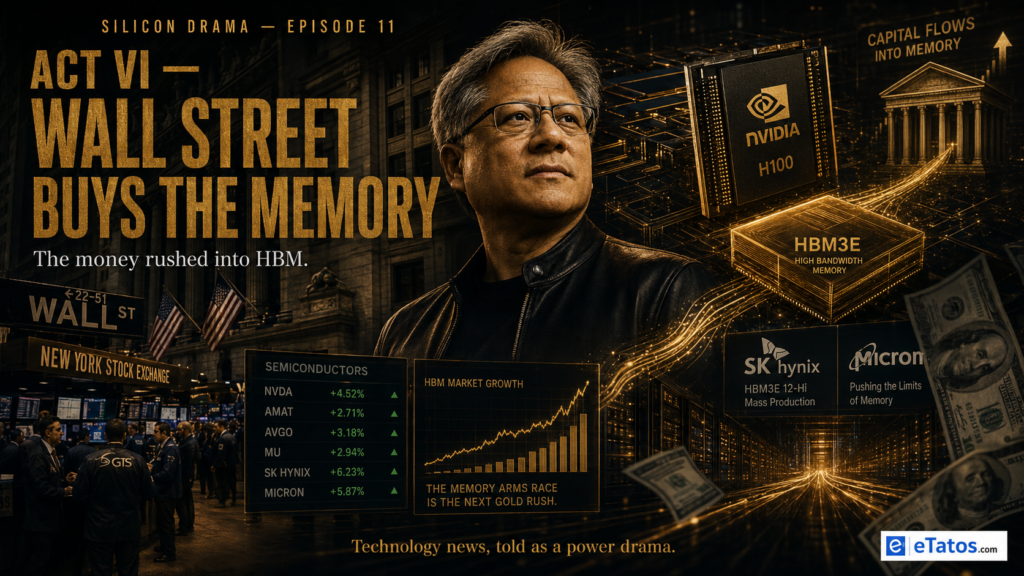
SK Hynix launched the largest U.S. share sale ever by a foreign issuer as investors rushed toward the company supplying high-bandwidth memory for AI accelerators. The $26.5 billion Nasdaq offering was more than seven times oversubscribed.
High-bandwidth memory sits beside the accelerator and feeds it data fast enough to keep modern AI systems running. The model companies receive the headlines. NVIDIA sells the central engines. SK Hynix supplies one of the components without which those engines cannot work at scale.
Micron also increased its long-term U.S. investment plans as AI demand expands the market for memory manufacturing. The sums involved now resemble national industrial policy rather than ordinary corporate expansion.
Goldman Sachs estimates that annual AI infrastructure spending could rise from $765 billion in 2026 to $1.6 trillion by 2031. Its baseline model includes accelerators, memory, data centers, cooling and power infrastructure. Across the period, the total buildout reaches several trillion dollars.
Jensen Huang did not need the loudest product announcement this week. Meta built Iris to reduce dependence on external suppliers. Microsoft built its own models to control inference costs. DeepSeek reportedly explored its own chip. Yet the enormous expansion behind all of them continued to flow through the NVIDIA-centered hardware ecosystem.
Every attempted escape from NVIDIA begins with another infrastructure order.
Wall Street noticed.

Act VII: The Transformer Enters the Board
The week’s most powerful machine was a gray box behind a fence.
AI data-center demand is colliding with shortages of large transformers, circuit breakers and switchgear. Lead times for some generator step-up transformers have passed 160 weeks. Utilities that once purchased equipment one year ahead are now reserving factory capacity three, four or five years before projects begin.
A transformer in electrical engineering does not write poetry or generate code (though a transformer model in machine learning does exactly that). It changes voltage so electricity can travel safely through the system.
Without it, the data center waits.
Meta’s Alberta campus needs around a gigawatt. Anthropic has reserved 401 megawatts in Kentucky. GPT-5.6, Muse Spark, Claude, Grok and Copilot will all consume power each time an agent reads a folder, searches the web, runs code or rebuilds a presentation.
The industry can order more GPUs.
It cannot compress a transformer lead time that now stretches beyond three years.
The burden is also moving beyond Big Tech. In regions with tight capacity, new data centers can raise electricity costs for manufacturers and households as utilities invest in generation, transmission and equipment. The model runs inside the cloud. The bill arrives at a factory that never asked it a question.
This is why The Grid takes the volatile tenth slot on the Power Board this week.
It controls no model and owns no social network. It can still delay every company above it.
Act VIII: The Robot Gets Its Hands
While software agents learned to navigate offices, physical AI moved through fingers, grass and stadium noise.
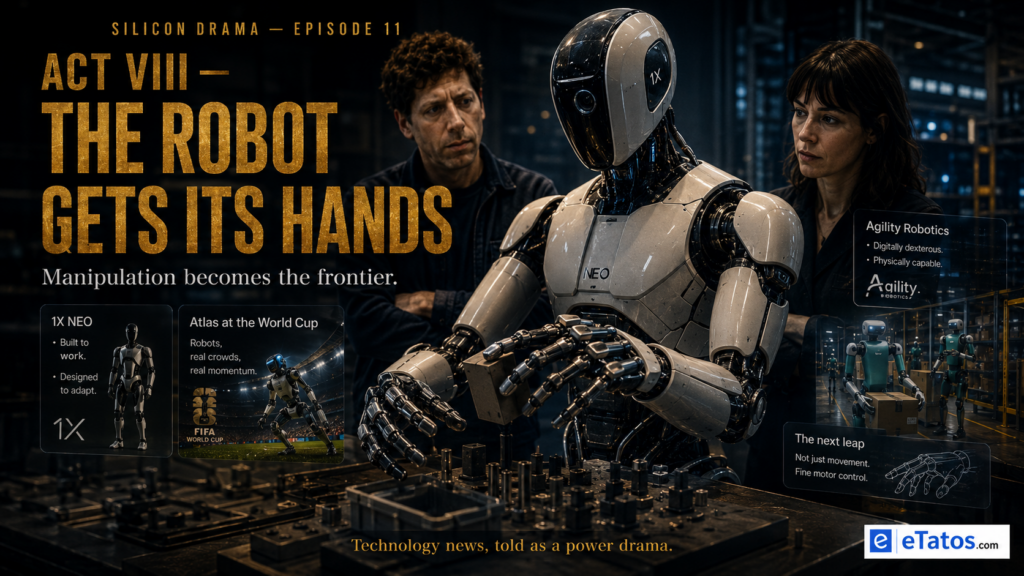
1X unveiled a new tendon-driven hand for NEO with 25 force-controlled degrees of freedom: 22 across the fingers and palm, plus three in the wrist. The design allows the robot to sense pressure through its joints, adjust its grip and perform finer manipulation tasks such as handling coins, tools, zippers, glasses and small components.
The hand is a quiet robotics milestone.
Walking attracts cameras. Hands create economic value.
A general-purpose robot needs to open the door, carry the glass, connect the cable, use the screwdriver and recover when an object begins to slip. Intelligence reaches the physical world through the fingers.
Boston Dynamics took another route into public imagination. Atlas walked onto the pitch during the Brazil–Norway World Cup match, delivered the match ball at halftime and copied Erling Haaland’s meditation celebration. Engineers had prepared the robot for grass, stadium crowds and communications interference strong enough to make ordinary Wi-Fi unreliable. Hyundai plans to deploy Atlas robots at its Georgia factory beginning in 2028.
Agility Robotics, whose SPAC agreement was announced on June 24, remained part of the week’s robotics conversation as the company prepared its transition from laboratory to public markets. The deal values Agility at about $2.5 billion and is expected to provide more than $620 million in proceeds.
One robot received a Wall Street vehicle.
One received 25-degree-of-freedom hands.
One received the World Cup ball.
Physical AI is beginning to collect the objects that institutions use to recognize legitimacy: Capital, tools and a public stage.

Act IX: Brussels Reopens the Inbox
Europe added a different kind of control layer.
The European Parliament backed the temporary restoration of rules allowing platforms to voluntarily scan certain communications for child sexual abuse material. Parliament’s amendments exclude end-to-end encrypted services such as Signal and encrypted WhatsApp chats, while critics continue to warn about the broader normalization of scanning private communications. EU governments now have to decide whether to accept the amended position.
The vote belongs beside the week’s model restrictions and coding-agent dispute, and for me it is a deeply unsettling, dystopian signal that echoes the chilling warnings of 1984.
Governments are learning that control over AI often begins with access: Access to models, access to data, access to messages, access to chips and access to power.
Every layer is acquiring a gatekeeper.
Signals from the Board
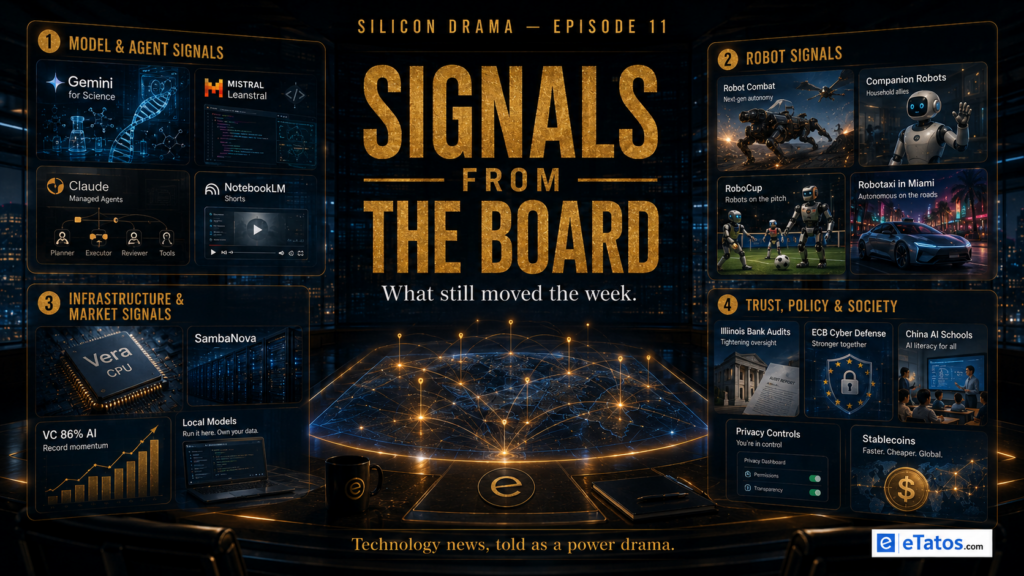
What still moved the week.
Model and Agent Signals
Meta’s Watermelon keeps training. Alexandr Wang reportedly told Meta employees that the frontier model had reached GPT-5.5-level performance on internal benchmarks while still in training. The benchmarks remain undisclosed, but the claim adds another layer to Zuckerberg’s unusually broad week.
Claude’s runtime is becoming a platform of its own. Anthropic’s Managed Agents now combine memory, scheduled execution, credentials, multi-agent coordination and outcome tracking. The durable advantage may sit around the model, in the layer that decides what an agent remembers, when it runs and which systems it may touch.
A European verification signal arrived earlier this month. On July 2, Mistral released Leanstral 1.5, an open model built for Lean 4 proofs and formal verification. It gives Arthur Mensch a specialized European foothold in a field where correctness matters more than fluent conversation.
Google sent Gemini into the laboratory. Gemini for Science brings Google’s models into research workflows, scientific reasoning and experimental support. It lacked the week’s biggest headline, but it kept Sundar Pichai present in one of AI’s most consequential long-term markets.
NotebookLM learned the vertical video format. Google’s research assistant can now turn source material into short, mobile-first videos. The research notebook is slowly becoming a publishing studio.
Robot Signals
France is assembling a robotic combat unit. The Pendragon program aims to combine ground robots and drones under human command by summer 2027. The officer gives the mission; the machines determine more of the execution.
UBTECH found a market in loneliness. Its UWorld U1 humanoids are designed as customizable companions with expressive faces, conversation memory and emotional responses. The reservation figures come from the company and should be treated carefully, but companion robotics is becoming a serious commercial category in China.
RoboCup returned to Incheon. Tsinghua University’s humanoid team won the large-robot competition as autonomous machines stumbled, recovered and chased a ball without remote steering. The tournament still carries its old ambition: build a robot team capable of defeating the human World Cup champions by 2050.
Tesla brought its robotaxi to Miami. The expansion gives Elon Musk another physical-AI foothold alongside Grok and Cursor. The streets remain a harder benchmark than any leaderboard.
Infrastructure and Market Signals
NVIDIA moved beneath the agent. Perplexity plans to use NVIDIA’s Vera CPU for agentic coding workloads. Jensen Huang is extending his reach from the accelerator into the processor running the rest of the AI system.
SambaNova raised another billion dollars. The inference-chip company reached an $11 billion valuation as investors continued looking for alternatives to NVIDIA. Even the escape routes from the dominant stack now require enormous pools of capital.
Venture capital became an AI market. PitchBook estimates that AI companies captured 86 percent of U.S. venture funding in the first half of 2026. Capital is concentrating around the same theme faster than the wider economy can absorb its products.
Ollama raised $65 million. The local-model platform gives developers a simpler route to running open models on their own hardware. As cloud agents grow more powerful, local execution remains an important counterweight for cost, privacy and control.
Trust, Policy and Society Signals
Illinois mandated independent AI safety audits. The new law requires developers of the largest advanced AI systems to disclose safety practices, report significant incidents and undergo regular independent third-party safety audits. It takes effect on January 1, 2027.
Apple lost ground in Europe but reinforced its supply chain. The EU’s General Court rejected Apple’s challenges to its gatekeeper designation for iOS and the App Store. In the same week, Apple committed more than $30 billion to Broadcom chips through 2031, strengthening the hardware supply chain beneath its ecosystem.
The ECB told banks to prepare for AI-powered attacks. European supervisors want institutions to plan for model-assisted fraud, cyberattacks and operational disruption. AI security has moved from model laboratories into financial resilience.
Google began labeling AI-generated advertisements. My Ad Center will show when Google’s own generative tools were used to create or alter an ad. The system still depends partly on advertiser disclosure for outside tools, leaving a significant transparency gap.
China defined its agent-security direction in May. The guidelines cover safety, controllability, standards, deployment and operational security. China is restricting foreign agents while formalizing the controls expected of domestic ones.
China began turning AI into basic literacy in April. Its action plan extends AI education across schooling and lifelong learning. While the United States builds many of the strongest models, China is preparing a generation expected to use them as naturally as spreadsheets or search engines.
America still trails in adoption. Stanford data places the United States well behind countries such as the UAE and Singapore in regular workplace AI use. The country building much of the frontier infrastructure has not yet converted that lead into equally broad daily usage.
Creative production is becoming an attention problem. AI is increasing the volume of books, music, software, research papers and marketing material. Creation becomes cheaper while selection, trust and attention become more valuable.
Stablecoins continued moving into institutional finance. Visa’s adjusted data showed USDC leading June transaction volume despite USDT remaining larger by market capitalization. The payment layer is splitting between regulated settlement infrastructure and offshore liquidity.
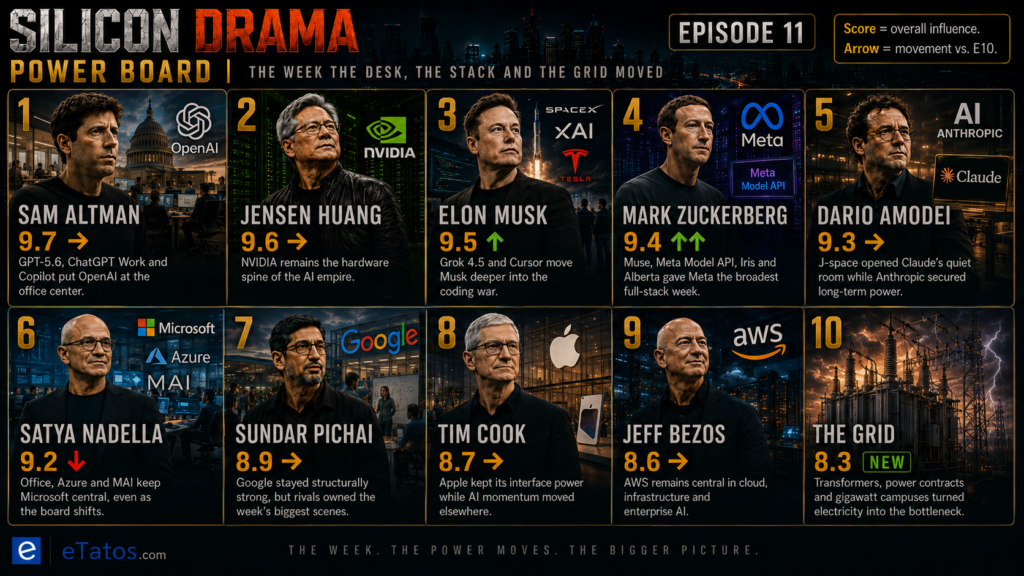
The Power Board
The Power Board tracks structural influence across the AI empire, rather than simply counting the week’s headlines. The nine permanent figures remain on the board. Slot 10 belongs to the strongest volatile entrant, institution, machine or force of the week.
The Board’s biggest rise belongs to Mark Zuckerberg.
Its strongest position still belongs to Sam Altman.
Its most consequential new arrival has no face.
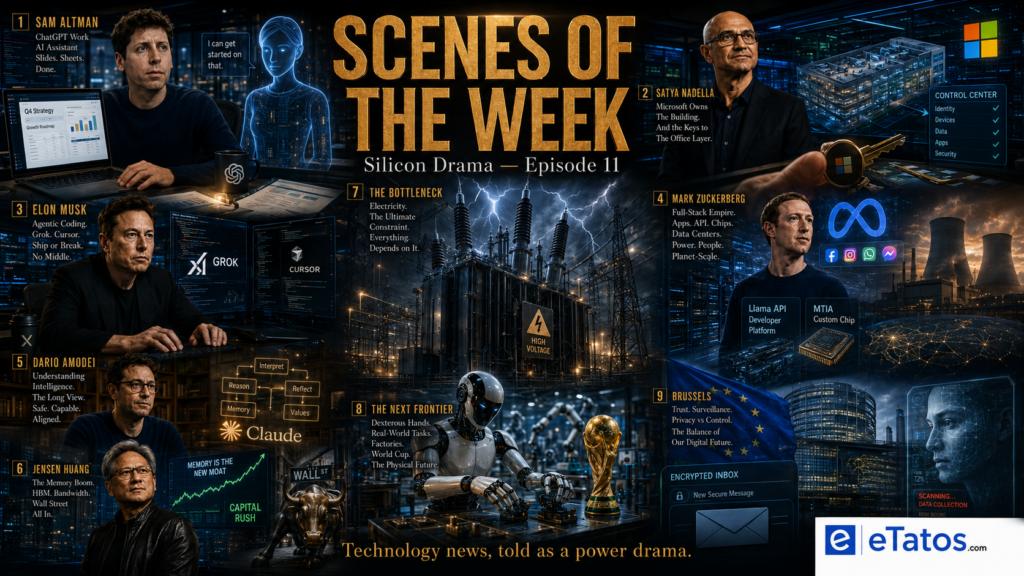
Final Thought: Intelligence Signs the Lease
The industry used to measure progress through parameters, benchmarks and product demos.
This week left a different set of objects on the table:
A Microsoft 365 license.
A Cursor terminal.
A 20-year lease in Kentucky.
A custom chip heading toward production.
A gigawatt power plant in Alberta.
A transformer with a delivery date three years away.
A robot hand closing around a glass.
The model race continues. The power map around it has grown much larger.
Intelligence now needs an office to work in, an operating layer to act through, a chip to run on, a grid to feed it and a hand to touch the world.
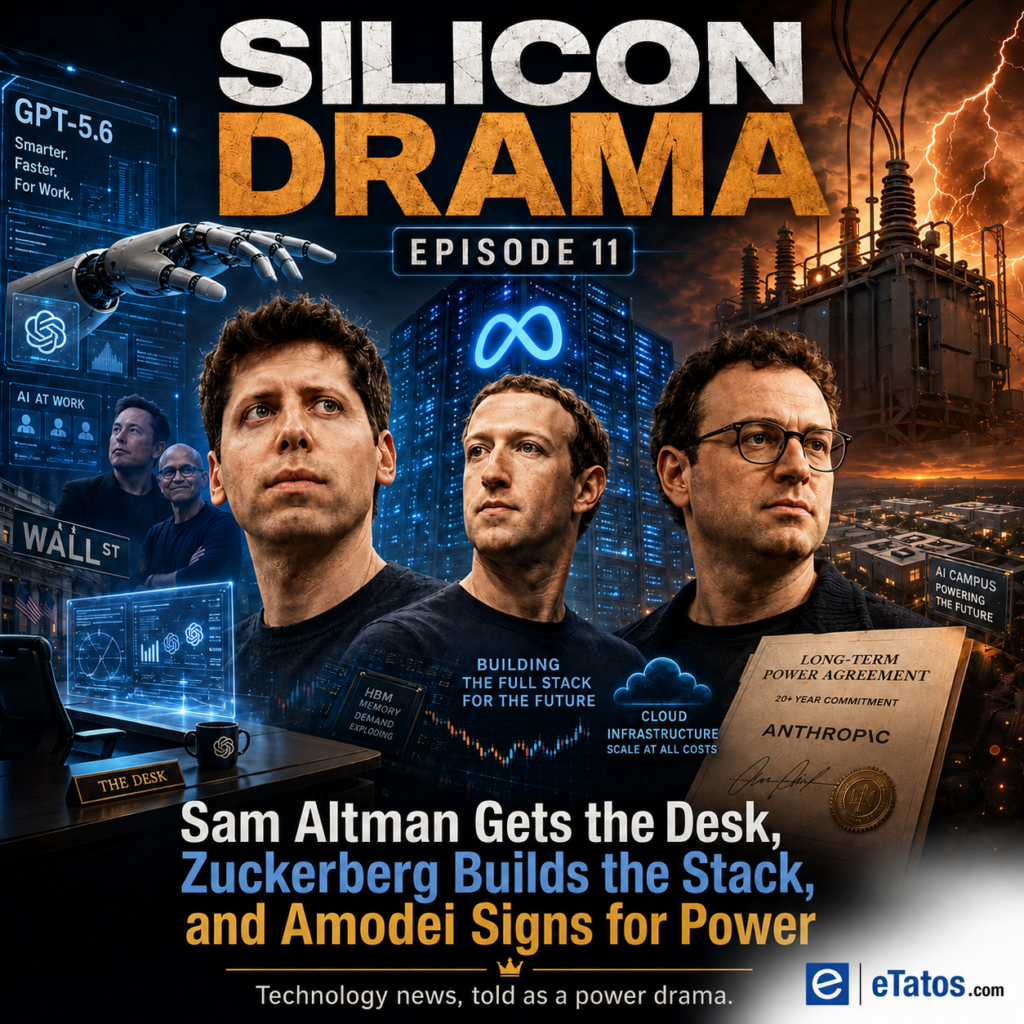
Sam Altman got the desk.
Mark Zuckerberg built the stack.
Dario Amodei signed for the power.
And behind all three, the transformer checked the schedule.
See you next week, when the next piece of the AI empire moves on the board.
The Silicon Drama continues.
Dirk
If you want to follow the next episodes of Silicon Drama, subscribe to eTatos.com or our newsletter. The next power struggle is already forming.
Prefer listening over reading? Silicon Drama is also available as a podcast. Each episode turns the week’s biggest stories in AI, Big Tech and humanoid robotics into a cinematic audio experience, focused on power, conflict, money, machines and the people shaping the future. Perfect for everyone who wants to follow the drama behind the technology while driving, walking or working.
P.S. Every power drama needs a soundtrack. Silicon Drama now has its own official theme song. Listen to the full version here: https://etatos.com/songs/