

I love all animals.
To be honest, insects not so much.
And to be even more honest: If there is one creature I would not miss at all on this planet, it is mosquitoes.
They are not just annoying little flying nightmares. Mosquitoes are connected to diseases like malaria, dengue, Zika, chikungunya, West Nile virus and yellow fever. Vector-borne diseases cause more than 700,000 deaths every year and malaria alone caused an estimated 610,000 deaths in 2024.
And yes, mosquitoes are also responsible for some of my sleepless nights.
That tiny evil sound next to your ear at 2:37 a.m.?
I HATE THEM.
So the following news might sound dystopian to some people.
For me, it is pure science fiction gold.
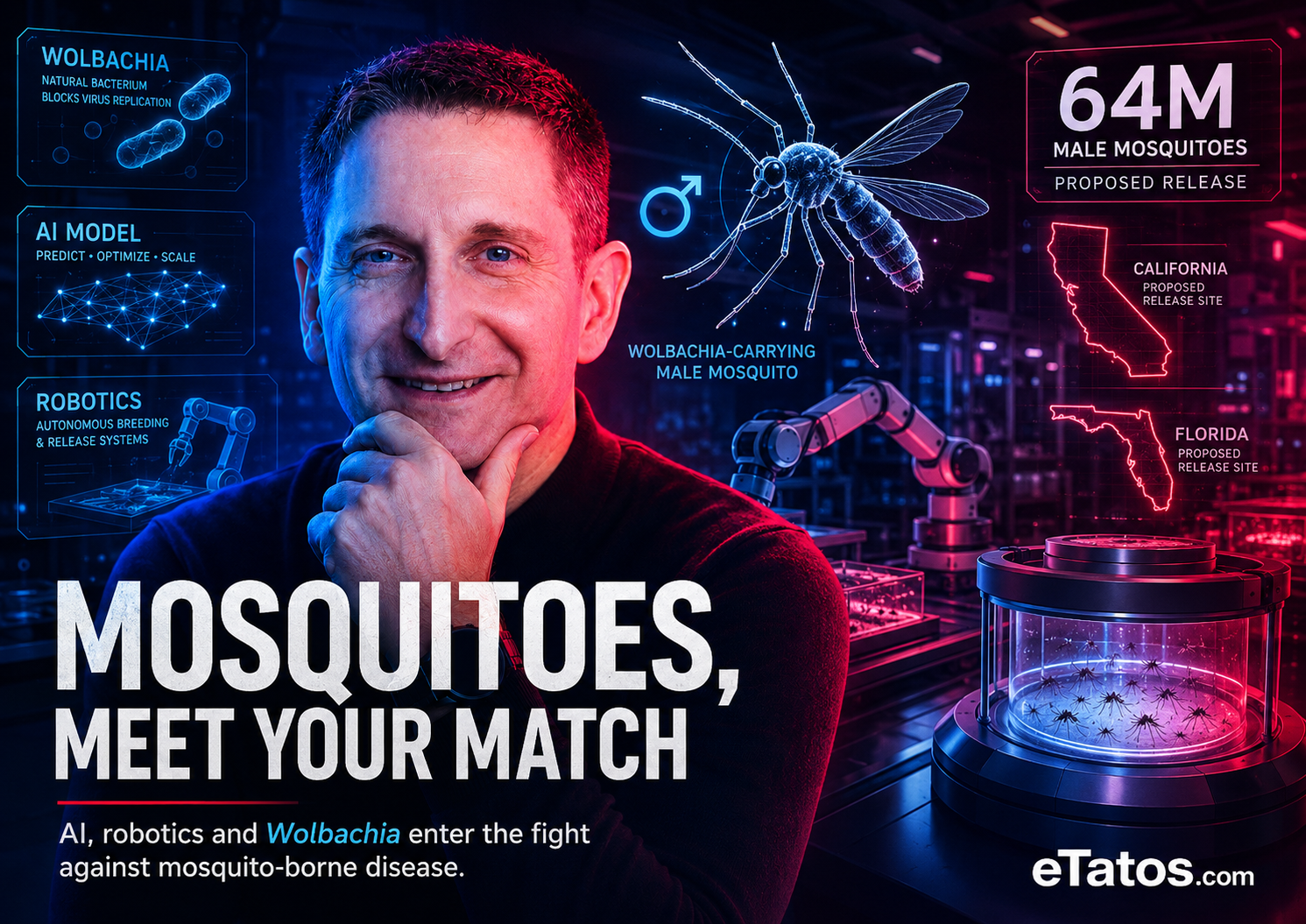
Google has filed an application with the U.S. Environmental Protection Agency to release up to 64 million male mosquitoes in California and Florida over two years.
But not just any mosquitoes.
Male mosquitoes carrying Wolbachia bacteria.
The idea: These males do not bite. They mate with wild females, but the eggs do not hatch. Over time, the mosquito population should decline.
So basically: Google wants to fight mosquitoes with sterile mosquito assassins.
And this is where it gets even more interesting.
The project, called Debug, uses automated mosquito-breeding systems, robotics and AI-powered sex sorting to separate males from females at scale.
Biology meets robotics and public health meets AI.
Mosquito control becomes a tech platform.
Of course, the concerns are real.
If you release millions of living organisms into the environment, people are right to ask hard questions:
How reliable is the sex sorting?
What happens if females are accidentally released?
How will the project be monitored?
Who decides whether a local community becomes part of the experiment?
And how much trust do we want to place in a tech company when biology enters the field?
But scientifically, this is fascinating.
Wolbachia-based mosquito control has already shown strong results in other places. In Yogyakarta, Indonesia, Wolbachia-treated areas saw a major reduction in dengue cases. Singapore has also used male Wolbachia mosquitoes as part of its mosquito-control strategy.
Still, this U.S. project is different: Different mosquito species, different diseases, different locations, different scale.
That is why the real story is not simply:
“Google wants to release infected mosquitoes.”
The real story is:
We are entering an age where AI, robotics and industrial-scale biology are moving from the lab into the real world. Into ecosystems.
And into the invisible war between humans and nature’s smallest killers.
And honestly?
If science can help us reduce mosquito-borne diseases without spraying more chemicals everywhere, I want to see the research.
Carefully. Transparently. Publicly monitored.
But yes, I want to see it.
Because if there is one villain creature that deserves a proper sci-fi ending, it is the mosquito.
Dirk
For anyone who wants to go deeper: The official EPA filing is here, and the CDC has a useful background page explaining Wolbachia mosquito control. Important detail: This is still an application for an experimental-use permit, not a final approval.
EPA filing:
CDC background:
https://www.cdc.gov/mosquitoes/mosquito-control/mosquitoes-with-wolbachia.html