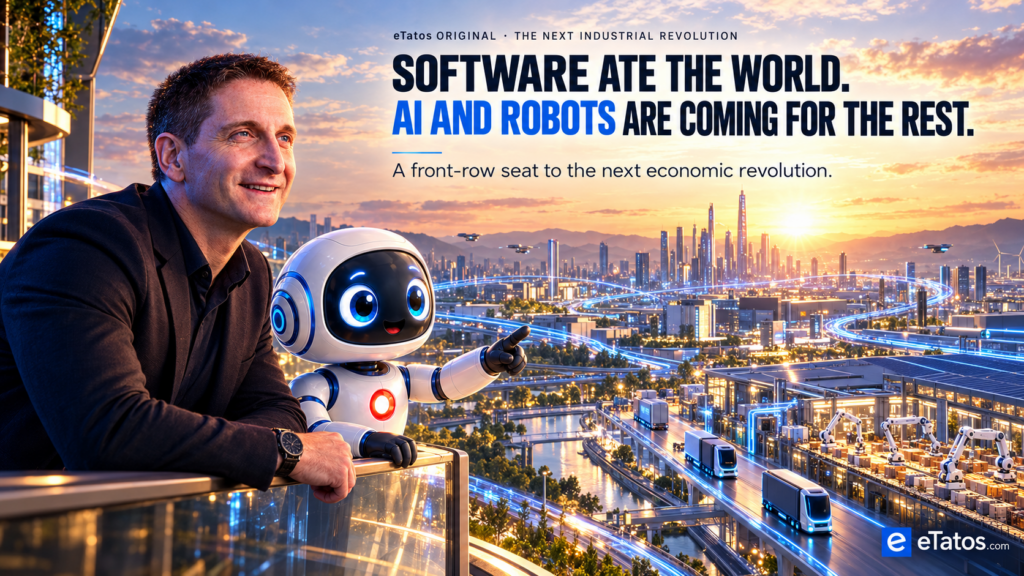
Fifteen years after Marc Andreessen predicted the software revolution, AI and robotics are preparing to challenge something much bigger: The economics of human work itself.
In August 2011, venture capitalist Marc Andreessen published an essay in The Wall Street Journal titled Why Software Is Eating the World.
His argument was surprisingly straightforward: More and more traditional industries were being transformed by software companies, and he expected that trend to continue.
At the time, companies such as Amazon, Netflix and Google were already demonstrating what software-driven businesses could achieve. But the full extent of the changes ahead was still difficult to imagine.
Fifteen years later, software has become the foundation of practically every industry. It runs our banks, factories, hospitals, cars, businesses and much of our personal lives.
And now I suspect we’re approaching the next stage of this development.
Artificial intelligence and robotics could consume a significant part of the economic value that traditional businesses currently create.
Considering the extraordinary amounts of money being invested in these technologies, I clearly wouldn’t be the only one anticipating something along those lines.
What fascinates me most is the speed at which this is happening.
We’re witnessing one of the most exciting periods in human history. And unlike previous generations, who could only read about the early industrial revolutions, we can actually watch this one develop in real time.
We can even participate in it.
I Wrote About This in January 2023
On January 4, 2023, I published an article on eTatos titled Want to Look Into the Future? These Awesome AI Innovations Are Going to Replace You!.
ChatGPT had been publicly available for little more than a month. Stable Diffusion was demonstrating what image generation could look like, and DeepL was already offering remarkably good machine translation.
I was fascinated.
In that article, I predicted that AI would increasingly replace or transform numerous professional activities.
Copywriting, photography, illustration, translation, sales calls and education were among the examples I discussed.
I also anticipated AI-generated movies with synthetic actors, significant changes to search engines and the growing automation of knowledge work.
One of my arguments was that highly skilled knowledge workers could experience a transformation similar to the automation that industrial workers had already experienced over previous decades.
Looking back, quite a few of those predictions have developed in the direction I expected.
AI-generated text, images and video have become widely accessible. Voice agents can conduct increasingly natural conversations. Software development itself is becoming one of the most significant applications of generative AI.
Other developments, particularly fully autonomous transportation and the broad replacement of entire professions, are taking longer.
And that’s worth acknowledging. Predicting the direction of a technology is considerably easier than predicting when it will become reliable, affordable and widely adopted.
Still, I find it remarkable how much has happened since that article.
Back then, we were experimenting with systems that could generate surprisingly good answers and creative content.
Today, we’re increasingly working with systems that can take action.
And that distinction has enormous economic consequences.
From Replacing Apps to Replacing Work
On October 23, 2026, I published an article about an unexpectedly revealing experience involving an old CD burner.
My wife and I had created songs using Suno, and I wanted to put some of them onto a physical music CD.
Windows Media Player refused to cooperate.
Eventually, Codex solved the problem by bypassing the application and using Windows’ disc-burning capabilities directly.
I described the experience in Yesterday, I Burned a CD. And Suddenly, I Saw the End of the App Economy.
It made me question why we would continue installing, learning and sometimes subscribing to specialized applications when AI agents can increasingly accomplish the same tasks directly.
That thought led to my follow-up article The App & Subscription Economy Is Dying. And Good Riddance.
In it, I explained why I’ve started cancelling software subscriptions, including Craft, and moving my personal knowledge into an open, Markdown-based Second Brain.
I increasingly want AI agents to work with my information without depending on one particular application’s interface or proprietary ecosystem.
But while thinking about the consequences for the software industry, another question occurred to me.
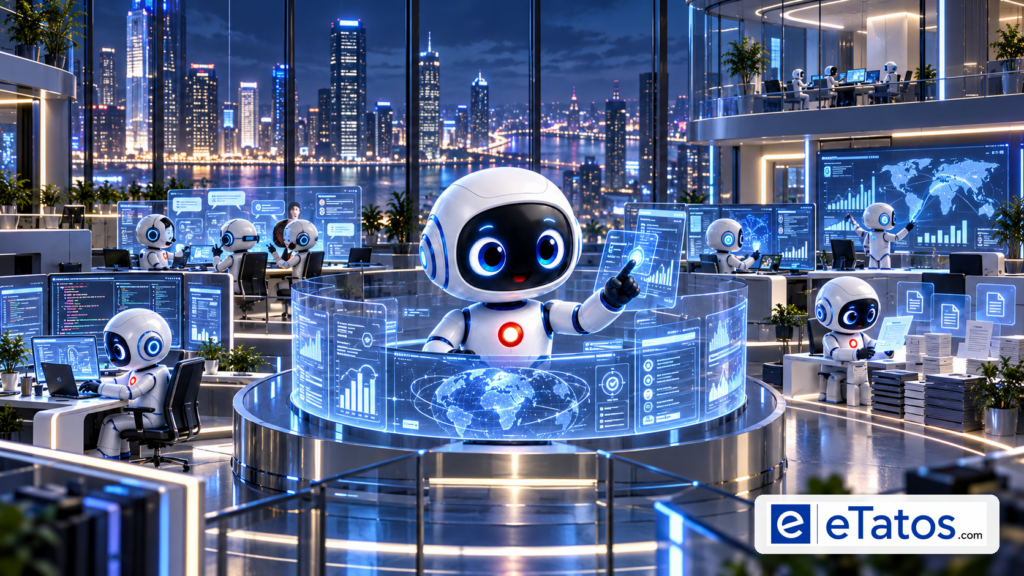
If AI agents can replace many of the tools we use to perform our work, why should the disruption stop at the tools?
What happens when they begin replacing significant parts of the work itself?
Because that’s where the potential economic consequences become much larger.
Consider a business that charges customers for preparing reports, processing documents, analyzing data, answering support requests or handling administrative workflows.
Its revenue ultimately depends on providing those services at a price customers are willing to pay.
If an AI agent can produce comparable results at a fraction of the cost, the business may have to rethink its pricing, staffing and entire operating model.
The company might become dramatically more productive by adopting AI itself. It might also face competition from smaller companies that can now deliver similar services with far fewer employees.
And some customers might decide to perform the work themselves.
This could affect a considerable portion of the service economy, especially businesses whose products consist largely of repeatable cognitive work.
The same principle becomes even more interesting when we add robotics.

The Numbers Behind the Ambition
I find the scale of current AI investment almost difficult to comprehend.
According to Goldman Sachs Research, worldwide AI-related investment could reach approximately $1 trillion in 2026 alone.
That’s a forecast, and investment estimates vary depending on which expenditures are included. But even allowing for considerable uncertainty, we’re talking about sums that would have been almost unimaginable for this industry just a few years ago.
Companies are building data centers, purchasing enormous quantities of advanced chips, expanding power infrastructure and investing heavily in AI research.
In October 2026, J.P. Morgan Global Research projected around $900 billion in global AI-related capital expenditure for the year.
And there’s no guarantee that all these investments will generate satisfactory returns.
Some companies will probably spend too much. Some business models won’t work. Some valuations may eventually look absurd in retrospect.
We saw something similar during the dot-com boom.
The internet fundamentally changed the world, while many investors still managed to lose extraordinary amounts of money betting on the wrong companies.
Both things can happen simultaneously.
But I find it difficult to believe that the world’s largest technology companies are investing at this scale merely because they expect people to pay a little more for smarter chatbots.
The economic ambition is clearly much greater.
AI companies are competing for a position in the infrastructure through which businesses and individuals will increasingly get work done.
If that ambition succeeds, a meaningful share of economic value could move toward the companies supplying the models, computing capacity, agent infrastructure and machines.
There is already evidence of that pressure.
According to McKinsey’s August 2026 State of AI survey, 32% of respondents reported that their organizations had decided against purchasing at least one software product or feature because they could build the required functionality internally with AI coding agents.
That’s quite a revealing result.
It doesn’t tell us how much revenue has already been lost by software vendors. But it demonstrates that businesses are beginning to make real purchasing decisions differently.
And the same economic logic could eventually extend far beyond software.
Then the Robots Arrive
Software has already transformed numerous industries without requiring machines to interact physically with the world.
Artificial intelligence can extend that transformation into cognitive work.
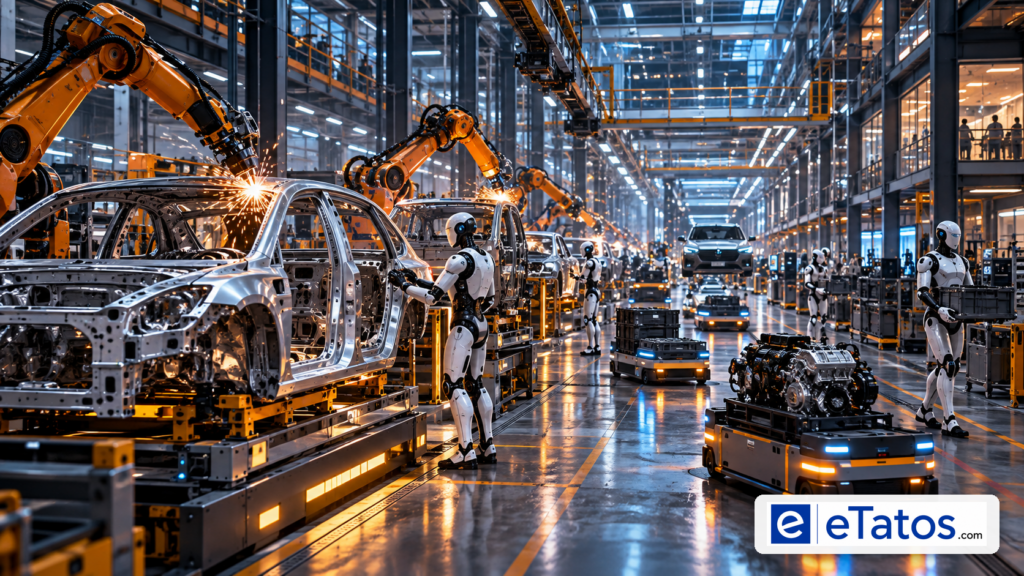
Robotics introduces the ability to automate more activities that require physical movement, manipulation and interaction with real environments.
And unlike the early days of industrial automation, the longer-term ambition is increasingly to develop machines that can adapt to different tasks.
According to the International Federation of Robotics, approximately five million industrial robots were operating in factories worldwide in 2025, with more than 600,000 newly installed during the year.
Most of these are conventional industrial robots designed for specialized jobs.
Humanoid robots remain much earlier in their commercial development. The IFR reports that about 7,000 full-size humanoids, defined as taller than 140 cm, were sold globally in 2025 for commercial and professional applications. It cautions that current applications remain specialized and often require human teleoperation.
We should keep that distinction in mind whenever we see an impressive robot demonstration.
A machine successfully moving boxes in a controlled environment is a long way from an affordable robot that can reliably handle almost any job in a factory, a warehouse or a household.
But the direction of development is unmistakable.
Companies such as Boston Dynamics, Figure and Apptronik are pursuing increasingly capable humanoid systems. Established industrial robotics manufacturers are also incorporating more advanced AI into their products.
The attraction is obvious.
Many factories, warehouses and workplaces are designed around human dimensions and movements. Robots capable of operating in those environments could eventually automate tasks that previously required specialized machinery or substantial changes to the physical infrastructure.
And when these systems become sufficiently reliable and economically competitive, their potential applications extend into logistics, manufacturing, agriculture, cleaning, maintenance and numerous other industries.
Imagine combining advanced AI planning with robots capable of performing complex physical tasks.
A company could automate an increasing share of its operations from the initial customer request to the delivery of a finished product.
The AI handles planning, coordination and decisions within defined limits. The robots handle physical execution. Human employees supervise, maintain, improve and intervene when necessary.
For some businesses, this could substantially change the relationship between revenue, labor costs and production capacity.
What Happens to Traditional Business Models?
I suspect many established industries will face a challenge similar to the one that software companies are beginning to experience.
Their customers may eventually ask why they should continue paying existing prices for products and services that have become substantially cheaper to produce.
Take professional services.
A small company that previously needed external support for research, routine legal documentation, accounting preparation, marketing or software development might be able to handle considerably more work internally.
Or consider logistics.
Companies already invest heavily in warehouse automation because moving goods efficiently is expensive. More versatile robots could expand the range of tasks that can be automated and reduce dependence on labor-intensive processes.
Manufacturing offers another example.
An AI-driven operation with advanced robotics might be able to produce goods with greater flexibility, smaller production runs and less manual intervention.
None of this means every consultant, accountant, developer, warehouse worker or factory employee suddenly becomes unnecessary.
Real businesses require judgment, accountability, relationships and expertise. Physical automation also comes with substantial capital costs, maintenance requirements and safety concerns.
But companies don’t need to eliminate an entire profession to transform its economics.
They only need to reduce the cost of providing a meaningful portion of its services.
In competitive markets, those productivity improvements can eventually result in lower prices, greater output, new business models and pressure on companies that fail to adapt.
Some established businesses will benefit tremendously from adopting AI and robotics.
Others could find themselves competing with companies that require far fewer people and considerably less infrastructure to deliver similar results.
I expect entirely new businesses to emerge as well.
A small team with capable AI agents and access to robotic production infrastructure could eventually achieve things that once required a much larger organization.
For entrepreneurs, that possibility is enormously attractive.
Where Will the Economic Value Go?
There’s another aspect that interests me even more than the potential disappearance of traditional jobs or business models.
Who will capture the financial benefits?
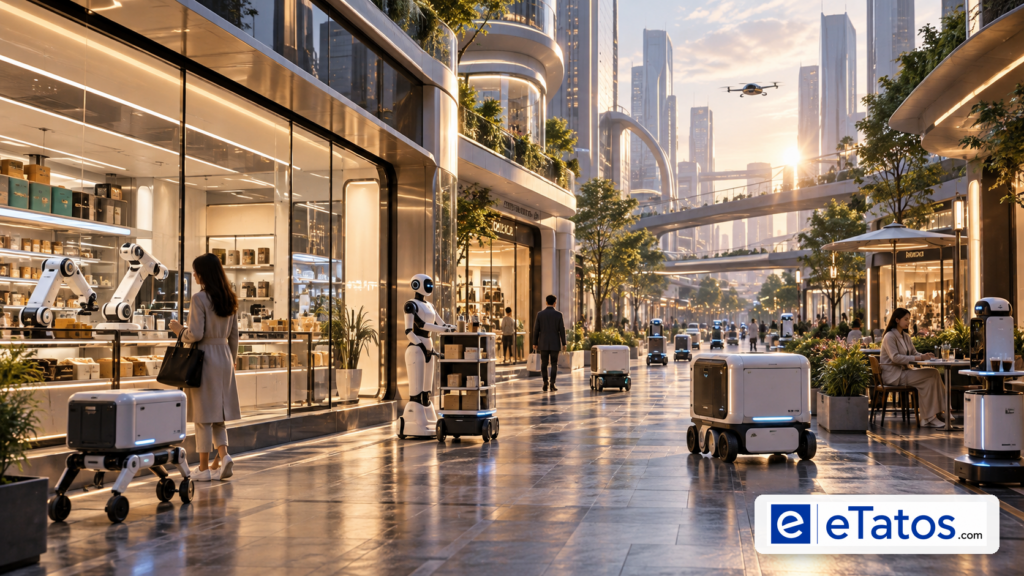
At the moment, much of the discussion centers on the companies developing foundation models, processors, robotics platforms and AI infrastructure.
Investors appear to be betting that some of these companies could capture extraordinary amounts of economic value.
But I’m not convinced the biggest winners will necessarily be the companies currently receiving the highest valuations.
Some of the benefits may flow to businesses that adopt the technology successfully. Others may flow to consumers through lower prices and better services.
Consider what happened with computing.
As processing power became cheaper, its applications expanded far beyond what earlier generations could have imagined.
We didn’t simply replace expensive computers with cheaper ones. We discovered entirely new things to do with computation.
Something similar might happen with intelligence and physical automation.
If useful cognitive work becomes dramatically cheaper, people may demand far more of it.
Small businesses could access sophisticated analysis. Individuals could create software and media that would previously have been unaffordable. Personalized education and services could become more widely available.
If robotics eventually lowers the cost of physical production and services, the effects could be just as significant.
The total economic activity generated might grow substantially, even as the cost of individual tasks falls.
Of course, lower production costs don’t automatically guarantee lower consumer prices. Market concentration, scarce resources, regulation and competitive conditions will still matter.
And there is a serious question about whether the ownership of AI and robotic infrastructure could concentrate an increasing portion of profits in relatively few companies.
The technology might make society substantially more productive while distributing the benefits very unevenly.
That possibility deserves at least as much attention as the latest AI valuation.
Who Will Buy Everything If Machines Do Most of the Work?
This is where the discussion becomes uncomfortable.
Modern economies depend on people earning income and spending it.
If a growing share of economic production can be handled by AI systems and robots, what happens to the income traditionally generated through human labor?
Who buys the products when fewer people are needed to produce them?
We shouldn’t jump immediately to the conclusion that mass unemployment is inevitable.
Technological progress has repeatedly changed the nature of work, eliminated certain occupations and created others.
The International Labour Organization estimated in 2025 that one in four jobs worldwide had some exposure to generative AI, while emphasizing that transformation of jobs was more likely than their complete elimination.
And a 2026 European Investment Bank study found productivity improvements associated with AI adoption without evidence of negative employment effects at the company level in the short term.
That’s encouraging.
Still, today’s results tell us relatively little about what might happen if AI agents become substantially more autonomous and robotic systems become capable of performing a much wider range of physical work.
We may eventually need to reconsider how employment, income, ownership and economic participation interact.
I don’t think anyone currently has a convincing, universally applicable answer.
And I certainly wouldn’t pretend to have one.
But these are questions worth thinking about long before the technology reaches its full potential.
The Most Fascinating Time to Be Alive
Despite these uncertainties, my personal outlook remains overwhelmingly positive.
I’ve spent a large part of my life working with technology, and I genuinely struggle to remember another period that felt quite like this one.
Developments that once seemed decades away are suddenly becoming things we can try ourselves.
New capabilities appear within months, sometimes weeks. Tools that seemed extraordinary a year ago can feel almost ordinary today.
I find that fascinating.
Of course, the visible speed of AI progress doesn’t mean that every industry will transform at the same pace.
Building reliable robots is much harder than generating a convincing video. Industrial deployment takes time. Electricity, infrastructure, regulation, investment cycles and human acceptance impose limits that impressive demonstrations cannot simply wish away.
But the convergence of increasingly capable AI agents, advanced robotics and enormous investment is creating possibilities that would have sounded like science fiction only a few years ago.
And I believe we have barely begun to understand their economic implications.
Marc Andreessen argued in 2011 that software would increasingly consume the traditional economy.
In January 2023, I wrote about AI replacing activities that many people considered uniquely human.
In October 2026, my own experiments with Codex made me question the future of specialized applications, followed by the subscription-based business models surrounding them.
Now I’m beginning to wonder how much of the broader economy could eventually be reorganized around artificial intelligence and robotic labor.
Some businesses will disappear. Others will adapt and become much more productive. Entirely new industries will emerge.
Some of today’s extraordinary valuations will probably prove justified. Others won’t.
And the economic benefits may be distributed in ways we don’t yet understand.
I have no idea exactly what the world will look like ten or twenty years from now.
But I’m increasingly convinced that the changes ahead could be at least as consequential as the software revolution Andreessen described fifteen years ago.
And I find the prospect incredibly exciting.
We are witnessing one of the most fascinating technological transformations in human history. And for once, we don’t have to read about the revolution in history books.
We get to watch it happen.