
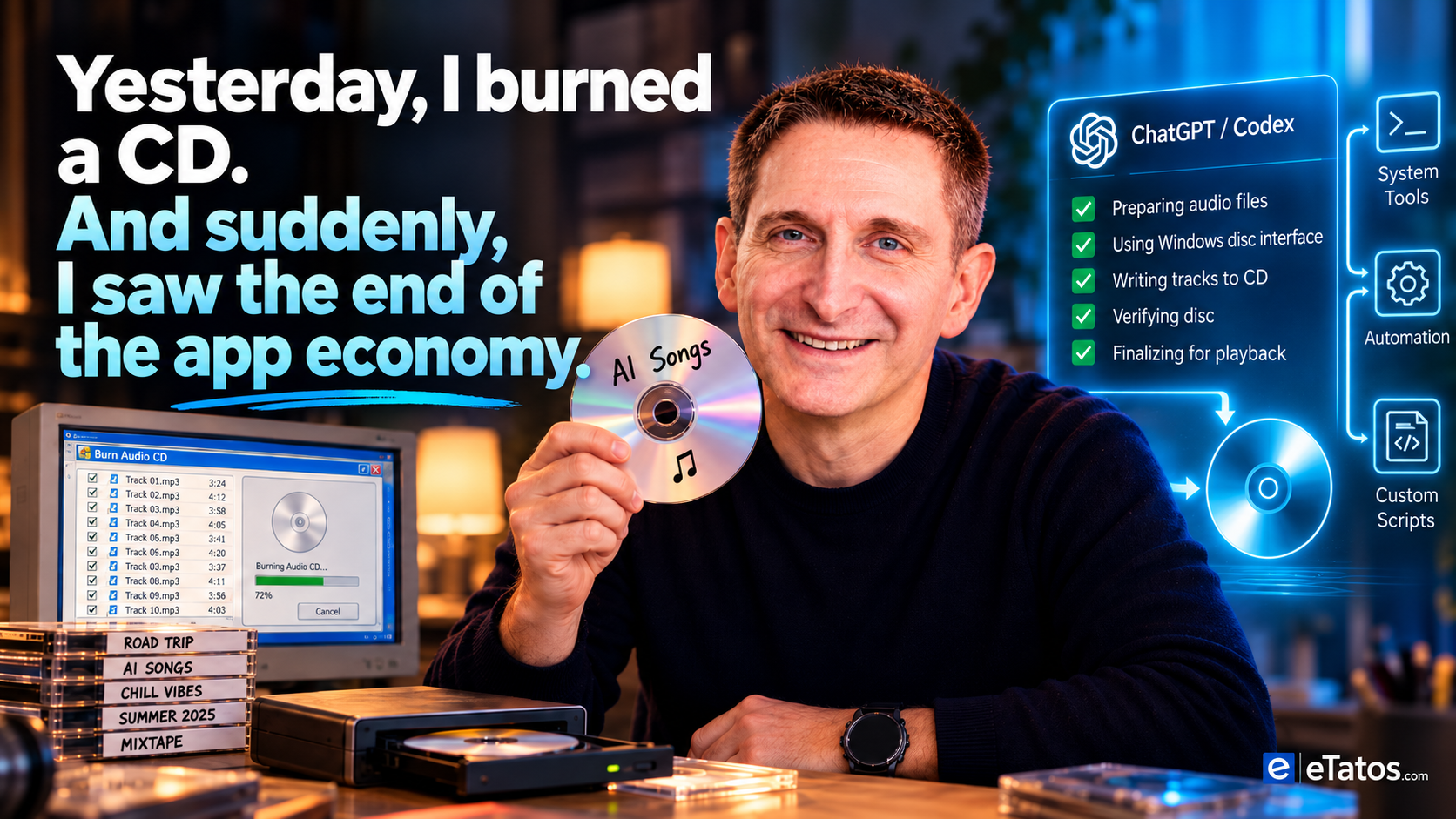
Yes, an actual music CD. In twenty twenty-six.
My wife and I have created quite a collection of AI-generated songs with Suno, which we release through our own music project, eTatos Music. We can stream them anytime, of course. But I’m from a generation that still appreciates something you can actually hold in your hands.
So I dug an old CD burner out of a cupboard, connected it to my PC and remembered the days when Nero Burning ROM was practically essential software.
I wasn’t going to install a dedicated burning application for this little nostalgia project, though. So I asked ChatGPT for a free alternative.
It suggested the classic Windows Media Player, which still supports burning audio CDs.
Great. I loaded our WAV files, clicked Burn… And immediately ran into a problem.
Four songs were supposedly incompatible. The files were perfectly fine, but Windows Media Player refused to burn the CD.
That’s when I asked Codex to take over.
It tried everything. Re-saving the audio files, importing them again, checking formats, disabling automatic volume adjustments… Pretty much the same troubleshooting I would have done myself.
Nothing worked.
Then came my little AI aha moment.
Codex essentially said: “Forget the media player. I’ll do it myself.”
It bypassed the application and worked directly with Windows’ disc-burning interfaces. It handled the tracks, checked the process and finalized the disc for playback in conventional CD players.
And there it was. A perfectly working music CD.
No Nero. No additional burning software. No complicated setup.
Just an AI agent getting the job done.
I sat there looking at that CD and started thinking about something much bigger.
For decades, the software industry has worked remarkably well for both giants and small developers.
Microsoft, Adobe and other major players dominated entire categories. But there was always room for thousands of specialized applications.
A little utility for converting files. A tool for burning CDs. A niche application that solved one particular problem better than anything else.
Entire businesses were built around those gaps.
But what happens when AI agents can simply fill those gaps themselves?
We’re approaching a world where I won’t necessarily need to find, install, learn, or even open an application.
I’ll describe the result I want.
The AI will decide which tools to use, operate the computer, access system interfaces, write a script, or create whatever functionality is missing.
And here’s the part I find particularly fascinating.
AI agents don’t need fancy graphical user interfaces. Humans do.
An enormous amount of software development has traditionally gone into making complex functionality accessible through buttons, menus, windows and workflows.
But an AI agent can often interact with the underlying functionality directly.
That potentially changes the economics of software.
Why would I pay for a specialized application I use twice a year if my AI agent can accomplish the same task on demand?
Why would I spend time learning another interface when I can simply explain what I want?
Of course, complex enterprise software, specialized professional tools and applications requiring strict reliability, security and regulatory compliance won’t disappear overnight.
And AI agents still make mistakes.
But I suspect the market for small, single-purpose applications could shrink dramatically.
Even the traditional app model itself may eventually become less relevant.
We might still need all the functionality that today’s applications provide. But we may no longer need to interact with those applications ourselves.
And that could be a much bigger disruption than AI simply helping developers write code faster.
Yesterday, I wanted to burn a CD.
Today, I’m wondering how many software companies will still need to exist in five years.
Funny what an old CD burner can teach you about the future. 💿🤖