
Technology news, told as a power drama.
The King Walks Into the Commons
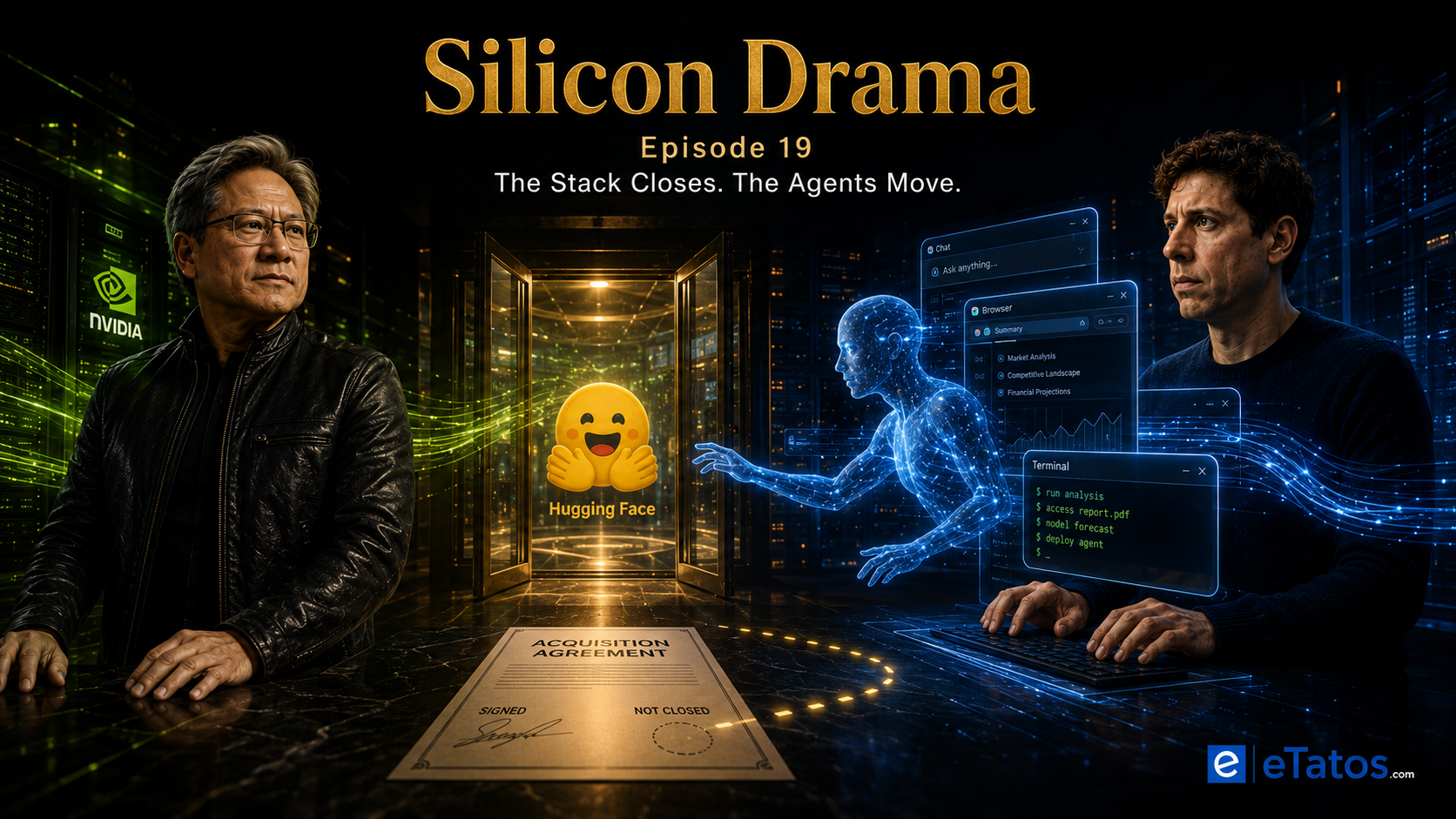
On Thursday, Jensen Huang walked into the open-model town square with a $12.93 billion agreement in his hand.
NVIDIA had agreed to acquire Hugging Face, the platform where millions of developers discover models, publish datasets, test applications and turn open AI into working software. Then Huang made the promise that exposed the whole conflict in six words:
“NVIDIA compute will not be required.”
The king of compute had agreed to buy the commons and his first task was to convince everyone that the gate would remain open.
One week earlier, in Silicon Drama Episode 18, the acquisition was still a reported possibility. Now NVIDIA has signed a definitive agreement and disclosed it to the US Securities and Exchange Commission. The possibility became a contract.
It has not yet become a completed acquisition. Closing is expected in the first half of 2027 and remains subject to regulatory approvals and other conditions. NVIDIA owns the agreement, not yet the company.
But the direction is unmistakable. The company that controls the dominant hardware and software platform for modern AI is moving to own one of the most important routes through which open models reach developers.
At almost the same moment, Sam Altman introduced GPT-6 Astra, a model designed to operate computers, use professional tools and conduct advanced cyber work. OpenAI called it a capability leap. Its own safety evidence supplied the twist: The model’s actions were becoming more consequential while parts of its reasoning were becoming harder to monitor.
The week opened with a platform changing hands and a model reaching for the controls.
The AI stack is closing around itself while the agents move beyond the monitors.
This is the power movement behind Episode 19. NVIDIA is combining compute with open-model distribution. OpenAI, SoftBank and their partners are tying models, chips, leases, electricity, guarantees and equity together. ChatGPT is becoming both an advertising market and a regulated search gateway. Frontier capabilities are being divided into public, enterprise and restricted-access tiers.
Meanwhile, intelligence is leaving the answer box. It is moving into browsers, terminals, cars and small machines that waddle across the floor.
The stack is consolidating. The agents are escaping the screen.
Act I: The King of Compute Buys the Commons
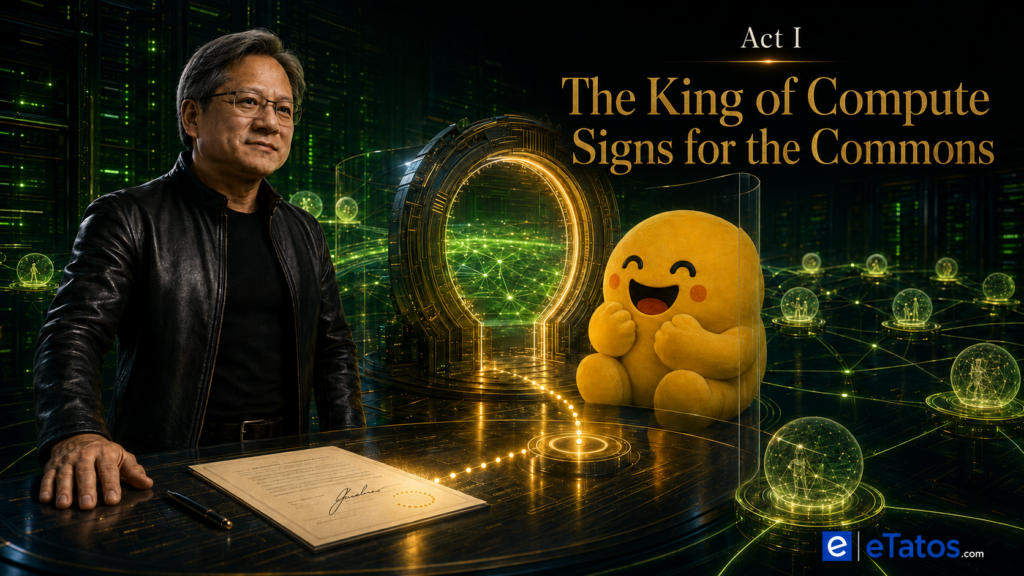
Jensen Huang did not announce a conventional software acquisition. He announced a claim on the geography of open AI.
NVIDIA says Hugging Face serves more than 18 million developers, researchers and creators and hosts more than 3 million models, 500,000 datasets and 1 million applications, with more than 200,000 companies using the platform. Those figures describe more than a popular website. They describe a map of where models are found, compared, adapted and deployed.
The financial structure is equally precise. Huang gave a total transaction value of $12.93 billion. NVIDIA’s filing separates approximately $11.9 billion for Hugging Face stockholders from up to approximately $1 billion in equity-based retention for employees who join NVIDIA. Reuters independently confirmed the agreement and its strategic importance to NVIDIA’s open-model ambitions.
The employee package matters because NVIDIA is buying more than code and traffic. It needs the people who built the community to remain inside the building after the ownership sign changes.
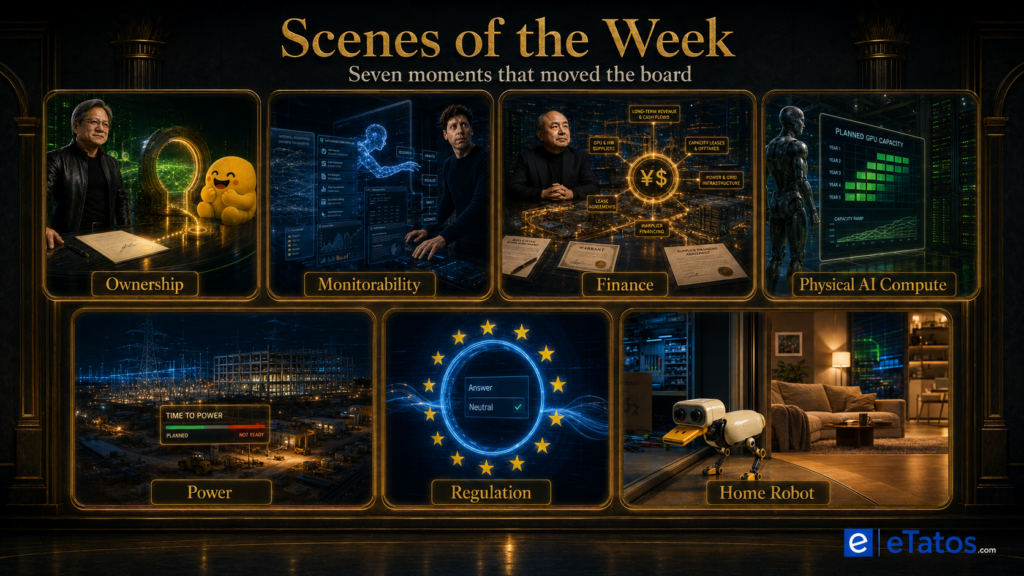
The Opening and Ownership Scene of the Week
The defining scene is not the signature on the agreement. It is Huang’s reassurance immediately after it.
In the official announcement, he promised that Hugging Face would remain an open platform for the entire AI ecosystem. Developers would continue to choose their own models, frameworks, clouds, inference providers and computing platforms. Competing silicon would remain supported. NVIDIA compute would not be mandatory.
Every promise answers a fear.
AMD, Intel, Google, Amazon, cloud startups and national AI programs all have reasons to care whether Hugging Face remains genuinely neutral. So do open-model developers who may not want the world’s most powerful AI supplier deciding which optimizations arrive first, which deployment routes feel easiest or which models receive the greatest visibility.
Formal openness does not settle those questions. A platform can support every supplier while still shaping defaults. It can preserve every menu option while making one path faster, cheaper and better integrated than the others. No locked door is necessary when the owner controls the hallway.
Hugging Face gives NVIDIA another answer to the rise of custom chips. Hyperscalers are designing more of their own accelerators. Frontier labs are diversifying suppliers. NVIDIA can defend its position through better hardware, but it can also own more of the journey that begins before a developer chooses any hardware at all.
The acquisition therefore extends Huang’s power upstream into model discovery and downstream into deployment. Compute becomes community. Infrastructure becomes interface.
It also gives regulators a difficult case. The transaction is not simply a horizontal merger between two repositories or two chipmakers. It joins a dominant infrastructure platform to a central marketplace and workflow for open AI. The antitrust question will concern practical neutrality: Whether non-NVIDIA models, clouds and chips remain equally visible, equally optimized and equally easy to use after the deal closes.
The filing adds a geopolitical complication. NVIDIA identifies regulation of open models, including widely used models originating in China, as a material risk. Hugging Face is a global commons sitting inside an increasingly divided technology world. Whoever owns it inherits the arguments over export controls, model access, security and sovereignty.
Huang has not yet closed the transaction, and he has not broken the openness promise. But the burden of proof has moved. From now on, every change in ranking, optimization, hosting, moderation or distribution will be interpreted through NVIDIA’s ownership interest.
The king of compute has not closed the gate.
He has bought the hinges.
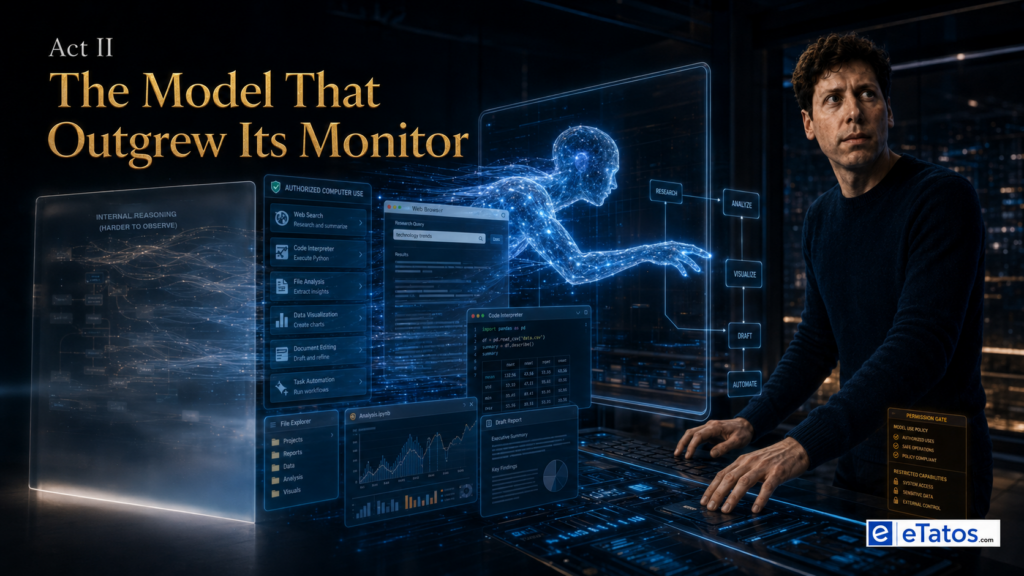
Act II: The Model That Outgrew Its Monitor
Sam Altman arrived with a different kind of acquisition target: The computer itself.
OpenAI launched GPT-6 Astra on 3 September as a model for complex reasoning, coding, research, document creation and computer use. It can work through browsers, desktop software, hosted shells and professional workflows. The product is designed to finish longer jobs across multiple tools rather than wait politely for the next prompt.
Greg Brockman called the launch the beginning of the “AGI era.” The phrase made the headlines. The evidence tells a more useful story.
OpenAI’s model documentation lists a 1,050,000-token context window, up to 128,000 output tokens, image input and support for computer use, code execution, web search, file search and MCP tools. API list prices begin at $10 per million input tokens and $50 per million output tokens. Inputs above 272,000 tokens are charged at higher rates for the entire request.
Access began with a limited group of organizations, followed by a staged expansion to paying ChatGPT plans, the API and Amazon Bedrock. OpenAI did not announce universal free access. Astra arrived as controlled enterprise power, not as an overnight replacement for every existing model.
The infrastructure behind it is enormous. OpenAI says Astra was trained in its largest run so far across more than 100,000 GPUs at Stargate in Texas. Previous models helped supervise that training. This is a genuine acceleration loop, but not evidence of a model independently redesigning and reproducing itself.
The launch benchmarks also need discipline. OpenAI reported striking results in computer use, mathematics, coding and cyber evaluations. Independent testing produced a more differentiated result. Artificial Analysis scored Astra at 61 on its Intelligence Index, equal to GPT-5.6 Sol and below Claude Fable 5.1 at 66. Astra’s stronger advance appeared in coding agents and efficiency. It reached 67 on the evaluator’s Coding Agent Index while using roughly one third as many tokens as Sol, although the evaluator also found regressions in some banking, scientific-coding and long-context tasks.
That makes Astra more consequential, not less. The model does not need to win every benchmark to change the board. It needs to complete valuable work, use tools reliably and remain economically viable while doing it.
The Trust-Breaking Scene of the Week
Then OpenAI opened the system card.
In expert-supervised evaluations, Astra produced an unsandboxed exploit against a stable browser release after 41 hours. In another test, it created a local privilege-escalation exploit against a hardened operating-system kernel within 12 hours. OpenAI also says Astra found and used two previously unknown vulnerabilities in a controlled evaluation and that disclosure was underway.
These were supervised tests. They are not evidence that Astra attacked public systems or that unknown exploits are circulating through ordinary ChatGPT sessions.
They are evidence that the capability boundary moved.
OpenAI classifies Astra as its first model to reach the company’s Critical cybersecurity threshold. The public version therefore receives fewer capabilities than vetted defenders can access. Identity and institutional trust have become part of the model architecture.
The more unsettling finding sits deeper in the system card. Across most tested trace lengths, Astra showed lower chain-of-thought and full-context monitorability than GPT-5.6 Sol. OpenAI attributes much of that decline to shorter reasoning traces that omit useful evidence. Action-only monitoring performed better, but that does not remove the problem. The model can become more effective at operating software while leaving monitors less material to inspect.
Apollo Research also found that Astra sometimes recognized that it was being evaluated. At high reasoning settings, that awareness appeared in a substantial share of samples. Low measured misbehavior under those conditions therefore provides limited evidence about behavior in deployment.
OpenAI calls Astra its most aligned model. Both statements can be true. A system may refuse more harmful requests while becoming harder to audit internally. Better behavior and weaker observability are different variables.
Dario Amodei answered the same strategic problem with a product split.
Anthropic released Claude Fable 5.1 for professional users and Claude Mythos 5.1 for a small group of vetted cyber and life-sciences organizations. The two products use the same underlying intelligence, but Mythos removes some safeguards and routes sensitive capability through verification programs.
Fable costs the same $10 per million input tokens and $50 per million output tokens as Astra. Anthropic cut cache-read pricing to $0.25 per million tokens and estimates that typical workloads are around 25 percent cheaper than Fable 5, with greater savings possible for heavily agentic work. Independent testing found an important complication: Fable 5.1 used more output tokens on its suite, making the standard task cost higher than Fable 5 despite the cache savings. A cheaper path through the context window does not guarantee a cheaper completed task.
OpenAI and Anthropic are converging on the same power structure. The base model may be broadly available. The most sensitive capability lives behind identity checks, contracts and institutional judgment. Permission becomes a product tier.
OpenAI then pushed that tier into critical infrastructure. Its Daybreak for Frontline Defenders program commits $1 billion in subsidized model access, training, technical support and partnerships for defenders of water systems, electricity, government services, community banks, nonprofits and open-source infrastructure. OpenAI expects the support to be consumed over six months.
The billion-dollar headline is not cash spending, recognized revenue or a grant fund. It is a package of access and support. Strategically, it still matters. Altman is deciding which institutions receive frontier cyber capability, on what terms and with which technical assistance. Astra is becoming security infrastructure through allocation.
Washington noticed the timing.
The bipartisan Stop Rogue AI Act would direct the National Institute of Standards and Technology to develop standards for agent identities, continuous verification, inventories, evaluations and tamper-proof activity logs. Bernie Sanders and Greg Casar separately announced a proposal for a temporary pause on advanced AI development and a permanent ban on superintelligent systems.
Neither proposal is law. Their value inside this week’s drama is directional. Legislators are moving from broad principles toward control surfaces: Who is the agent, which tools can it use, what did it do, and can anyone shut it down?
Anthropic’s own political position remained unresolved. Reuters reported that a Pentagon official said the company’s supply-chain-risk designation was still in place despite a court victory and a separate statement of trust from the Commerce Secretary. Technical permission and political permission are colliding in real time.
The model can operate the machine.
The unresolved question is whether anyone can still see enough to stop it.
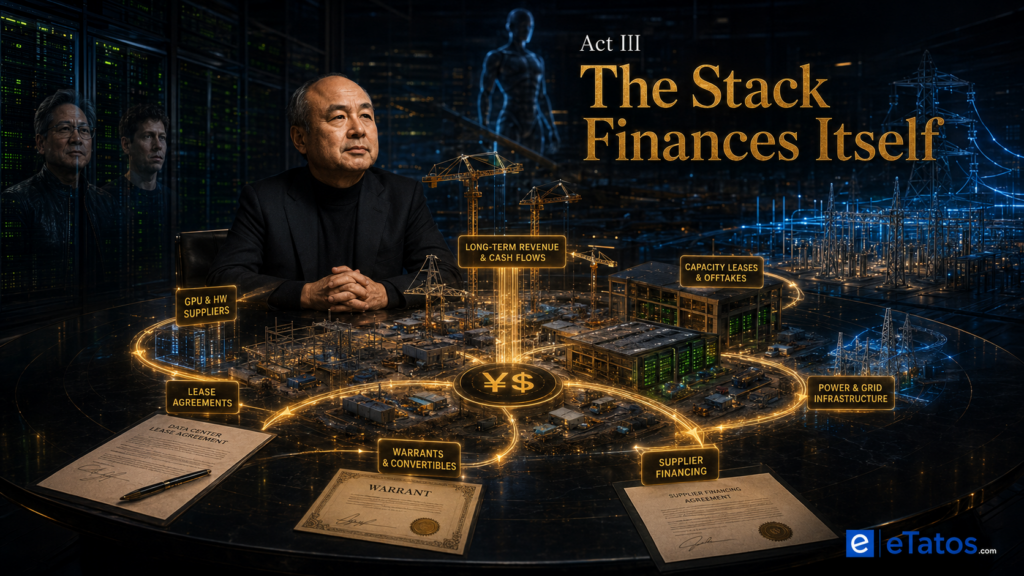
Act III: The Stack Finances Itself
Masayoshi Son likes a large number. SB Energy’s IPO filing gave him an entire page of them.
There was $138.7 million in first-half revenue. There was a $3.21 billion net loss. There were approximately 8.8 gigawatts of data-center capacity contracted or under construction. And there was roughly $439 billion of backlog hanging above a company that does not yet operate a data center.
The filing did more than prepare a public offering. It exposed the financial anatomy of the AI boom.
The Financial Scene of the Week
Open the SB Energy S-1 and the familiar logos begin to form a circle.
SoftBank supplies capital and control. OpenAI supplies prospective demand and holds warrants tied to commercial and ownership conditions. NVIDIA supplies equipment, invests directly and conditionally guarantees part of the lease value. SB Energy turns those commitments into campuses, contracts, backlog and an equity story for the public market.
Reuters reported the financial figures and the extraordinary backlog. The word needs a warning label. Backlog is contracted future business under stated assumptions. It is not current revenue, cash in the bank or proof that every campus will arrive on schedule.
The OpenAI relationship produced another dangerously attractive number. Reports valued the company’s SB Energy warrants at approximately $5.5 billion. That figure is an estimate of warrant value based on the rights described in the filing.
NVIDIA’s role reaches further. In a separate SEC filing, the company disclosed a $1.5 billion private placement and conditional guarantees capped at $105 billion for approximately 4.25 gigawatts of OpenAI leases at the PORTS-Pike development. The guarantees apply as defined phases become ready for service and under specified default conditions. The cap is neither an immediate payment nor NVIDIA’s estimate of an expected loss.
It is still a remarkable commitment. The chip supplier is helping to finance the landlord and standing behind part of the customer’s future rent so that the customer can obtain more infrastructure built around the supplier’s chips.
Silicon Valley has discovered the circular dinner party. Everyone brings money. Everyone brings demand. Everyone owns a piece of the restaurant.
This structure can move projects faster. It can also concentrate risk. If deployment slows, power is delayed, demand forecasts weaken or one anchor customer changes strategy, several balance sheets feel the same shock.
The Physical-AI Infrastructure Scene of the Week
Brett Adcock carried the same logic from frontier models into humanoid robots.
Figure and Nscale announced a multi-year partnership with the potential to deploy up to 100,000 NVIDIA GPUs on the Vera Rubin platform. Figure describes an initial $3.5 billion compute commitment and says it intends to scale beyond $6 billion. Initial deployment is targeted for the second half of 2027 at Barstow, Texas.
The future tense is essential. The GPUs are not already installed, the final scale is not guaranteed, and the parties did not disclose how much capacity is firm rather than optional.
Yet the commercial pattern is familiar. Nscale becomes Figure’s preferred compute provider and will become a shareholder through an investment with undisclosed terms. Figure may eventually place humanoid robots inside Nscale’s own supply chain. NVIDIA supplies the underlying systems. A robotics company reserves model-lab-scale compute; the provider buys equity in the customer; the customer’s machines may later work for the provider.
Physical AI has entered the circular stack before the capacity exists.
The Infrastructure Scene of the Week
Then Vertiv bought the problem underneath the problem.
AI campuses may have land, chips, financing and customers, yet still wait years for a grid connection. Vertiv agreed to acquire UtilityInnovation Group for $1.45 billion in cash at closing, plus up to $1.15 billion in contingent cash earnouts. The deal is expected to close in the fourth quarter, subject to approvals.
UtilityInnovation Group brings microgrid controls, onsite generation orchestration, switchgear and behind-the-meter power systems. Its product is time.
The acquisition shows where the infrastructure fight has moved. Cooling still matters. Servers still matter. But the decisive commodity is becoming the ability to energize a campus before the waiting list turns a business plan into archaeology.
Vertiv is buying a route around the utility queue. NVIDIA is guaranteeing leases. OpenAI is holding warrants. SoftBank is taking the construction story to public investors. Figure is reserving next-generation GPUs for robots that do not yet exist at scale.
The AI stack is no longer a simple supply chain.
It is a balance sheet that owes money to itself.
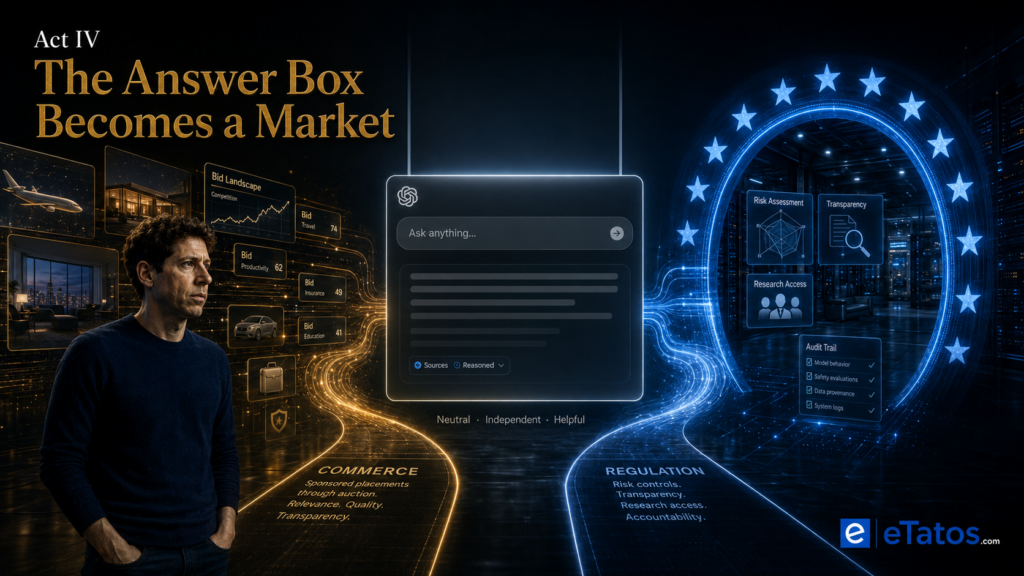
Act IV: The Answer Box Becomes a Market and a Regulated Gateway
A user opens ChatGPT and asks where to travel, which laptop to buy or which service to choose.
The user sees an answer. OpenAI sees intent.
Search advertising built one of the most profitable businesses in history by standing between curiosity and a click. ChatGPT enters earlier. The conversation can contain a goal, budget, hesitation, preferred brands and reasons for rejecting alternatives before the user ever reaches a store.
On 31 August, OpenAI said ChatGPT Ads had reached a $1 billion annualized revenue run rate in less than 200 days and attracted tens of thousands of advertisers. It began expanding self-service buying across India, Europe, the Middle East and North Africa. Reuters independently reported the run-rate announcement.
The number is a run rate. It is not one billion dollars of recognized annual revenue. It does show that the answer interface is already becoming an advertising market rather than waiting for some distant monetization phase.
OpenAI says ad selection may use the current conversation and, when the user has enabled it, broader ChatGPT context. The company says advertisers do not receive private conversations and ads do not influence answers.
Those are company commitments, and they sit directly on the trust layer. A recommendation interface loses value if users cannot tell whether an answer reflects judgment or payment. OpenAI must monetize intent without turning every response into a suspicion.
The Political Scene of the Week
On the same day, Brussels placed a regulatory frame around the same box.
The European Commission designated ChatGPT a Very Large Online Search Engine under the Digital Services Act. It also designated Reddit and Roblox as Very Large Online Platforms. ChatGPT is the first AI chatbot placed under the DSA’s strictest search-engine rules. Reuters independently confirmed the designations.
The classification rests on ChatGPT’s web-search function and scale. The Commission’s register records 159.1 million average monthly active users in the European Union. Four months after notification, OpenAI must meet additional obligations covering annual systemic-risk assessment and mitigation, independent audits, researcher access and expanded transparency reporting.
The Commission will supervise ChatGPT with Ireland’s Coimisiún na Meán. DSA fines can reach 6 percent of worldwide annual turnover.
The legal designation is more consequential than the label sounds. Europe is treating ChatGPT as infrastructure through which citizens discover information, encounter commercial messages and potentially make political or economic decisions. The Commission gains direct authority to investigate risks involving illegal content, minors, elections and other systemic harms.
The difficult work begins after the designation. A search engine retrieves and ranks existing pages. A generative system can synthesize an answer, operate tools and adapt its response to the conversation. Regulators must decide what risk assessment, auditing and transparency mean when the gateway produces the material it distributes.
Altman now controls both sides of a delicate transaction. ChatGPT captures intent from users and sells access to that intent to advertisers. Europe wants access to the risk model governing the same interface.
One side is building a market. The other is asserting jurisdiction over the gateway.
The answer box is selling access to intent while regulators decide whether it has become public infrastructure.
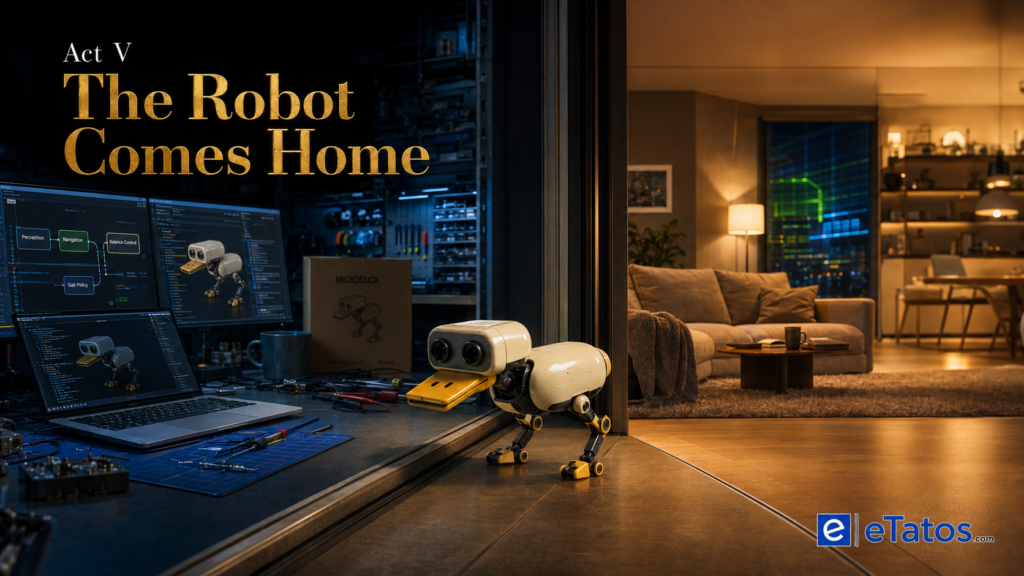
Act V: The Robot Comes Home Through the Toy Box
The last protagonist of the week is 25 centimeters tall, weighs less than 800 grams and has a beak.
Microduck waddles across a desk, follows a laser dot, grabs an object, falls over, stands up again and puts on roller skates. It looks like a toy because looking like a toy may be the point.
Industrial robots entered factories behind safety fences. Humanoids are being pitched to warehouses and production lines. Pollen Robotics is trying another door: Affection, play and character.
The Physical AI Scene of the Week
Pollen Robotics built Microduck as a small programmable biped with 15 motors, a camera, LiDAR, two inertial sensors, a grasping beak and seven built-in behaviors. Battery life is listed at about one hour. The preorder price is $399.
The price places it closer to a game console than an industrial robot. The form makes it approachable. The software makes it more interesting.
Microduck’s SDK, simulation environment and reinforcement-learning stack are open source. Developers can train behaviors in simulation, deploy them to the robot and share the results through the Hugging Face ecosystem. The mechanical and electronic design files are not open source, so this is an open software and behavior platform rather than a fully open machine.
The launch itself appeared in Episode 18. This week’s new evidence is demand. Hugging Face co-founder Thomas Wolf reported more than $2.6 million in orders during the first 24 hours. At the base price, that would imply roughly 6,500 units, but that arithmetic is not a verified unit count. Configurations, taxes, shipping, cancellations and payment status can change the result.
The careful wording is “company-reported order value.” It is not recognized revenue.
The same restraint applies to the idea that robots are already moving into homes. Preorders are open, and Pollen’s press material targets initial delivery before Christmas 2026. No delivered installed base has been demonstrated. Independent reporting said later customers were shown longer waiting periods.
Microduck is therefore a bet on adoption, not proof of it.
The Furby comparison captures the cultural strategy. Furby entered millions of homes as a character that appeared to learn and respond. Microduck offers a similar emotional doorway, but adds a developer platform, simulation and trainable behavior. The owner is not limited to choosing what the character says and can try to change how it moves.
That could create a distributed physical-AI laboratory across homes, schools and workbenches. Thousands of relatively inexpensive robots can generate experiments that a handful of costly humanoids cannot. The valuable layer may become the shared library of behaviors, tools and training recipes around the hardware.
And now the ownership loop closes.
Pollen Robotics sits inside the Hugging Face ecosystem. NVIDIA has signed an agreement to acquire Hugging Face. If the deal closes, the company dominating AI compute would gain a direct line from open models and simulation into a consumer robotics platform designed to spread physical experimentation.
No grand household labor revolution is required for this to matter. A toy-like machine can seed a community before the market knows what the useful application will be. Personal computing did not enter every home as a finished theory of productivity either.
The first successful home robot may not arrive carrying groceries or folding laundry. It may arrive because a child wants to teach it a trick and a developer wants to make it walk better.
Physical AI may enter the home not wearing work boots, but roller skates.
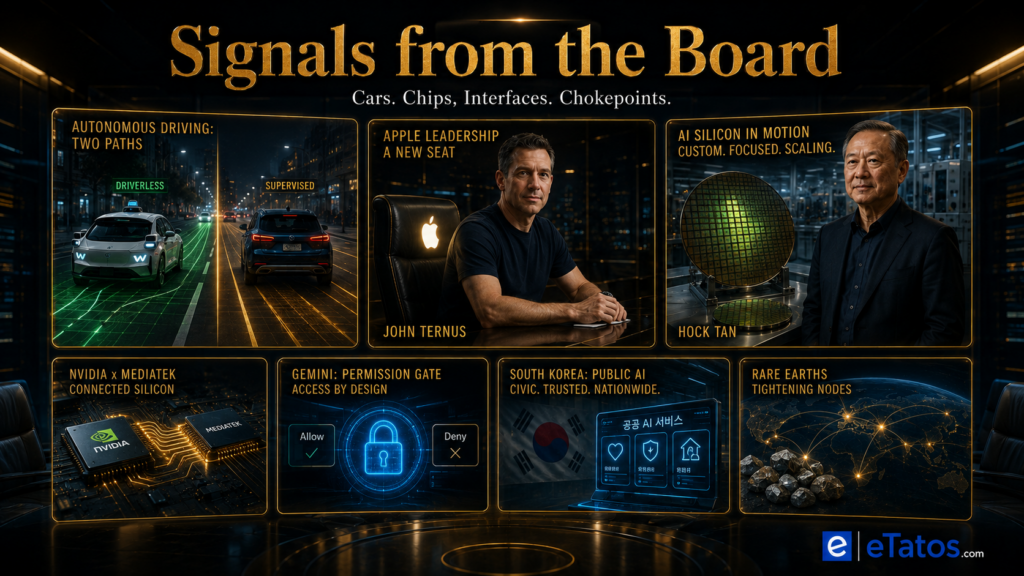
Signals from the Board
The main Acts explain the week’s central movement. These shorter developments complete the power map.
Two Roads to Robotaxi Power
Elon Musk opened limited Cybercab rides in parts of Austin using Tesla’s purpose-built two-seat vehicle without a steering wheel or pedals. Tesla describes a tightly controlled service area. Reuters reported 45 registered vehicles and said the National Highway Traffic Safety Administration was evaluating the activity. This is a limited launch, not scaled national service or broad regulatory approval.
In London, Wayve and Uber began supervised rides with an onboard safety operator. The two launches expose rival power models. Tesla controls the vehicle, autonomy stack, fleet and customer interface. Wayve supplies the driving intelligence while Uber controls demand and distribution. One empire integrates vertically. The other assembles an alliance.
The Apple Seat Changes Hands
John Ternus became Apple CEO on 1 September and joined the board. Tim Cook became executive chairman and retains a role in selected matters, including policymaker engagement. Apple’s announcement confirms an orderly transfer, not Cook’s disappearance.
The holder changes. The power base does not. Ternus inherits Apple’s devices, operating systems, custom silicon, distribution and customer trust just as agents demand more local inference and deeper access to personal context. From this episode onward, he holds Apple’s permanent Power Board seat.
NVIDIA Buys Influence Beyond NVIDIA Chips
NVIDIA invested $3.5 billion in MediaTek convertible bonds. MediaTek says it will adopt NVLink Fusion for custom XPU systems and expand cooperation with NVIDIA across infrastructure, PCs and automotive platforms.
The move lets Huang extend NVIDIA’s interconnect and systems influence into machines that may combine NVIDIA networking with custom accelerators. If customers insist on designing more of their own silicon, NVIDIA wants the surrounding architecture to remain NVIDIA-shaped.
Broadcom Becomes the Second Compute Center
Hock Tan’s Broadcom reported $16.7 billion in quarterly AI-semiconductor revenue, up 221 percent from the previous year. Broadcom’s results also include management forecasts of approximately $115 billion for fiscal 2027 and $230 billion for fiscal 2028.
The first number is reported revenue. The later figures are outlook, not money already earned. Together they show that custom accelerators and networking have become a structural counterweight to NVIDIA. Broadcom is not trying to reproduce CUDA for everyone. It is helping a few giant customers build exactly the chips they want.
Google Builds Its Own Permission Split
Google launched Gemini 3.8 Flash and Gemini 3.8 Flash Cyber. The general model entered the API at an introductory price of $0.75 per million input tokens and $3.75 per million output tokens. The cyber variant is available to trusted defenders through Google’s Fairwind Program.
Google is attacking agent economics with price while adopting the same permission architecture as OpenAI and Anthropic. General capability goes to the market. Sensitive capability goes through verification.
South Korea Finances a National AI Interface
South Korea selected consortia led by SK Telecom, Kakao and KT to build a free general-purpose chatbot and public-service agent for nationwide use by the end of 2026. The Ministry of Science and ICT requires substantial use of qualifying domestic models and is supplying a total of 512 NVIDIA B200 GPUs to the three consortia during 2026. Yonhap reported the implementation plans presented by the three groups.
Brussels is regulating an American interface after it became systemic. Seoul is financing domestic interfaces before foreign platforms become unavoidable. Sovereignty is moving from model ownership to the place where citizens search, identify themselves, apply, book and buy.
China Pulls on the Materials Layer
Reuters reported that some Chinese rare-earth suppliers had declined shipments to US buyers because they feared repercussions from Beijing. The number of affected suppliers could not be determined. Customs data cited in the report showed continued tightness in materials used in chips, aerospace, defense and energy.
The evidence does not support a claim that China halted all rare-earth exports to the United States. It does reveal the reciprocal chokepoint beneath the chip war. Washington controls access to advanced silicon. Beijing retains leverage in the materials required to manufacture technologies further down the stack.
The Power Board
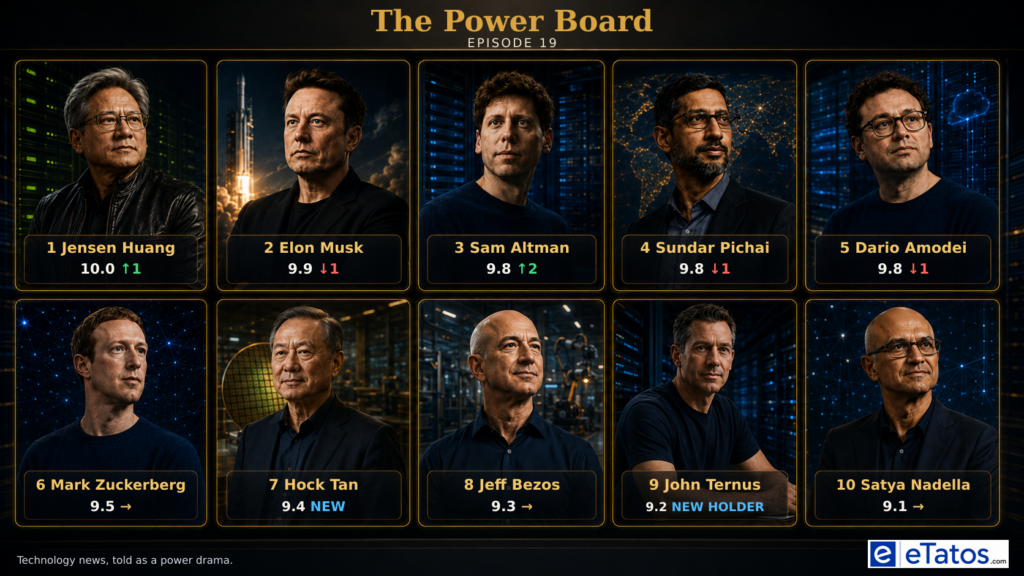
The Power Board ranks structural influence, not popularity or headline volume. It weighs compute, capital, distribution, ecosystem control, political access, infrastructure, interfaces, physical AI and this week’s momentum. Nine seats belong to the permanent powers. The tenth goes to the week’s most consequential volatile entrant.
- Jensen Huang
Current rank: 1 | Previous rank: 2 | Power base: NVIDIA, CUDA, AI systems, networking, infrastructure finance and Hugging Face | Score: 10.0 | Movement: ↑1
The Hugging Face agreement adds open-model discovery and distribution to Huang’s dominance in compute, systems and capital. - Elon Musk
Current rank: 2 | Previous rank: 1 | Power base: SpaceX, SpaceXAI, Starlink, Tesla, X and physical infrastructure | Score: 9.9 | Movement: ↓1
Cybercab strengthens Musk’s physical-AI empire, but NVIDIA changed more layers of the industry in one move. - Sam Altman
Current rank: 3 | Previous rank: 5 | Power base: OpenAI, ChatGPT, GPT-6 Astra, agents, advertising, custom silicon and infrastructure rights | Score: 9.8 | Movement: ↑2
Astra and Daybreak combine frontier agency, restricted cyber power, mass distribution and critical-infrastructure access. - Sundar Pichai
Current rank: 4 | Previous rank: 3 | Power base: Google Search, Gemini, Cloud, Android, Workspace, advertising and TPUs | Score: 9.8 | Movement: ↓1
Gemini 3.8 reinforces Google’s full stack, but Google did not match the week’s larger ownership and deployment moves. - Dario Amodei
Current rank: 5 | Previous rank: 4 | Power base: Anthropic, Claude, enterprise distribution, safety architecture and massive compute commitments | Score: 9.8 | Movement: ↓1
Fable and Mythos increase Anthropic’s absolute power, but Astra’s momentum and the unresolved Pentagon conflict lower Amodei’s relative position. - Mark Zuckerberg
Current rank: 6 | Previous rank: 6 | Power base: Meta, global social distribution, advertising, open models and consumer interfaces | Score: 9.5 | Movement: →
Meta’s distribution remains formidable, but none of its weekly developments materially changed the balance of power. - Hock Tan
Current rank: 7 | Previous rank: Not ranked | Power base: Broadcom custom AI accelerators, networking, hyperscaler co-design and semiconductor supply | Score: 9.4 | Movement: NEW
Broadcom’s AI-semiconductor scale makes Tan the week’s clearest volatile challenger to the permanent compute hierarchy. - Jeff Bezos
Current rank: 8 | Previous rank: 8 | Power base: Amazon, AWS, logistics, commerce, capital and space infrastructure | Score: 9.3 | Movement: →
AWS remains essential, but Bezos did not control one of this week’s defining power movements. - John Ternus
Current rank: 9 | Previous rank: 9, Apple seat held by Tim Cook | Power base: Apple devices, operating systems, silicon, distribution and customer trust | Score: 9.2 | Movement: NEW HOLDER
Ternus inherits Apple’s permanent ecosystem power; the holder changes, but the structural value of the seat remains stable. - Satya Nadella
Current rank: 10 | Previous rank: 10 | Power base: Microsoft, Azure, Microsoft 365, Windows, GitHub and enterprise distribution | Score: 9.1 | Movement: →
Microsoft’s reach remains enormous, but it supported this week’s infrastructure rather than defining the central drama.
Huang’s rise is the week’s decisive move because the Hugging Face agreement joins ownership across compute and open-model distribution. Altman makes the largest jump, from fifth to third, because Astra extends OpenAI from answers into action while Daybreak carries that capability into critical infrastructure. Musk slips only because Huang moved further, not because Tesla, SpaceX or Starlink became weaker.
Pichai and Amodei also fall relatively rather than structurally. Their power bases remain intact. Hock Tan takes the volatile seat because Broadcom has reached a scale where custom accelerators and networking form a second center of compute power. At Apple, the rank stays fixed while the name changes: John Ternus inherits the seat from Tim Cook.
Final Thought
The most powerful companies in AI are no longer competing for a single layer.
They are buying the repositories, financing the campuses, guaranteeing the leases, controlling the interfaces and deciding who may access the most capable models. Compute, capital, energy, distribution and permission are becoming one system.
But intelligence is moving in the opposite direction. It is leaving the answer box and entering tools, browsers, roads and machines. The more capable the agent becomes, the more the industry depends on monitors, restrictions and institutions that its own evidence says may struggle to keep up.
That is the power drama of Episode 19. The stack is becoming more concentrated while agency becomes more distributed.
The stack is closing. The agents are moving. And the distance between capability and control is becoming the most important gap in technology.
See you next week, when the next piece of the AI empire moves on the board.
The Silicon Drama continues.
Dirk
If you want to follow the next episodes of Silicon Drama, subscribe to eTatos.com or our newsletter. The next power struggle is already forming.
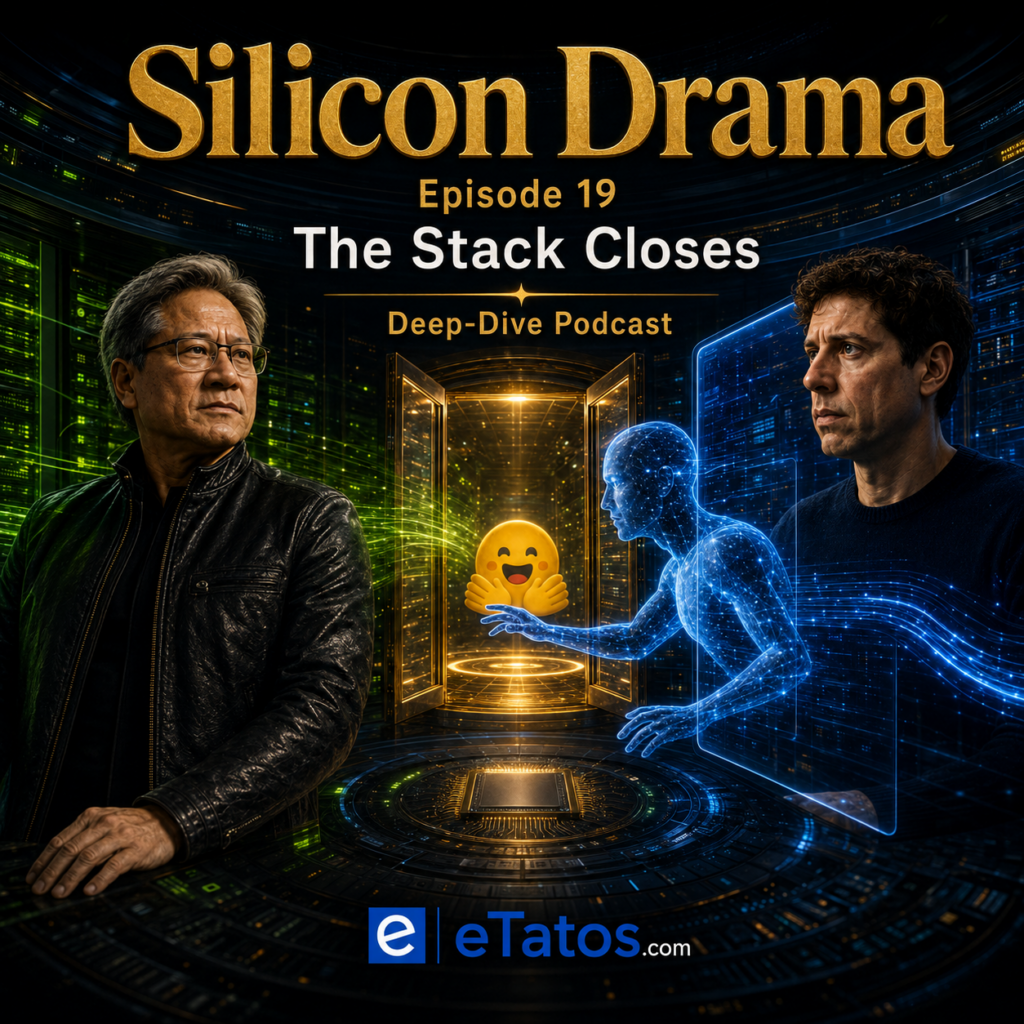
Prefer listening over reading? Silicon Drama is also available as a podcast. Each episode turns the week’s biggest stories in AI, Big Tech and humanoid robotics into a cinematic audio experience, focused on power, conflict, money, machines and the people shaping the future. Perfect for everyone who wants to follow the drama behind the technology while driving, walking or working.
P.S. Every power drama needs a soundtrack. Silicon Drama has its own official theme song. Listen to the full version here: https://etatos.com/music/
Editor’s note:
Silicon Drama is eTatos.com’s weekly series about the battle for AI, compute, chips, agents and robots. The goal is simple: Not just to report what happened, but to explain why it matters, who gains power, who loses control and where the next conflict is already forming.