

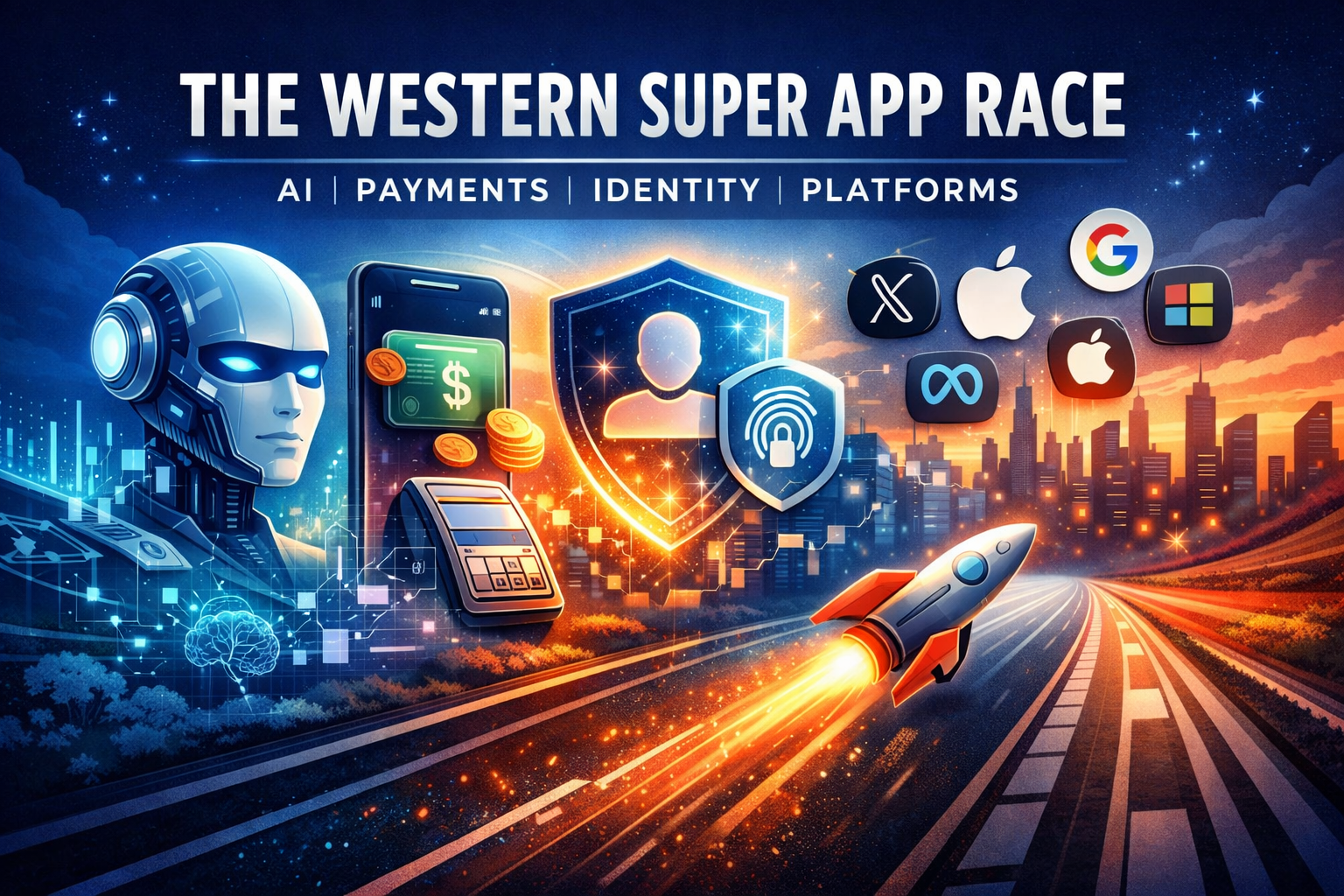
The race to build the Western super app is accelerating. AI companies, social platforms, operating system giants, and big tech players all want to become the main interface for how people work, communicate, pay, and manage daily life. But the winning model in the West will likely look very different from WeChat. Instead of one giant app doing everything, the future points toward intelligent orchestration across the apps and services people already use.
The idea of the “super app” has become one of the most important strategic debates in tech. In China, WeChat proved that one platform can become the default interface for communication, payments, commerce, and everyday services. In the West, that success has triggered a race to build something similar.
But the Western super app probably will not look like WeChat.
Instead of one giant monolithic app swallowing every use case, the more likely winners in Western markets are platforms that act as orchestration layers across tools, services, and workflows people already use. That is why the current race is so interesting. Different players are approaching the same goal from very different angles:
- WeChat built from messaging into payments and third-party services
- OpenAI is trying to build an AI-first workflow operating layer
- X is combining social distribution, messaging, AI, and payments into a multi-layer super app strategy
- Meta, Google, Apple, and Microsoft are pursuing adjacent strategies through messaging, operating systems, identity, and workplace platforms
The question is no longer whether the West will get a super app. The real question is: what form will it take?
What is the Western super app?
A Western super app is unlikely to be one giant app that replaces every other service. The more realistic model is an orchestration layer built on AI, payments, identity, and platform integration that connects the tools people already trust and removes friction across digital life.
Table of Contents
- What Made WeChat So Powerful
- Why the Same Model Is Harder in the West
- OpenAI and the AI-First Super App
- X and the Multi-Layer Super App Strategy
- Meta, Google, Apple, and Microsoft Are Also in the Race
- The Most Likely Outcome: Orchestration Beats Aggregation
- Conclusion
- FAQ
What Made WeChat So Powerful
WeChat became one of the most influential digital platforms in the world because it combined multiple layers of everyday digital life into one tightly connected ecosystem. Its real strength did not come from simply adding more features. It came from making communication, payments, and services reinforce one another.
WeChat is often described as an “everything app,” but that label can be misleading. It did not start as a giant all-in-one product. It started as a messaging and social platform, then expanded step by step into identity, payments, and third-party services.
That matters because WeChat’s strength was never just its long feature list. Its true advantage came from the way it combined three powerful layers inside a single daily habit:
- messaging and social interaction
- wallet and payment functionality
- third-party services inside the same environment
That combination created a strong flywheel. Messaging drove daily attention. Payments created habit and practical utility. Embedded services made the platform useful in more and more parts of everyday life.
Tencent’s scale gave WeChat the foundation to make this work. With more than 1.3 billion monthly active users, it had the reach needed to connect identity, social behavior, and payment functionality inside one interface.
The payment breakthrough: red packets and QR codes
A major reason for WeChat’s success was the way payments became part of social behavior. Sending money did not feel like a separate financial action. It became part of how people interacted.
The turning point came when digital red packets transformed wallet activation into a social ritual. During Lunar New Year, sending money became playful, familiar, and culturally natural. Instead of asking users to adopt a payment tool in isolation, WeChat embedded payments into relationships and celebrations.
The growth was extraordinary:
- around 16 million red packets in 2014
- around 1 billion in 2015
- more than 8 billion in 2016
- around 46 billion in 2017
This was not just a seasonal gimmick. It was a masterclass in product design. WeChat made payments feel social first and financial second.
At the same time, QR-code payments made merchant adoption cheap and simple. Businesses did not need expensive hardware or complicated rollouts. That lowered the barrier dramatically and turned mobile payments into an everyday utility.
Mini Programs: the app store without the app store
WeChat also lowered friction by keeping users inside the same ecosystem. The biggest leap came with Mini Programs. These allowed third-party services to operate inside WeChat without requiring users to download separate apps.
That changed the platform’s role entirely. Services became functions inside WeChat, not separate destinations competing for attention. A user could message friends, pay, order food, book appointments, hail a ride, and interact with businesses without leaving the ecosystem.
This was one of the most important innovations in the super app model. It created an internal distribution layer that pulled outside developers and services into the platform rather than pushing users out into the wider app economy. In doing so, WeChat evolved from a communication tool into a broader digital infrastructure.
Why the Same Model Is Harder in the West
The Western market works differently. The conditions that helped WeChat rise are not easily replicated in Europe or the United States.
Legacy banking and payments are already deeply established
In China, mobile wallets could leap ahead because the environment was more open to replacement. In Europe, the UK, and the US, mobile payments usually complement existing bank accounts and card rails rather than replacing them.
Consumers in Western markets already have strong payment infrastructure. Credit cards, debit cards, bank apps, Apple Pay, Google Pay, PayPal, and fintech services are already part of daily behavior. A new platform is not solving an empty-market problem. It is asking users to change habits that already work.
That means a payment-centered super app is not entering a vacuum. It is trying to break into markets where trust, convenience, and habit are already deeply embedded.
Regulation is far more fragmented
A company trying to combine messaging, identity, finance, and commerce in the West faces a far more complex set of rules. Privacy regulation, financial compliance, anti-money-laundering requirements, app store policies, authentication rules, and competition law all add friction.
Several structural barriers make Western consolidation harder:
- in the EU, the Digital Markets Act pushes interoperability and limits self-preferencing
- PSD2 and strong customer authentication improve security, but can add friction to payment flows
- GDPR makes it harder to combine data across messaging, finance, and commerce
- in the US, money transmission is regulated state by state, which makes national rollout slower and more operationally heavy
That creates a very different environment from the one in which WeChat scaled.
Users are more comfortable with specialized apps
Western users are used to choosing purpose-built apps for different needs. One app for work. One for shopping. One for messaging. One for streaming. One for payments. That makes feature overload a real risk. When one product tries to do too much, it can start to feel bloated rather than convenient.
Many consumers prefer best-in-class tools for different jobs rather than one central app doing everything. That does not mean bundled services are unattractive. It means the bundle has to be selective and useful, not overloaded.
This is why the Western super app is more likely to succeed by connecting services than by trying to absorb them all directly.
Why WeChat worked so well in China
WeChat’s rise was not just a product story. It was also a market-structure story. Several conditions strongly supported consolidation:
1. Identity-first infrastructure
Real identity linkage was easier to build into the system, making it simpler to connect accounts, verification, and wallet functionality.
2. Payment-first behavior
QR payments became practical and widespread, while social payment behavior accelerated trust and adoption.
3. Platform-first distribution
Mini Programs created an alternative to the classic app store model. Third-party services could live inside WeChat rather than fight for separate downloads.
4. A market structure that supported consolidation
A concentrated mobile payment landscape helped a small number of giant platform ecosystems dominate.
Put simply, WeChat grew in a market where digital identity, daily payments, developer distribution, and user behavior could all be pulled into one center of gravity. The West is far more fragmented.
OpenAI and the AI-First Super App
One of the most important strategic paths is the AI-first model.
Among Western approaches, this is one of the most interesting because it does not try to recreate WeChat directly. Instead of making payments or social networking the center of gravity, the AI-first model treats agentic work as the universal interface.
Instead of building one giant consumer mega-app that owns every service directly, an AI-first platform tries to become the place where users plan, search, decide, create, execute, and manage actions across many services.
In this model, the super app is not just a container for features. It is a workflow layer. It is less like a shopping mall and more like a workflow operating system.
Product consolidation as a signal
A major part of this strategy is product consolidation. A more unified environment can bring together:
- ChatGPT
- Codex
- a browser layer such as Atlas
- agentic task execution
The logic is simple. Fragmentation hurts user experience and quality. If users must jump between chat, browser, coding tools, and automation products, the experience becomes disjointed. A more unified surface reduces that complexity.
The building blocks of the AI-first model
An AI-first platform can help users:
- research across the web
- summarize information
- draft and edit content
- automate repetitive actions
- interact with tools and software
- connect workflows across multiple services
Its deeper building blocks include:
- Codex as a cloud-based software engineering agent that can work in parallel on features, bugs, and pull requests
- a Codex interface that can coordinate multiple agents across longer-running tasks
- an AI-native browser layer with the assistant attached to web context
- an action layer that selects tools and executes tasks end to end
- app directories and connectors that bring external tools and data into the workflow
This is not the same logic as WeChat’s Mini Programs. WeChat was about distribution of embedded services. The AI-first model is about safe access, orchestration, and action across existing tools.
Why the AI-first model is attractive
This is a powerful fit for Western markets because it does not require replacing every existing platform. It builds value on top of the fragmented digital environment that already exists.
Its structural advantage is that it is complementary, not replacement-driven.
It reduces complexity across many tools. It works with existing services instead of replacing all of them. It creates value through orchestration. It fits users who already depend on multiple apps and platforms.
OpenAI does not need to replace banks, e-commerce platforms, or enterprise software from scratch. It only needs to become the interface that helps users plan, research, execute, and control work across those systems.
That is a much better fit for an environment where services are fragmented, regulations are stricter, and users already rely on many trusted apps.
The biggest challenge
As soon as AI starts taking actions instead of only generating answers, trust becomes the deciding factor.
Users and companies need:
- visibility into what the system is doing
- control over actions and approvals
- strong security and reliability
- confidence that mistakes can be corrected quickly
- auditability and user control
- clear safeguards around autonomous execution
The AI-first model also faces real obstacles:
- agent reliability and safety
- regulation around general-purpose AI
- trust around systems that can act autonomously
- distribution challenges against operating system owners like Apple and Google
Once AI stops being just a chat tool and starts acting inside tools and websites, the standard changes. It must be far more reliable, observable, and controllable.
That means the AI-first super app will only scale if intelligence is matched by safety, transparency, and governance. Its advantage will not come from intelligence alone. It will come from intelligence plus trust.
Of course, it is far from certain that an AI-first super app, if it emerges, would come from OpenAI alone. Anthropic is clearly moving in a similar direction with Claude’s computer-use capabilities, Claude Code, and newer Claude releases that emphasize agent planning, long-context work, coding, and multi-step task execution.
Perplexity is also pushing into adjacent territory. Its Comet browser is positioned as a personal AI assistant that can automate tasks, research the web, manage email, and handle other delegated workflows, while its recent product updates show broader rollout of Comet and Perplexity Computer across enterprise, iOS, and Mac.
That means the race is still open. The likely winner will not be defined only by model quality, but by who can combine agentic capability, product integration, safety, and user trust into the most compelling everyday operating layer.
X and the Multi-Layer Super App Strategy
Another major model starts with payments as a wedge, and X is pursuing that path within a broader social, messaging, and AI ecosystem. The company’s direction increasingly combines three layers: social distribution, private messaging, and AI. That makes X one of the most interesting super app experiments in the West, because it is trying to turn an existing social platform into a more complete operating environment for communication, discovery, transactions, and creator activity.
X also benefits from something few platforms can replicate easily: its role as a real-time information network. Even after years of competition from newer platforms, X remains one of the most influential places for breaking news, live commentary, market reactions, and early tech insights. For many journalists, founders, investors, and highly engaged users, major stories still surface on X before they are fully processed elsewhere. That real-time discovery layer strengthens X’s broader super app ambitions, because it gives the platform a daily relevance that goes beyond payments, messaging, or AI alone.
At the center of this strategy is X Money. Elon Musk said in March 2026 that X Money would enter early public access in April 2026, and Reuters described it as part of the company’s broader push to turn X into an “everything app.” That is an important distinction: X Money is strategically significant, but it should still be understood as an early rollout rather than a fully mature, broadly established financial platform. X is building this layer with existing financial infrastructure, including a Visa partnership, rather than trying to recreate banking rails from scratch.
That approach gives X a meaningful opportunity. A platform that already has an audience and a social graph can potentially embed payments directly into creator monetization, tipping, peer-to-peer transfers, subscriptions, and merchant activity. If those financial features feel native to the platform, they can deepen retention and make X more useful in everyday digital life. In other words, the goal is not just to add a wallet, but to create a tighter loop between attention, interaction, and transactions.
Messaging is also becoming a more important part of the picture. X has launched X Chat, its upgraded private messaging layer, with encrypted messaging, encrypted file sharing, disappearing messages, voice and video calls, and rollout on iOS and the web, with Android support planned. Strategically, this matters because a super app needs more than a payment layer. It also needs a private communication channel where users can talk, share, coordinate, and eventually transact in context. That makes messaging a natural complement to the finance-first strategy.
Grok adds another dimension. If X can combine a social feed, private messaging, payments, and a native AI assistant inside one ecosystem, the platform starts to look less like a single-purpose financial expansion and more like a multi-layer digital hub. Grok can strengthen discovery, recommendations, assistance, and task support across the platform, which could make the overall experience feel more connected and more useful over time. At the same time, the public scrutiny around Grok shows how central trust and product quality will be if AI is meant to become a core layer of the X ecosystem.
This is why X should not be viewed as a purely finance-first story anymore. It is increasingly a social + messaging + AI + payments story. That broader combination gives it a more realistic path toward super app relevance in Western markets, because it creates multiple reinforcing entry points instead of relying on a wallet alone. Payments may still be the clearest utility wedge, but messaging and Grok could be just as important in making the ecosystem feel sticky and differentiated.
The main challenge is execution. In Western markets, financial products still require strong trust, operational reliability, and compliance, and AI-driven platforms face their own scrutiny around safety and governance. But if X can align these pieces successfully, its long-term opportunity is larger than payments by themselves. The upside is not just becoming a social platform with money features. It is becoming a more unified environment where users communicate, discover, transact, and increasingly act with the help of AI.
Meta, Google, Apple, and Microsoft Are Also in the Race
The super app future will not be shaped by one or two companies alone. The largest platform owners may still hold the strongest long-term positions because they already control critical gateways.
The race is not only about OpenAI and X. It also includes the biggest technology companies, each with a different strategic advantage.
Meta: messaging as a commerce layer
Meta has enormous leverage through messaging. If customer support, product discovery, business interaction, and shopping continue moving into chat, messaging platforms become much more than communication tools. They become commercial infrastructure.
WhatsApp is Meta’s strongest asset here. It is the closest large-scale Western parallel to a messaging-first model. But large distribution does not automatically translate into payment dominance. Even with scale, differentiation and competition still matter.
Google: orchestration through the operating system
Google’s advantage is not necessarily one giant app. It is Android, app integration, assistant capabilities, and AI-driven coordination across services.
Google is embedding more agentic functionality closer to the operating system. That makes it a natural contender in a world where orchestration matters more than ownership of every feature.
This matters because it shifts the battleground from app competition to platform control.
Apple: identity, wallet, and trust
Apple has one of the strongest ecosystem positions in the market because it controls the device, the operating system, the wallet layer, and a trusted identity framework.
Apple is building one of the most powerful identity and payments layers in the Western market through Wallet, Digital ID, passes, credentials, and secure device-level integration.
Apple does not need to build a classic super app if it already controls the secure layer through which many services flow. It may never present itself as “one app for everything,” but it does not need to. If identity, payments, and trust run through the operating system, Apple controls one of the strongest super app subsystems in the market.
Microsoft: the enterprise super app
In business environments, Microsoft already operates something close to a super app through Teams, Microsoft 365, workflows, bots, and enterprise integrations.
In the workplace, Microsoft Teams already functions like a super app. It unifies communication, collaboration, apps, workflows, and execution in one operational context.
That is an important reminder that the super app model does not only apply to consumer mobile behavior. In B2B, it often appears first as a workplace platform.
The Most Likely Outcome: Orchestration Beats Aggregation
The Western super app will most likely be defined by orchestration, not aggregation.
That means the winner will probably not be the company that squeezes the most features into one interface. It will be the one that makes fragmented services feel connected, intelligent, and easy to use together.
The strongest models are likely to include:
- AI systems that coordinate tasks across tools
- operating systems that connect apps and actions invisibly
- wallet and identity layers that simplify trust and access
- enterprise platforms that unify work in one environment
This points to a very different future from the classic “everything app” dream. The real opportunity is not owning every vertical directly. The real opportunity is becoming the trusted layer that connects them.
The most likely path to mainstream adoption in the West is not a WeChat-style monolith. It is an orchestration layer.
That is why the AI-first approach currently appears structurally better positioned than the finance-first approach for broad adoption. It can sit across existing tools and services without trying to replace all of them. That makes it more compatible with Western regulation, existing app diversity, and entrenched financial infrastructure.
At the same time, the long-term wildcard may be the operating system itself. Apple and Google have the deepest distribution, the strongest defaults, and the closest access to user behavior, identity, and device-level actions.
Conclusion
The Western super app is coming, but it will not look like WeChat.
WeChat showed what platform consolidation can look like when messaging, payments, identity, and third-party services reinforce each other inside one ecosystem.
But the West is not China.
Legacy banking is stronger. Regulation is more fragmented. Data privacy is more restrictive. Platform gatekeepers are more contested. User behavior is more fragmented.
It is unlikely to be one bloated destination app that tries to do everything itself. Instead, it will more likely emerge as a trusted orchestration layer that links apps, payments, identity, workflows, and services across digital life.
Some companies will pursue this through AI agents. Others will focus on payments, messaging, operating systems, or workplace platforms. But the strategic direction is clear.
In the West, the biggest winner will not be the company that owns everything.
It will be the company that removes the most friction between everything that already matters.
The companies that win this race will not simply offer the most features.
They will offer the least friction.
FAQ
What is a super app?
A super app is a platform that combines or coordinates multiple digital services such as messaging, payments, commerce, identity, and productivity in one ecosystem or interface.
Why is WeChat hard to copy in Europe and the US?
Western markets have stronger legacy banking systems, stricter privacy rules, more fragmented regulation, and consumer habits shaped around specialized apps. These factors make direct platform consolidation much harder.
Why is AI important for the future of super apps?
AI can act as an orchestration layer across multiple tools and services. Instead of forcing users into one giant app, it can connect the apps they already trust and make workflows smoother.
Is finance still a strong entry point for a super app?
Yes, but it is harder in the West than many expect. Payments can create habit and utility, but finance also requires high trust, regulatory compliance, customer support, and operational reliability.
Who are the biggest players in the Western super app race?
Important players include OpenAI, X, Meta, Google, Apple, and Microsoft. Each is approaching the opportunity from a different angle, such as AI, social platforms, payments, identity, operating systems, or enterprise software.