
Humanoid robotics has reached a decisive moment.
For years, spectacular videos shaped public perception: robots walking, waving, dancing, lifting boxes or impressing audiences on stage. But the real breakthrough of this technology will not be measured by whether a humanoid robot goes viral on social media.
It will be measured by whether it can perform useful work in a real, narrow, chaotic and safety-critical environment.
That is exactly why the latest news from Japan matters so much.
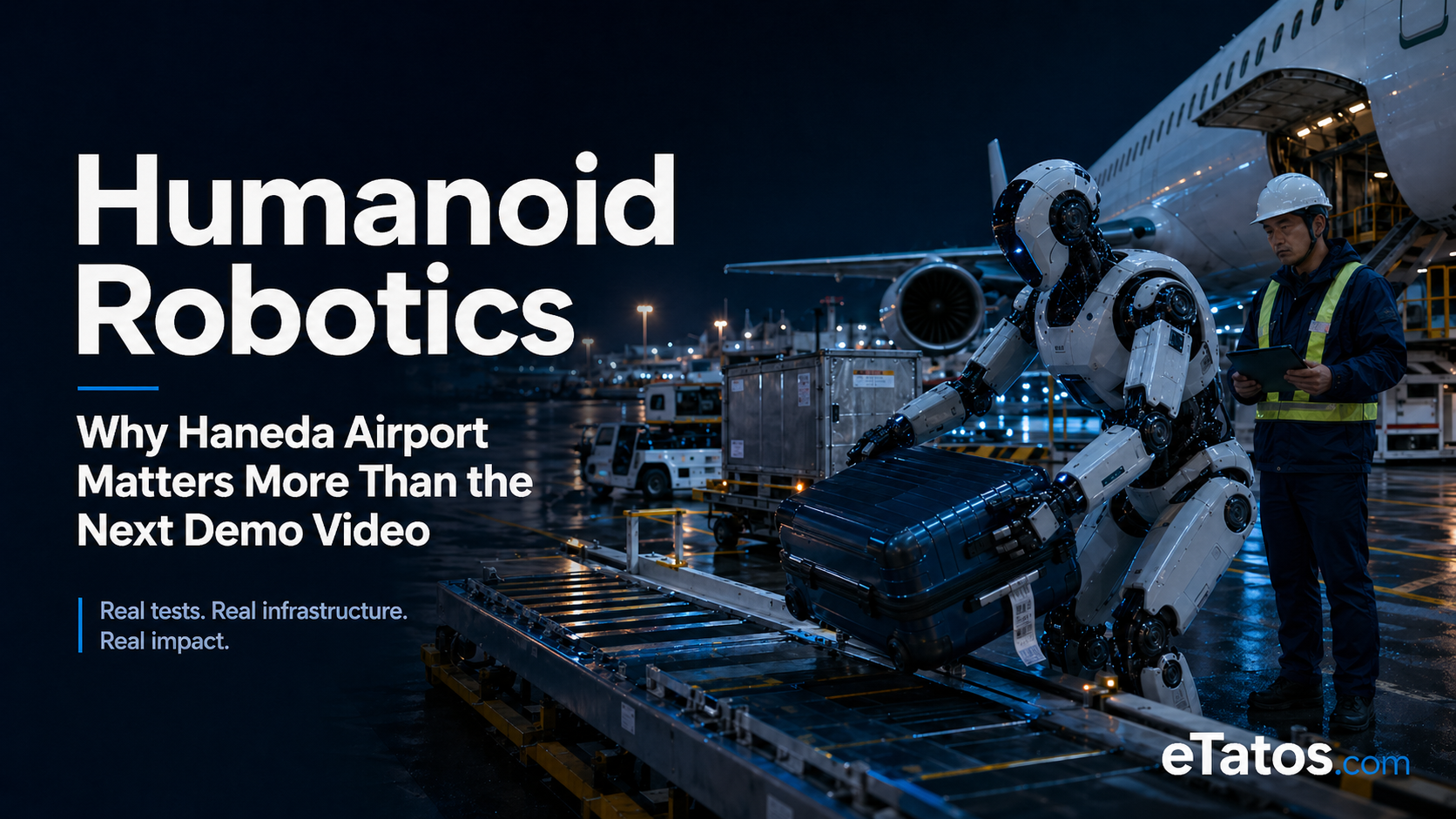
Starting in May 2026, Japan Airlines, JAL Ground Service and GMO AI & Robotics Trading will launch a demonstration trial using humanoid robots in airport operations at Tokyo Haneda Airport. According to JAL’s official announcement, this will be Japan’s first demonstration trial of humanoid robots in an airport environment. The goal is to automate ground-handling processes, improve efficiency and reduce the physical burden on human workers.
At first glance, this may sound like just another robotics headline. But in reality, it touches one of the most important strategic questions in the entire industry:
Do we need humanoid robots because they look like humans?
Or do we need them because our world was built for humans?
The answer from Haneda is remarkably clear.
JAL explicitly argues that conventional automation reaches its limits in airport environments. Ground handling takes place in tight spaces, around aircraft, baggage systems, vehicles and ground support equipment. Fixed automation systems and specialized single-purpose robots struggle to adapt flexibly to existing infrastructure and complex workflows.
This is exactly where humanoid robots may have an advantage: they offer human-like mobility and can operate in environments originally designed for people.
That is the key point.
Humanoids are not automatically the most efficient form of robot. A conveyor belt is better at moving items. An industrial robotic arm is more precise in a factory cell. An autonomous vehicle is often more useful for transportation tasks.
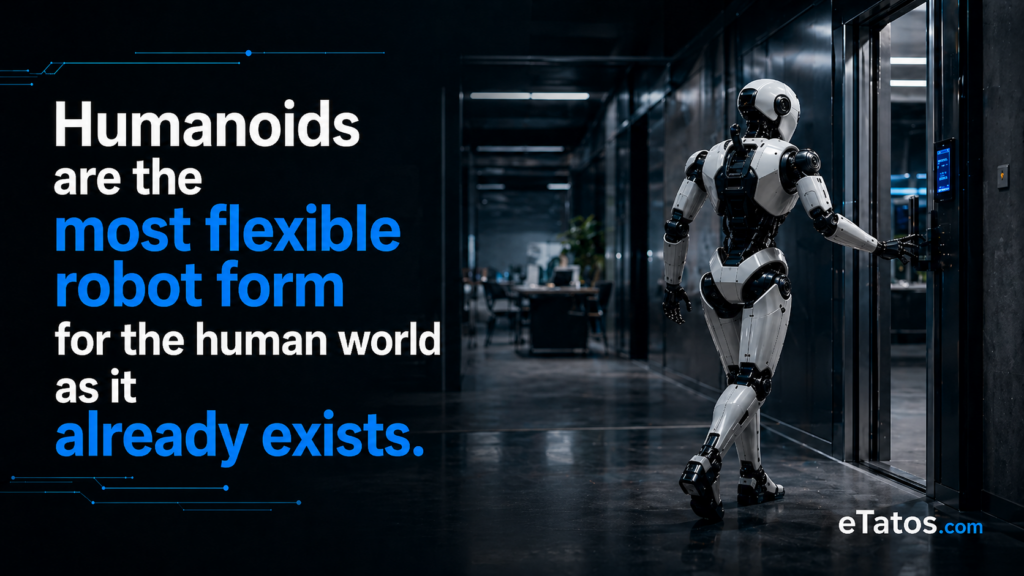
But humanoids may be the most flexible robot form for the human world as it already exists.
And that is where their economic potential lies.
If a robot can move luggage, clean aircraft cabins, operate simple equipment, use doors, move among people and function in existing workspaces without requiring an entire airport to be redesigned, then a completely different model of automation becomes possible.
Not anymore:
We redesign the world for robots.
But instead:
We build robots that can work in our world.
That is the fundamental difference.
Airports are a particularly interesting test market for this. Haneda is not a sterile laboratory. It is a high-frequency, complex operation handling more than 60 million passengers per year. Media reports also name Unitree as the manufacturer of the robots being tested and mention technical specifications of around 130 centimeters in height, roughly 35 kilograms in weight and approximately two to three hours of runtime per charge.
The planned use cases also reveal where the market really stands today.
This is not about robots replacing entire teams tomorrow. It is about integrating robots as physical assistance systems into tightly controlled operational processes. JAL describes a phased approach: first, airport workflows will be visualized and analyzed. Then repeated tests will follow in realistic airport environments. The long-term goal is to create a model in which humanoid robots complement human work and reduce physical strain.
That is more sober than many headlines.
But that is exactly why it is so relevant.
The first real wave of humanoid robotics will probably not begin in private homes. It will also not begin with a robot that can do everything. It will begin where work is physically demanding, repetitive, expensive, labor-intensive and at least partially standardized.
Airports. Logistics centers. Factories. Hospitals. Hotels. Train stations. Warehouses. Cleaning services. Basic maintenance and transport processes.
Japan is the perfect testbed for this. The country is facing an aging population, labor shortages and strong tourism growth at the same time. Aviation is therefore under pressure from both sides: rising demand, but fewer available workers for physically demanding jobs. In this context, robotics is no longer just a technological curiosity. It becomes strategic infrastructure.
Still, the hype needs to be kept in check.
The decisive questions remain open:
Can these robots work long enough? Can they lift enough weight? Can they grip reliably? Can they operate safely next to humans? Can they handle the reality of airport operations? Can they function under wind, noise, time pressure, tight spaces and unpredictable situations? And above all: Does their use make economic sense compared with human labor, conventional automation or specialized robots?
Two to three hours of runtime would still be limited for real shift work. This shows that the next major advances in humanoid robotics will not come from better AI models alone. They will also depend on better batteries, stronger actuators, more reliable grippers, robust safety systems, fleet management and clearly defined operating processes.
Humanoid robotics is not just an AI topic.
It is a systems topic.
Hardware, software, safety, maintenance, energy, labor law, process design and economic scaling all have to come together. Only then does an impressive robot become a productive worker in everyday industrial operations.
At the same time, current market overviews and rankings show how much perception is changing. Names such as Tesla Optimus, Unitree, Agility Robotics, UBTech, Apptronik and Boston Dynamics are no longer judged only by technical capabilities. They are increasingly assessed by real-world deployment, commercial traction, price, visibility, momentum and the balance between hype and reality.
That is also a signal.
The market is beginning to evaluate humanoid robots not just as a science-fiction vision, but as an emerging product category.
And this is exactly where the real significance of the Haneda announcement lies.
The robot itself is not the news. The video is not the news. Even the airport is not the news.
The news is this:
Humanoid robots are slowly leaving the stage of demonstrations and entering the world of operational processes.
That is the moment when attention turns into responsibility.
Because a humanoid robot in airport operations does not need to look cool. It needs to work. Repeatedly. Safely. Predictably. Maintainably. Economically.
That is much harder than producing a viral demo video.
But it is also much more important.
My assessment:
The Haneda trial could become a reference case for the entire industry. Not because it immediately proves that humanoid robots are ready for the mass market. But because it shows what kind of environment could become the first real market for humanoids.
Not the completely unstructured world. Not immediately the private household. Not the science-fiction scenario of an all-purpose robot.
But real working environments that were built for people and increasingly struggle to find enough people.
If humanoid robots can work there, a new phase of automation begins.
Then it is no longer only about installing machines in factories.
It is about introducing machines into human infrastructure.
And that may ultimately be the real reason why humanoid robots matter.
Not because they imitate humans.
But because they can work in a world made for humans.
Humanoid robotics will not be decided by the most spectacular video.
It will be decided where robots deliver real operational value for the first time: in narrow, complex, physically demanding and safety-critical work environments.
The trial at Tokyo Haneda Airport is therefore more than an interesting news story.
It is a glimpse into the next phase of automation.
What do you think: Will airports, logistics centers and factories become the first real mass market for humanoid robots?