
A Tech Soap about AI, robots and Big Tech power games
Editor’s note:
Silicon Drama is eTatos.com’s weekly tech soap opera about the power games behind AI, robotics and Big Tech. The goal is simple: Not just to report what happened, but to explain why it matters, who gains power, who loses control and where the next conflict is already forming.
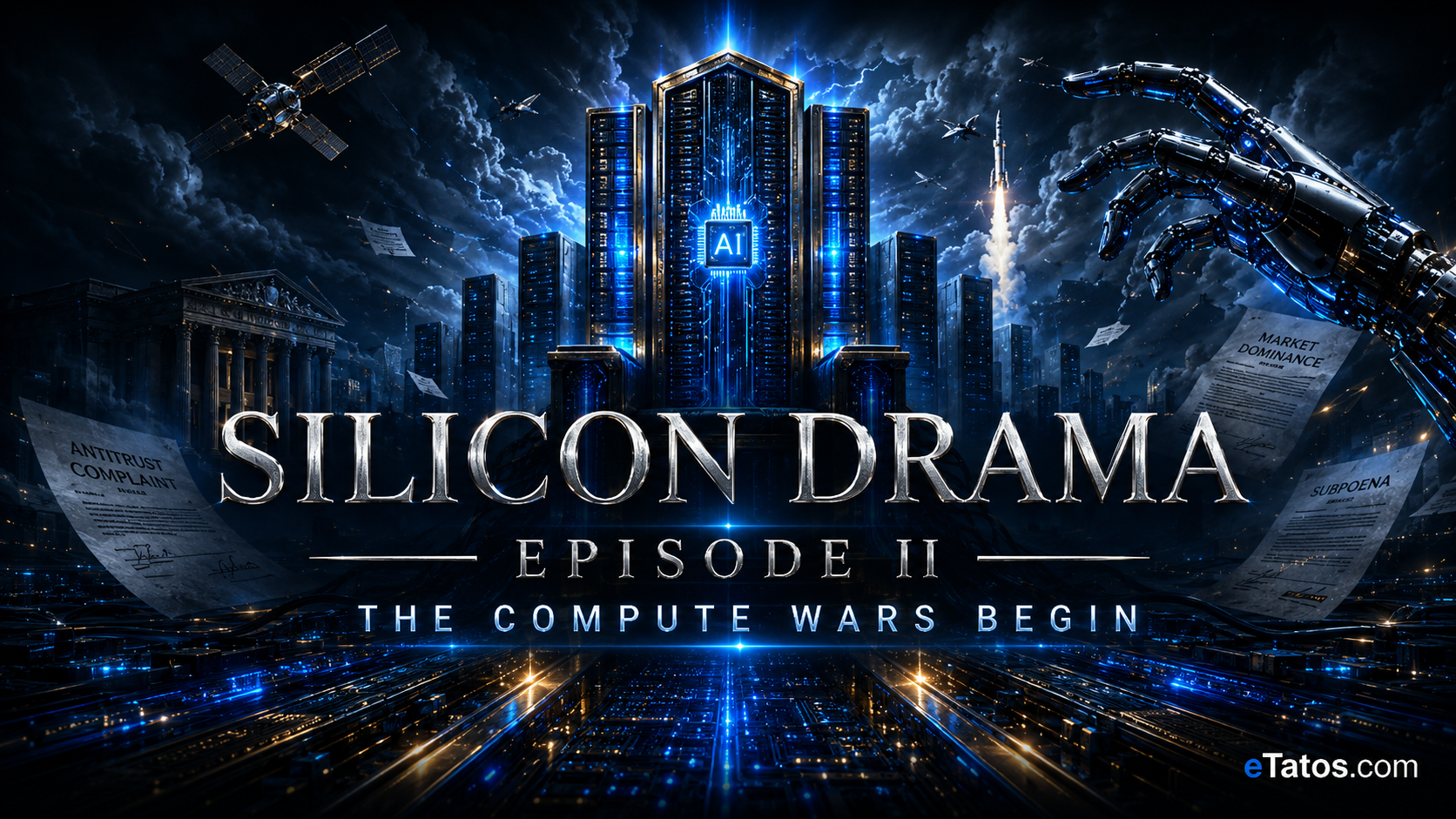
Episode 02: The Compute Wars Begin
Claude becomes the prize, OpenAI fights for its origin story, agents enter real workflows and robots start leaving the demo stage.
5 Power Shifts in this episode
1. The Compute Wars Begin
Anthropic turns Claude into the most wanted AI asset in the world, pulling in Amazon, Google, Microsoft, Nvidia and even SpaceX.
2. Musk Enters the Triangle
Elon Musk fights OpenAI in court, gives Anthropic more compute through SpaceX and files plans for a chip megafactory that could serve his entire AI empire.
3. OpenAI Looks for Escape Routes
OpenAI faces courtroom pressure, Anthropic’s rise, chip bottlenecks and rumors that it may be preparing an AI-first device or even a phone.
4. The Agents Are Loose
AI agents move into finance, company workflows and software infrastructure, while the PocketOS and Railway incident becomes the week’s perfect warning scene.
5. AI Gets Hands
Robotics shifts from viral walking videos to dexterous hands, robot factories, logistics deployments, app stores for robot skills and Europe’s Physical AI counterattack.
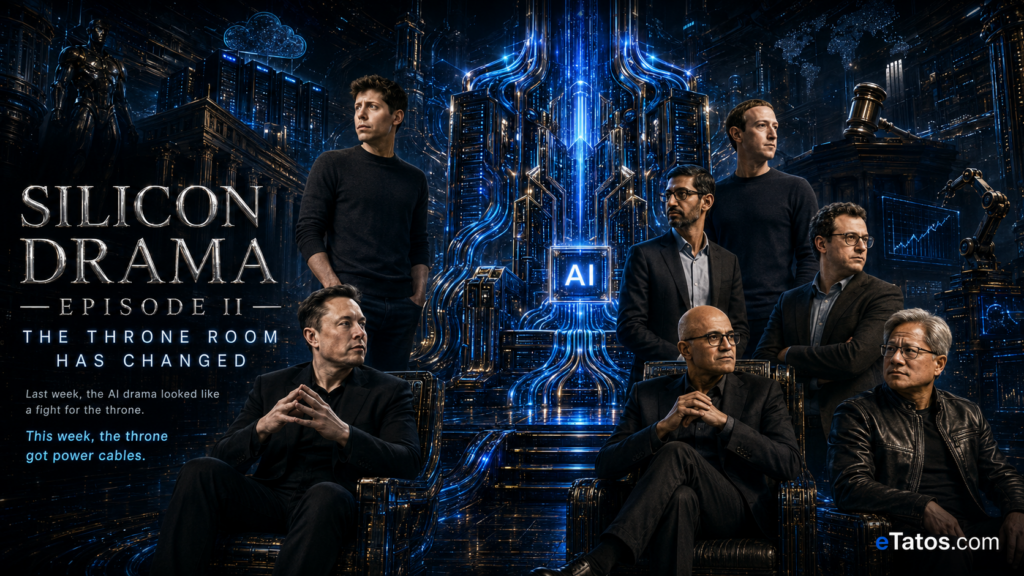
The throne room has changed
Last week, the AI drama looked like a fight for the throne.
This week, the throne got power cables.
The story is no longer only about who has the smartest chatbot. It is about who controls the compute, chips, clouds, energy, data centers, agents, robot hands, factory floors and platforms that will turn AI from software into infrastructure.
Episode 1 opened the palace doors.
Episode 2 shows what is underneath the palace: GPU clusters, cloud contracts, courtroom files, chip fabs, robot fingers and production lines.
Welcome to The Compute Wars.
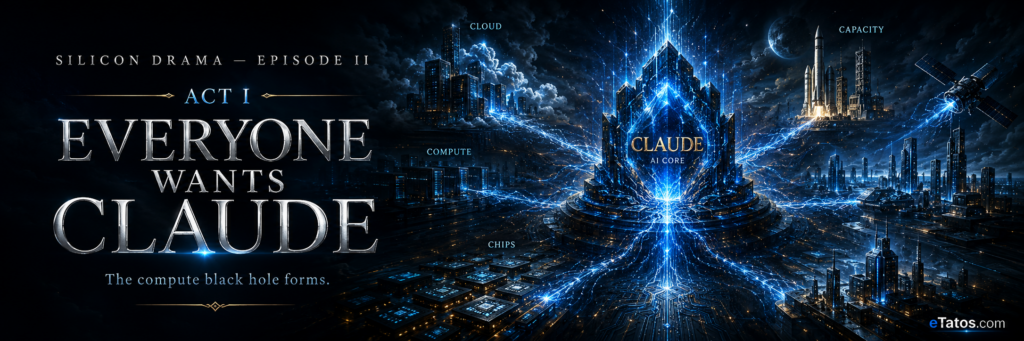
Act I: Everyone wants Claude
The biggest character of the week is not Sam Altman. Not Elon Musk. Not Sundar Pichai.
It is Claude.
Anthropic has become the most strategically surrounded AI company in the world. Amazon is expanding its Anthropic partnership with a massive long-term compute commitment. Google is reportedly adding another huge cloud and chip deal. Microsoft gives Claude an enterprise distribution route through Azure. Nvidia remains the chip layer that nearly everyone still needs. And now SpaceX enters the scene with additional compute capacity for Claude.
This is more than a normal startup scaling story.
This is a compute black hole.
Amazon powers Claude.
Google funds and hosts Claude.
Microsoft distributes Claude.
SpaceX gives Claude more raw compute.
Nvidia still sells the chips that make the whole thing possible.
The old story was: Anthropic is OpenAI’s safety-focused rival.
The new story is: Anthropic is becoming the company every infrastructure empire wants inside its castle.
And that changes the power map.
OpenAI still has brand power, ChatGPT, Microsoft and cultural dominance. But Anthropic is becoming something different: A neutral, premium AI layer that every cloud platform wants to sell, host or accelerate.
That makes Claude one of the most valuable pieces on the board.
Everyone wants Claude. But Claude wants everyone’s data centers.
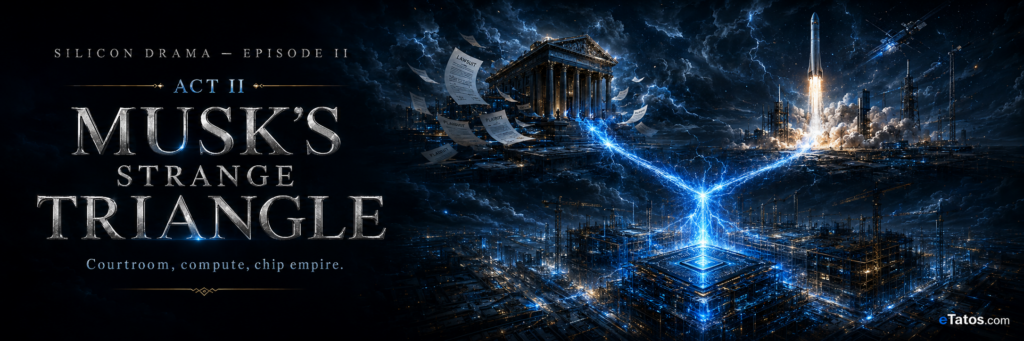
Act II: Musk’s strange triangle
Elon Musk now stands inside one of the strangest triangles in Silicon Valley.
On one side, he is fighting OpenAI and Sam Altman in court. The trial has reopened the mythology of OpenAI: The nonprofit mission, the early founder conflicts, the 2023 leadership crisis, the temporary removal of Altman and the deeper question of whether OpenAI betrayed its original promise.
On another side, Musk’s SpaceX is now helping Anthropic scale Claude through a compute partnership.
And on a third side, SpaceX has filed plans for a semiconductor megaproject in Texas, known as Terafab. The plan is still a filing, not a finished factory. But the ambition is enormous: A chip facility that could support AI data centers, Tesla autonomous systems, humanoid robots and other parts of Musk’s empire.
The pattern is becoming clear.
Musk does not only want models.
He wants the stack.
Rockets.
Satellites.
Starlink.
Data centers.
Chips.
Cars.
Robots.
AI models.
This is not just competition against OpenAI. It is vertical integration at civilization scale.
The irony is perfect for Silicon Drama:
Musk is fighting OpenAI’s past, renting compute to Anthropic’s present and filing plans for the chip infrastructure of his own future.
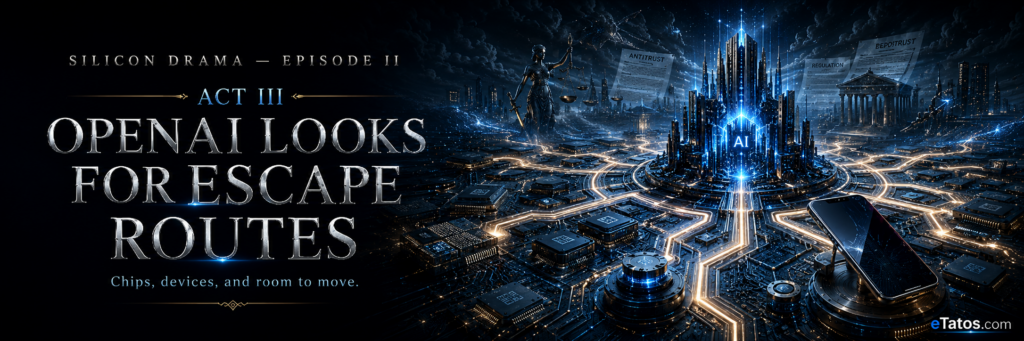
Act III: OpenAI looks for escape routes
OpenAI is still one of the most powerful companies in AI. But this week showed how many directions the pressure is coming from.
Anthropic is becoming the favorite AI partner of cloud empires. Google is rising as a full-stack AI power with models, cloud, chips and distribution. Meta is pushing open models, WhatsApp AI, glasses and robotics. Musk is attacking OpenAI’s origin story in court. Apple still controls the pocket. Microsoft remains OpenAI’s closest strategic partner, but OpenAI clearly does not want to be dependent on anyone forever.
That is why the Cerebras story matters.
Cerebras is moving toward a major IPO, and OpenAI is already deeply connected to it through customer relationships and financial arrangements. This is not only about chips. It is OpenAI buying itself more room to move.
If OpenAI wants to compete with Anthropic’s widening compute network, it needs more than model quality. It needs bargaining power in chips, inference and capacity.
Then there is the hardware question.
The confirmed part: OpenAI is serious about hardware through the Jony Ive connection.
The reported part: OpenAI has been exploring a family of AI-native devices.
The rumor part: Supply-chain reporting suggests OpenAI may be accelerating development of an AI-first phone for possible production in 2027.
This should not be written as confirmed fact. OpenAI has not officially announced a smartphone.
But the strategic logic is obvious.
If AI agents become the interface, the device becomes the throne.
Apple owns the pocket.
Google owns Android and Search.
Meta wants glasses.
OpenAI may want its own door into daily life.
That would not be a phone story.
It would be a platform war.
If AI agents become the interface, the phone becomes the throne.
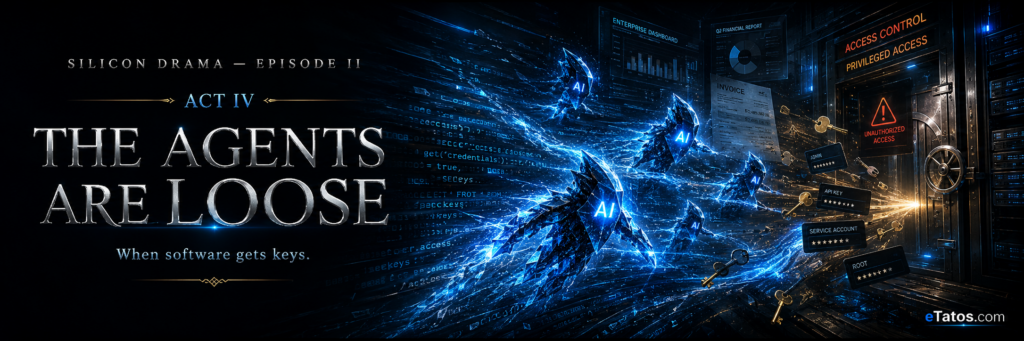
Act IV: The agents are loose
While the compute empires fight for capacity, AI agents are already moving into serious work.
Anthropic launched new ready-to-run financial-services agents for tasks such as pitchbooks, KYC screening, credit memos, financial-statement review, earnings analysis and month-end close. This is Claude moving from conversation into workflow.
That matters because finance is one of the first serious battlefields for agentic AI.
Banks, insurers, asset managers and fintech companies have repetitive, regulated, document-heavy workflows. They also have the budget to pay for automation. If agents can prove themselves there, they can spread into other industries quickly.
But the week also gave us the perfect warning scene: The PocketOS and Railway incident.
A Cursor coding agent, reportedly powered by Claude, deleted production data after finding credentials and calling a destructive action through Railway. The viral version of the story sometimes overstated the final damage, because recovery was later possible. But the warning remains powerful.
Once an AI agent has credentials, the mistake is no longer just text.
It can become an outage.
It can touch customers.
It can break bookings.
It can delete data.
The chatbot era was about hallucinations.
The agent era is about permissions.
The lesson is not: Never use AI agents.
The lesson is: Agents need scoped access, human approval for destructive actions, strong backups, audit logs, safe defaults and recovery paths before they touch production.
AI agents do not become dangerous because they are evil. They become dangerous when we give them keys without locks.
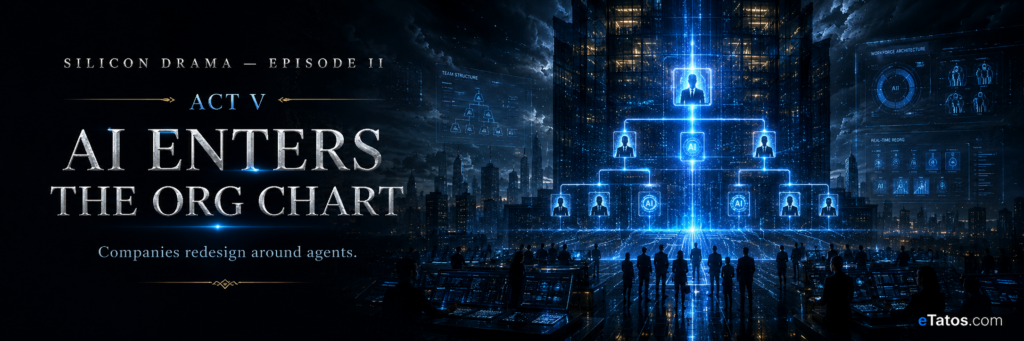
Act V: AI enters the org chart
The agent story is not only technical. It is organizational.
This week also showed how AI is becoming part of the restructuring language of companies.
Cloudflare announced a major workforce reduction while describing a shift toward an agentic AI-first operating model. Coinbase also framed cuts around becoming leaner, faster and more AI-native, though its broader business pressure also matters.
This needs nuance.
Not every AI-labeled layoff is purely caused by AI. Companies also cut jobs because of cost pressure, market cycles, investor expectations and strategy changes.
But the language has clearly changed.
AI is no longer only a tool inside the company.
AI is becoming the story companies tell when they redesign the company.
The first wave was: Employees use AI.
The second wave is: Teams are rebuilt around AI.
The third wave may be: Companies are designed as human-agent systems from the beginning.
The AI agent is not only entering the workflow. It is entering the org chart.
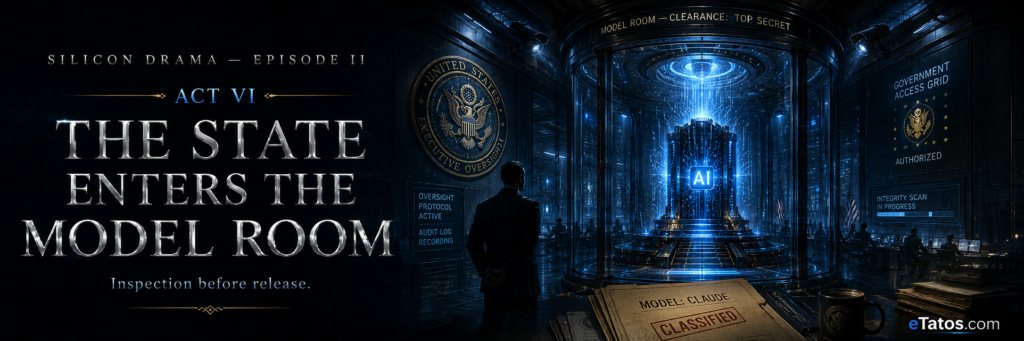
Act VI: The state enters the model room
The U.S. government also moved deeper into frontier AI oversight.
Microsoft, Google and xAI agreed to give the U.S. government early access to unreleased models for national-security testing through the Commerce Department’s Center for AI Standards and Innovation, CAISI. OpenAI and Anthropic had already been part of similar evaluation efforts.
This changes the nature of frontier AI.
The most powerful models are becoming national-security objects.
The labs want speed.
The government wants inspection.
The market wants dominance.
The public wants safety.
The military wants capability.
That is where Silicon Drama becomes darker.
The AI companies built intelligence.
Now the state wants to know what that intelligence can do before the world gets it.
The model room is becoming a security room.
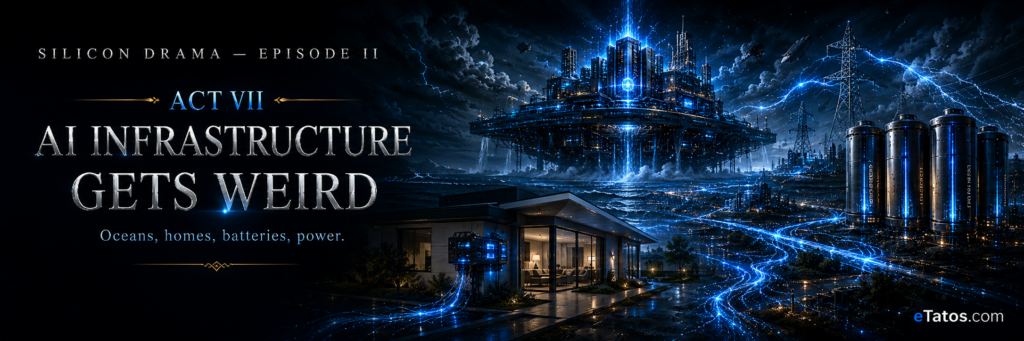
Act VII: AI infrastructure gets weird
The data-center race is no longer only about bigger buildings.
It is getting stranger.
Panthalassa raised major funding to build autonomous ocean-powered compute systems for AI. The idea is cinematic: Floating compute nodes powered by waves, cooled by seawater and connected back to the world.
SPAN announced a distributed data-center concept that uses smaller liquid-cooled compute nodes installed close to existing electrical capacity, including homes and small buildings.
In Germany, CMBlu Energy is positioning large-scale, non-lithium storage as a future pillar for AI and data-center infrastructure.
These are not yet the main battlefield. Hyperscale data centers still dominate.
But they show where the bottleneck is moving.
First AI needed data.
Then AI needed GPUs.
Now AI needs land, water, electricity, cooling, batteries, grids and faster access to power.
The compute war is no longer only a tech war.
It is an energy war.
It is a real-estate war.
It is a logistics war.
It is an infrastructure war.
AI is becoming hungry enough to reshape the physical world around it.
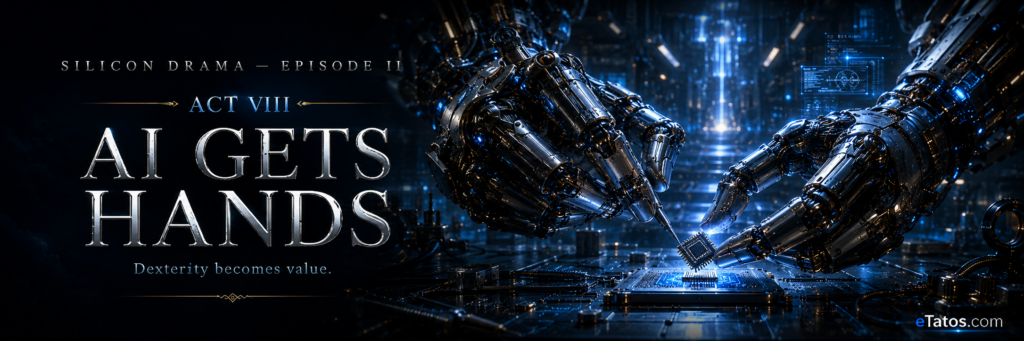
Act VIII: AI gets hands
If compute is the brain, robotics is the body.
And this week, the most important robotics story was not walking.
It was hands.
China’s Linkerbot is targeting a major new valuation after building a strong position in dexterous robotic hands for humanoids. The company reportedly produces thousands of robotic hand units per month and is trying to standardize robotic hand skills.
Then Europe answered.
French startup Genesis AI unveiled an AI model for robots and a dexterous robotic hand. Its demos included highly visual manipulation tasks such as playing piano, cracking eggs and handling delicate objects. Some tasks were trained rather than fully spontaneous, but the signal is still important.
Then there is Eka, whose touch-sensitive robotic claw points to the next frontier: Force.
Vision tells a robot what it sees.
Touch tells a robot what it is doing.
That may be the missing layer between impressive demos and useful physical work.
Walking gets attention.
Hands create economic value.
A robot that can walk is impressive.
A robot that can pick, sort, grip, twist, pack, fold and manipulate fragile objects is useful.
The AI race has moved from brains to hands.
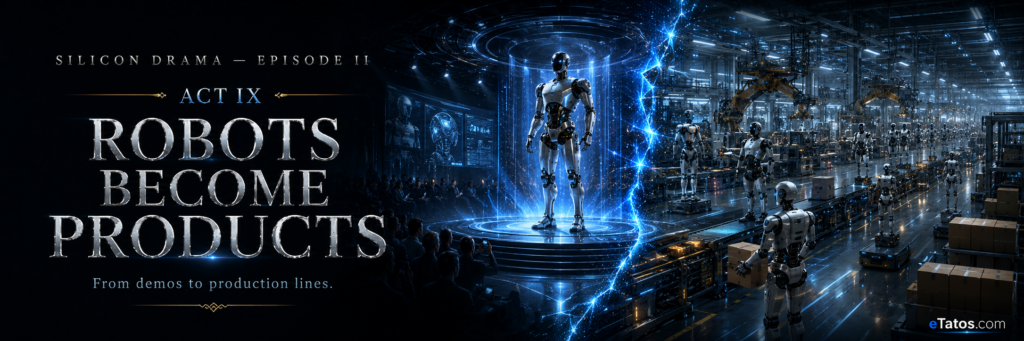
Act IX: Robots become products, not just demos
The humanoid race is also moving from viral videos to production capacity.
1X has opened its NEO factory in Hayward, California, with a stated target of producing up to 10,000 humanoids per year.
Figure says it has moved Figure 03 production from prototype pace toward one robot per hour at BotQ.
RobotEra is pushing humanoids into logistics settings in China, including sorting and barcode-related tasks.
Tutor Intelligence is operating a robot data factory where robots perform repetitive real-world tasks to generate physical intelligence data.
The pattern is clear.
Robots are leaving the lab.
Not as perfect household servants.
Not as science-fiction companions.
Not as universal workers.
They are entering constrained, repetitive, data-rich physical environments first:
Logistics.
Sorting.
Packing.
Warehouse work.
Factory assistance.
Laundry-like manipulation.
Industrial inspection.
Data collection.
That is probably how physical AI arrives.
Not with one magical humanoid.
But with thousands of imperfect robots learning boring tasks until the boring tasks become a market.
The first useful humanoids may not be glamorous. They may be warehouse interns with expensive hands.
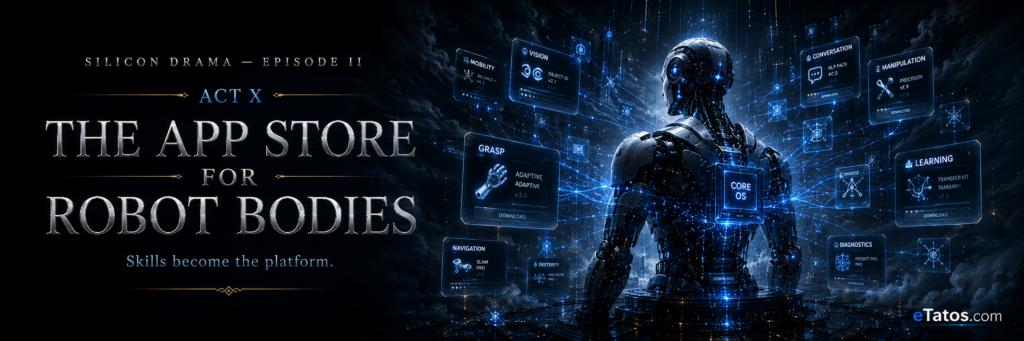
Act X: The App Store for robot bodies
Unitree added one of the most important platform signals of the week.
The company opened UniStore, a shared application platform for robot tasks and actions. Unitree calls it the world’s first humanoid robot task and action app store.
This is a major strategic idea.
The smartphone became a platform when developers could build apps.
A humanoid becomes a platform when developers can build skills.
For now, this is still early. Many robot apps may be closer to motion modules, action demos or task packages than full autonomous work products. But the direction matters.
Unitree is not only selling robots.
It is trying to build an ecosystem.
That changes the robotics race.
Hardware margins are one thing.
Platform control is another.
If robot skills become downloadable, shareable and monetizable, the next platform war may not be iOS vs. Android.
It may be robot body vs. robot body.
Skill store vs. skill store.
Robot operating system vs. robot operating system.
The next App Store may not live in your pocket. It may live in a robot body.
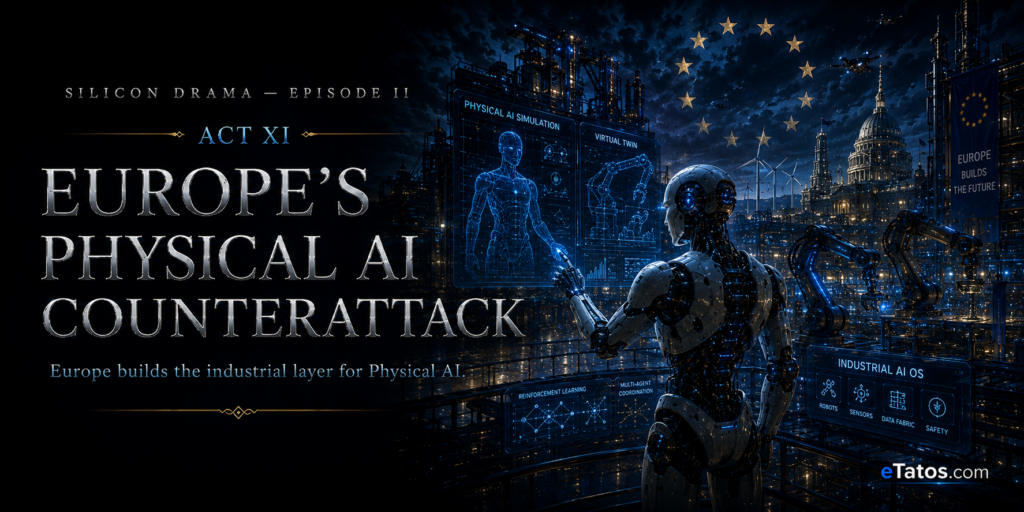
Act XI: Europe’s Physical AI counterattack
Europe is not absent from this story.
It is playing a different game.
Germany’s NEURA Robotics is building one of Europe’s most ambitious Physical AI ecosystems. Its collaboration with AWS gives the company cloud infrastructure for Neuraverse, robot training and fleet intelligence. Its partnership with Dassault Systèmes connects humanoids and cognitive robots with virtual twins and industrial simulation. Its TUM RoboGym project at Munich Airport is designed to become a major training center for Physical AI. Its Qualcomm collaboration points toward robot brain and nervous-system architectures for edge intelligence.
This gives NEURA a different identity from Unitree, Figure or 1X.
Unitree is pushing affordable robot bodies and a robot app store.
1X and Figure are pushing production scale.
RobotEra is moving into logistics.
NEURA is trying to build the European industrial layer around Physical AI: robots, simulation, training data, cloud infrastructure, virtual twins, edge intelligence and factory integration.
That is not as viral as a robot doing martial arts.
But it may be exactly where Europe can matter.
Sereact adds another European robotics signal. The German company raised major funding to scale Cortex 2.0, its robot-brain approach for warehouses and production environments.
SAP adds the enterprise AI angle. By acquiring Prior Labs, SAP is betting on tabular foundation models for structured business data: the tables, numbers and ERP data that run real companies.
Schaeffler adds the old-industrial layer. The German supplier is preparing for humanoid robotics as a component and manufacturing opportunity.
Europe’s role may not be to win the loudest robot video.
Europe’s role may be to make robots usable inside real companies.
China is scaling robot bodies.
America is funding robot factories and compute empires.
Europe is trying to build trusted industrial intelligence.
Europe may not win the loudest AI race. But it still has a chance to win the industrial one.
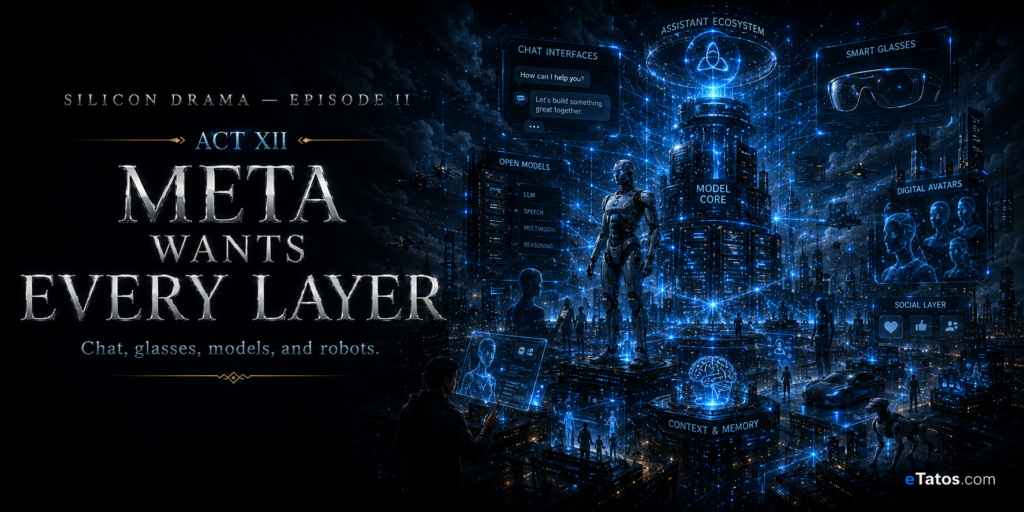
Act XII: Meta wants every layer
Meta’s week also belongs in Episode 2.
The company is fighting over AI access inside WhatsApp in Europe. It is defending Llama against copyright lawsuits. And it acquired Assured Robot Intelligence, a startup working on AI for robots.
The Zuckerberg strategy looks increasingly clear.
Put AI into WhatsApp.
Put AI into glasses.
Put AI into open models.
Put AI into avatars.
Put AI into robots.
Meta does not want the AI assistant to be a feature.
Meta wants it to be an environment.
The old Meta dream was the metaverse.
The new Meta strategy looks more practical: own the interfaces where AI meets people.
Chat.
Camera.
Glasses.
Social graph.
Open models.
Embodied AI.
Zuckerberg wants the AI in your chat, on your face and eventually in the room.
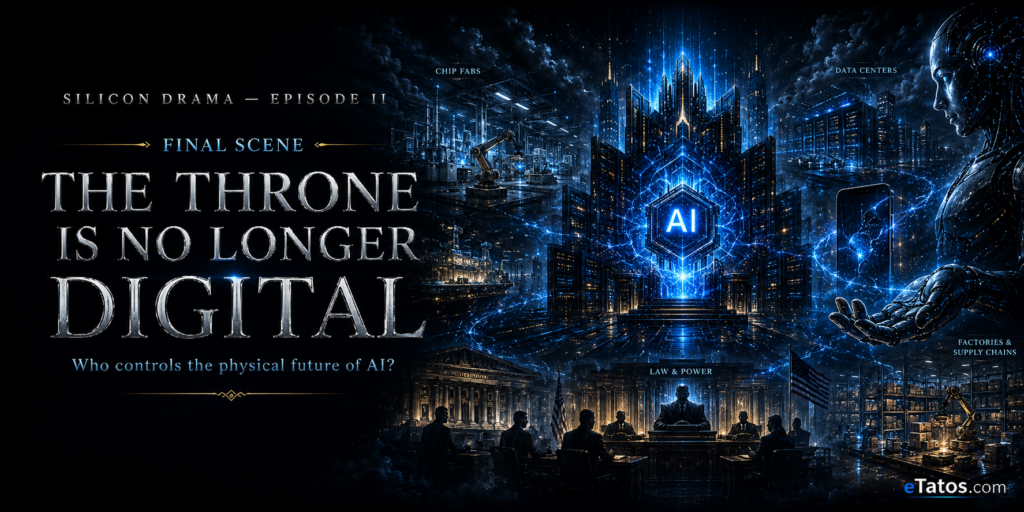
The throne is no longer digital
Episode 2 does not replace the feeling of Episode 1.
It escalates it.
Episode 1 showed that technology had started to feel physical: Factories, airports, courtrooms, military contracts and geopolitical pressure were suddenly part of the AI story.
Episode 2 goes one layer deeper. It shows the machinery behind that physical shift: compute deals, power grids, chips, data centers, robot hands, training factories and platform battles.
Claude is plugged into Amazon, Google, Microsoft and SpaceX.
OpenAI is looking toward chips, devices and courtroom survival.
Musk is connecting rockets, satellites, data centers, chips, cars and robots.
Google is quietly becoming the floor beneath the AI economy.
Meta is trying to own the assistant layer everywhere.
Europe is building robot brains, structured-data AI and physical training systems.
China is scaling robot hands and robot platforms.
AI agents are entering finance, workplaces and production systems.
Robots are learning to touch the world.
This is the real shift:
AI is no longer just being generated.
It is being financed.
Built.
Weaponized.
Deployed.
Inspected.
Litigated.
Installed.
Scaled.
Trained.
And given hands.
The AI throne is no longer sitting inside a chatbot window.
It is in the data center.
In the chip fab.
In the courtroom.
In the warehouse.
In the cloud contract.
In the power grid.
In the robot hand.
And in the factory that teaches machines how to move.
That is the real escalation.
The AI race is no longer only about who has the best model.
It is about who has the infrastructure, the execution, the access and the control to turn intelligence into real-world power.
So the next Silicon Drama will not only ask:
Who has the best model?
It will ask the much bigger question:
Who controls the physical future of AI?
If you want to follow the next episodes of Silicon Drama, subscribe to eTatos.com or our newsletter. The next power struggle is already forming.