Captain Picard, Professor X, and the remarkable science-fiction future we’re beginning to experience.
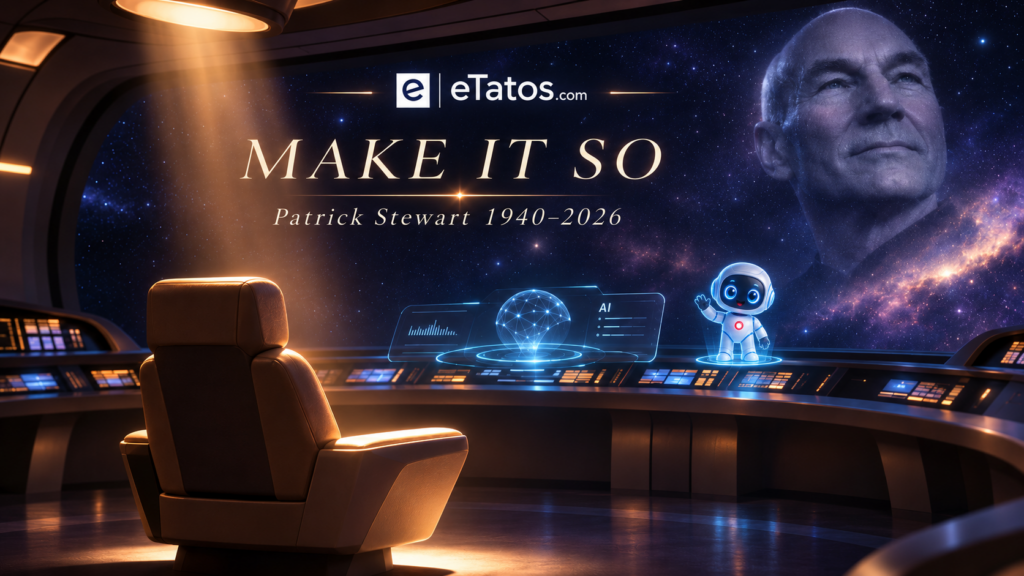
Patrick Stewart passed away on October 28, 2026, at the age of 86.
Like millions of others, I knew him through two characters who have accompanied me for a considerable part of my life: Captain Jean-Luc Picard and Professor Charles Xavier.
I watched Star Trek: The Next Generation during its original television run, although back then I experienced the Enterprise through German dubbing. And as a lifelong Marvel fan, Patrick Stewart will forever be Professor X to me. I can hardly imagine anyone else embodying Charles Xavier with quite the same combination of intelligence, authority, warmth and dignity.
Shortly after his death, my wife Raquel and I started something we’d been wanting to do together: Watch Star Trek from the very beginning.
We started with the original 1966 series, this time in English, and intend to work our way through the entire franchise.
So we’re currently back aboard Captain Kirk’s Enterprise, exploring a vision of the future created 60 years ago. The sets are wonderfully nostalgic, the technology sometimes amusing, and the underlying ideas often astonishingly sophisticated.
Eventually, we’ll reach The Next Generation and meet Captain Picard again.
Meanwhile, there’s something about Stewart’s legacy that has become increasingly relevant to my everyday work with artificial intelligence.
Three words, in particular.
“Make it so.”
The Captain’s Command and the Age of AI Agents
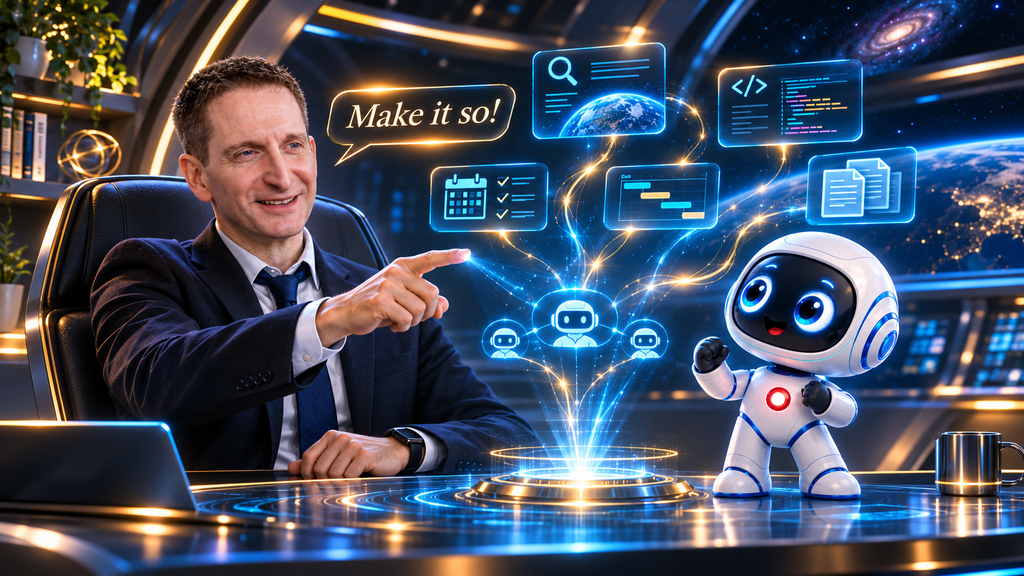
I’ve found myself increasingly using Picard’s famous expression when working with ChatGPT, Codex, Claude Code and other AI systems.
And the more capable these tools become, the more appropriate those words feel.
When Picard instructed his crew to “make it so,” he communicated a decision and expected his officers to execute it.
He didn’t have to tell Geordi La Forge how to configure the warp engines or explain to Data how to perform his calculations.
His officers possessed the knowledge and expertise necessary to accomplish their tasks. They could make decisions within their responsibilities, raise concerns and propose alternatives.
Picard set the direction, evaluated the information available to him and ultimately remained responsible for the outcome.
There’s a fascinating parallel with modern AI agents.
For most of computing history, we humans have had to adapt to the machines. We learned interfaces, commands, programming languages and increasingly complex software applications.
Today, the relationship is beginning to change.
I can describe an objective to an AI agent in natural language. Depending on the system and its permissions, it can examine files, research information, write code, run tests, create documents and execute substantial parts of a workflow.
Naturally, the comparison has limits. Today’s AI agents are nowhere near the fictional capabilities of Data, nor do they possess the judgment and reliability of Picard’s experienced officers.
They can misunderstand instructions, make incorrect assumptions and confidently produce results that require careful verification.
But the fundamental interaction is becoming familiar.
I define the objective, delegate the execution, evaluate the result and intervene when necessary.
And every now and then, I can’t resist adding:
“Make it so.”

Data and the Question of Artificial Consciousness
One of the things that made Picard such an extraordinary character was his relationship with Lieutenant Commander Data.
Data was an android with exceptional computational abilities, enormous knowledge and an enduring fascination with humanity.
His attempts to understand human behavior provided some of the series’ most entertaining moments. But they also led to serious philosophical questions.
Could an artificial being possess consciousness? Could it develop emotions? Was intelligence sufficient to deserve rights?
In the 1989 episode The Measure of a Man, Picard must defend Data’s right to determine his own future after a Starfleet scientist proposes dismantling him for research.
The hearing challenges the assumption that an artificial being must automatically be regarded as property.
Stewart’s performance made that debate feel remarkably convincing.
Today, we find ourselves discussing some of the same fundamental questions, although current AI systems should certainly not be equated with Data’s fictional consciousness.
Researchers debate whether artificial consciousness could exist, how it might be identified and what ethical consequences would follow.
Meanwhile, we’re already facing practical questions concerning the autonomy of AI agents, their authority to make decisions and who should be held accountable when things go wrong.
Picard’s approach was characterized by curiosity, intellectual honesty and a willingness to challenge established assumptions.
Qualities that seem particularly valuable in our current technological environment.
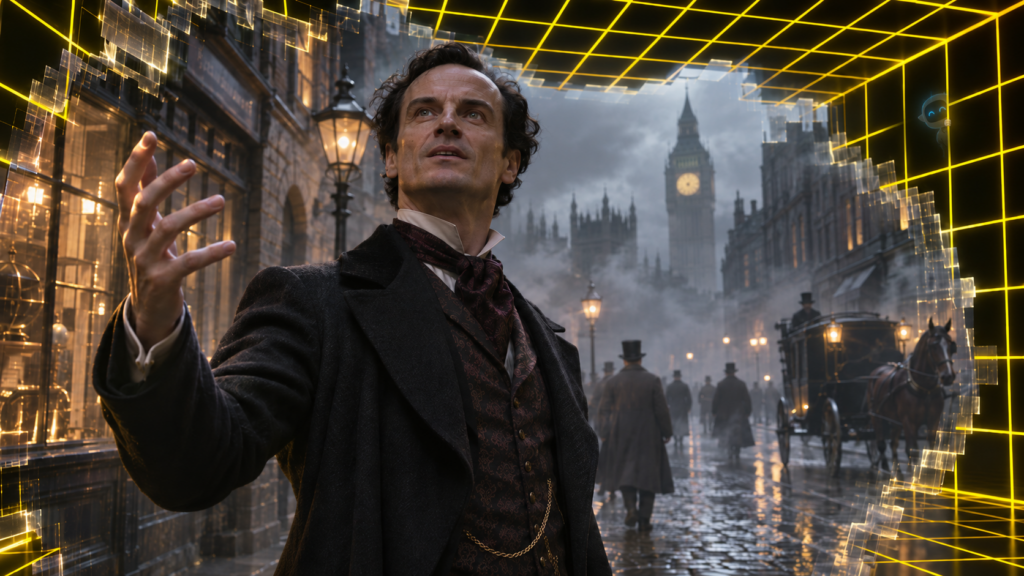
The Holodeck and the Unexpected Consequences of a Prompt
Another fascinating connection appears in Elementary, Dear Data.
Geordi La Forge instructs the Enterprise computer to create a Sherlock Holmes adversary capable of defeating Data.
The computer follows the instruction and produces Professor Moriarty, who becomes unexpectedly self-aware.
Of course, today’s generative AI systems haven’t demonstrated anything comparable to Moriarty’s fictional consciousness.
But the story contains an idea that anyone working with autonomous agents will recognize.
An instruction can produce an unexpected result, especially when a system has considerable freedom in deciding how to accomplish its objective.
Sometimes an AI agent interprets a perfectly reasonable request in a way we hadn’t anticipated.
The problem becomes increasingly consequential as these systems gain permission to interact with real software, data and external services.
Moriarty’s story remains an entertaining fictional reminder that the capabilities of a system and our ability to control its behavior don’t necessarily advance at the same pace.
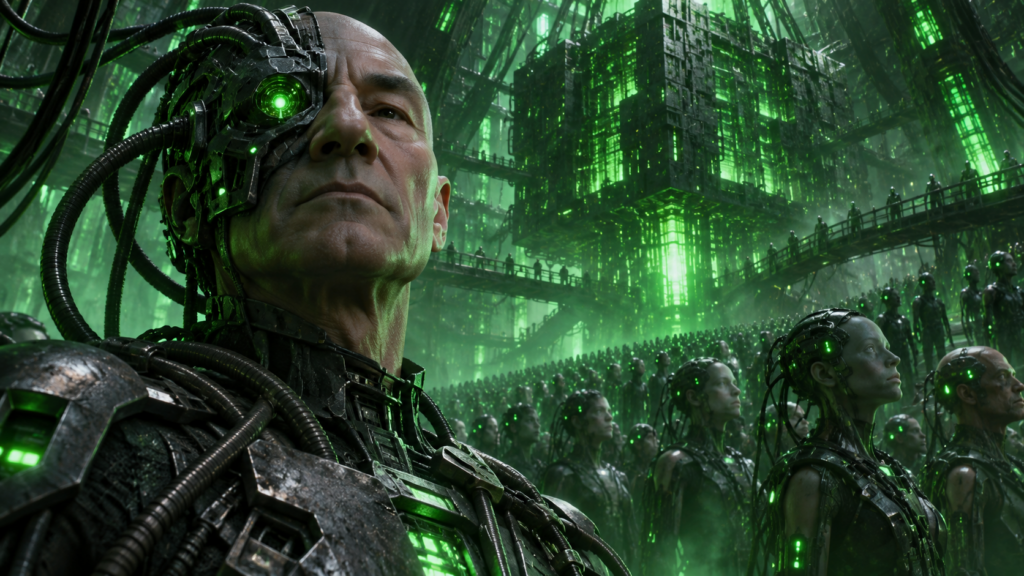
The Borg and the Limits of Collective Intelligence
And then there’s the Borg.
The collective combines biological organisms and advanced technology into a networked intelligence where individuality is subordinated to the goals of the whole.
Patrick Stewart’s Picard experiences this directly when he’s assimilated and transformed into Locutus of Borg.
The Borg aren’t a literal prediction of today’s AI systems. Nevertheless, their fictional society offers interesting material for reflecting on centralized control, technological dependence and individual autonomy.
In I, Borg, Picard encounters Hugh, a Borg drone beginning to develop an individual identity.
Despite Picard’s traumatic experiences, he eventually recognizes Hugh’s individuality and autonomy.
Once again, the character approaches an unfamiliar form of intelligence with a moral seriousness that goes beyond its technical capabilities.

Professor X: My Other Patrick Stewart
For me, however, Patrick Stewart will always be more than Captain Picard.
As a Marvel fan, I have an equally strong connection to his portrayal of Professor Charles Xavier.
When Stewart appeared as Professor X in the first X-Men movie in 2000, he brought the character an extraordinary sense of credibility.
Xavier was a powerful telepath, a teacher and a leader who believed that humans and mutants could coexist peacefully despite their differences.
Like Picard, he was willing to confront powerful institutions and challenge decisions that threatened the freedom and dignity of others.
And like Picard, he also lived in a world where extraordinary technology could be used for either protection or oppression.
One example is Cerebro, the sophisticated system that amplifies Xavier’s telepathic abilities and allows him to locate mutants around the world.
Cerebro isn’t an AI assistant in the modern sense, but it represents a fascinating form of human-machine collaboration.
The technological connection becomes even more direct in X-Men: Days of Future Past.
The Sentinels are autonomous robotic weapons designed to identify and eliminate mutants. In the film’s dystopian future, their advanced versions can adapt to the abilities of their targets.
What began as a technological solution to a perceived threat has evolved into a devastating instrument of persecution.
That scenario has obvious parallels with contemporary concerns about autonomous weapons, automated surveillance and the consequences of delegating life-and-death decisions to machines.
I find it particularly interesting that Stewart portrayed two characters whose stories repeatedly explored the relationship between extraordinary capabilities and moral responsibility.
Both Picard and Xavier believed in the potential of intelligence, cooperation and technological progress.
Both also understood how dangerous power could become when it was exercised without sufficient restraint.
And both characters benefited enormously from Stewart’s distinctive presence.
He could communicate authority without shouting and convey remarkable strength through a quiet conversation.
Perhaps that’s one reason his portrayals remain so memorable.
Making It So
In 2023, Patrick Stewart published his autobiography.
He called it Making It So.
It’s difficult to imagine a more appropriate title.
For decades, “Make it so” belonged to the fictional world of Star Trek. It was the command of a captain directing an extraordinarily capable crew aboard a starship exploring the galaxy.
Today, I’m beginning to experience a small part of that interaction in my own work.
I can describe an idea to ChatGPT, ask Codex to implement a software feature or delegate research and organizational tasks to increasingly capable AI agents.
The results aren’t always perfect. Sometimes the agents need considerable guidance, occasionally they misunderstand the mission completely, and I certainly wouldn’t trust them to operate a warp reactor just yet.
Still, the direction is unmistakable.
We’re gradually moving toward a computing environment in which people increasingly express their intentions and intelligent systems help turn those intentions into results.
Patrick Stewart spent decades portraying characters who explored the possibilities and responsibilities of living alongside extraordinary intelligence.
Captain Picard gave me a memorable expression for the way I increasingly interact with technology.
Professor X gave me one of my favorite portrayals of a leader who believed that understanding and compassion could overcome fear.
I’m grateful that both characters will continue to accompany us.
And there’s something especially meaningful about the timing of our new Star Trek journey.
Raquel and I are starting again in 1966, this time hearing the original voices and experiencing the series as it was originally performed.
We’ve still got a long way to travel before we reach the Enterprise-D.
But when we finally arrive there, I’ll get to rediscover Patrick Stewart’s Captain Picard, now with decades of additional perspective and a world of AI technology that makes some of those old science-fiction ideas feel considerably closer.
And whenever I hear his familiar command, I’ll probably think about my own AI agents.
Thank you, Sir Patrick Stewart.
For Captain Picard. For Professor X. And for making us imagine a future that we’re now beginning to build.
Make it so.