
A Tech Soap about AI, robots and Big Tech power games
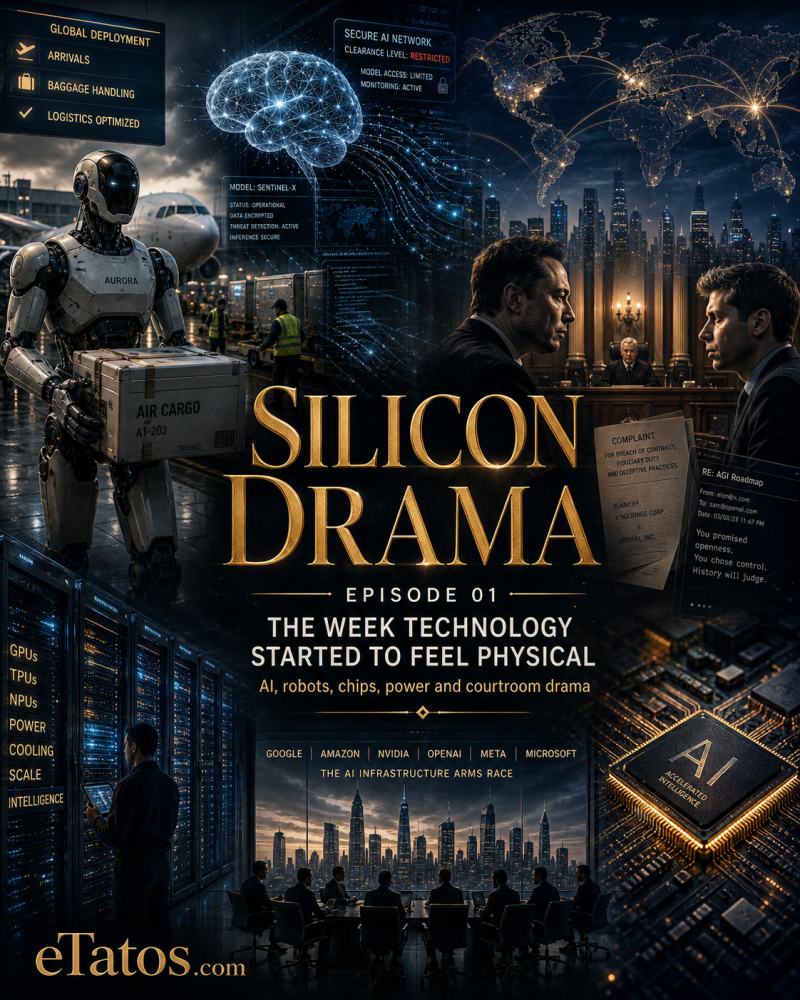
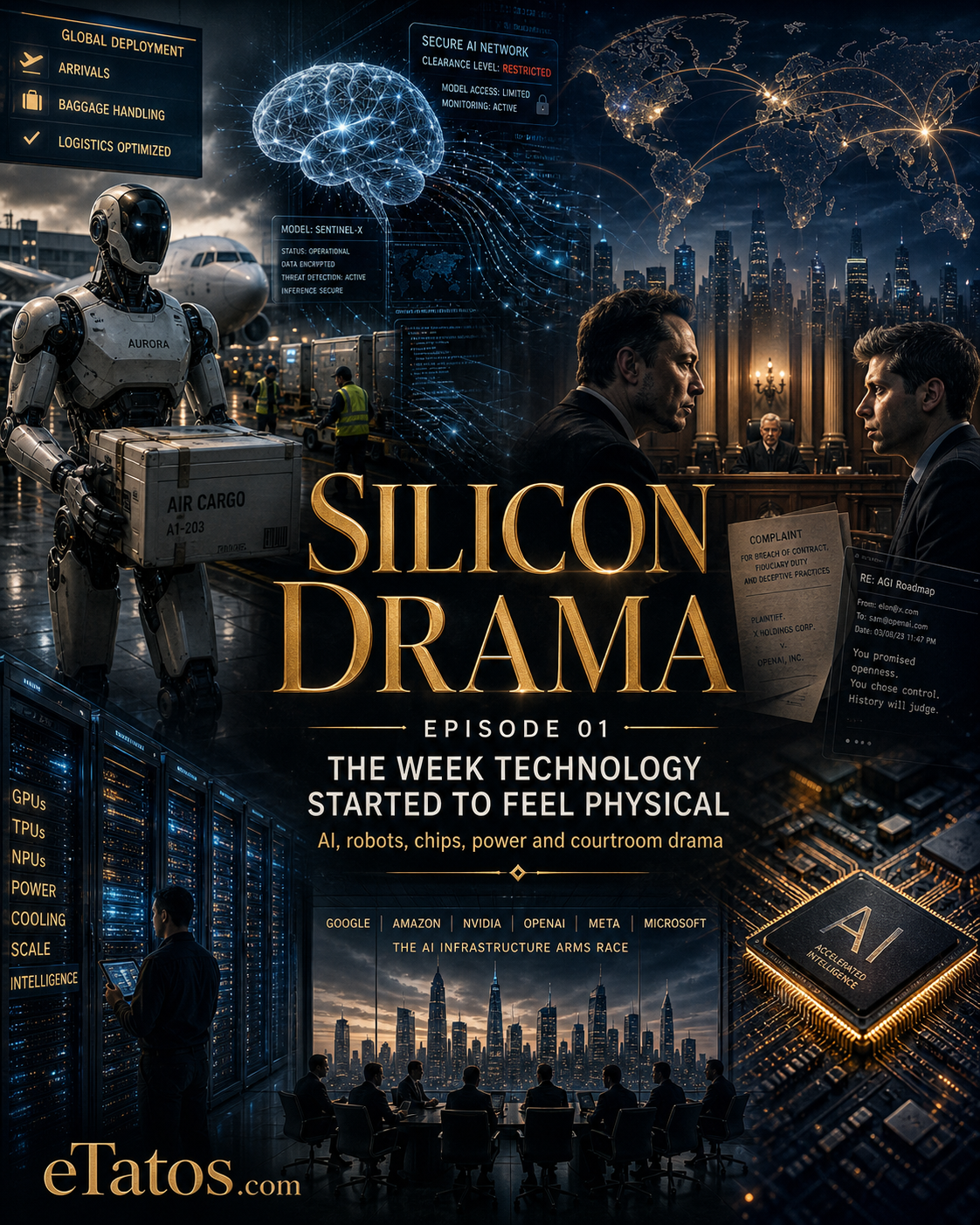
Editor’s note: This is the first edition of Silicon Drama, a weekly look at the power games behind AI, robotics and Big Tech. The goal is simple: Not just to report what happened, but to explain why it matters, who gains power, who loses trust and where the next conflict is already forming.
Episode 01: The Week Technology Started to Feel Physical
Some weeks in tech feel like product updates.
A new model. A new chip. A new demo video. A new promise that everything will be faster, smarter and cheaper very soon.
This week felt different.
The stories were not only about software anymore. They had weight. They had bodies, factories, airports, courtrooms, military contracts and geopolitical pressure behind them.
Humanoid robots moved closer to real work. AI companies moved deeper into national security. Cloud giants moved further into the chip business. And in Oakland, California, two of the most famous names in AI walked into a courtroom and turned the founding myth of OpenAI into public theater.
The old question, “Who has the best model?”, suddenly felt too small.
The better question may be:
Who is building the infrastructure of the next world?
Welcome to Silicon Drama.
1. The Body: Humanoid Robotics
The most interesting robot story of the week did not come from a polished keynote.
It came from an airport.
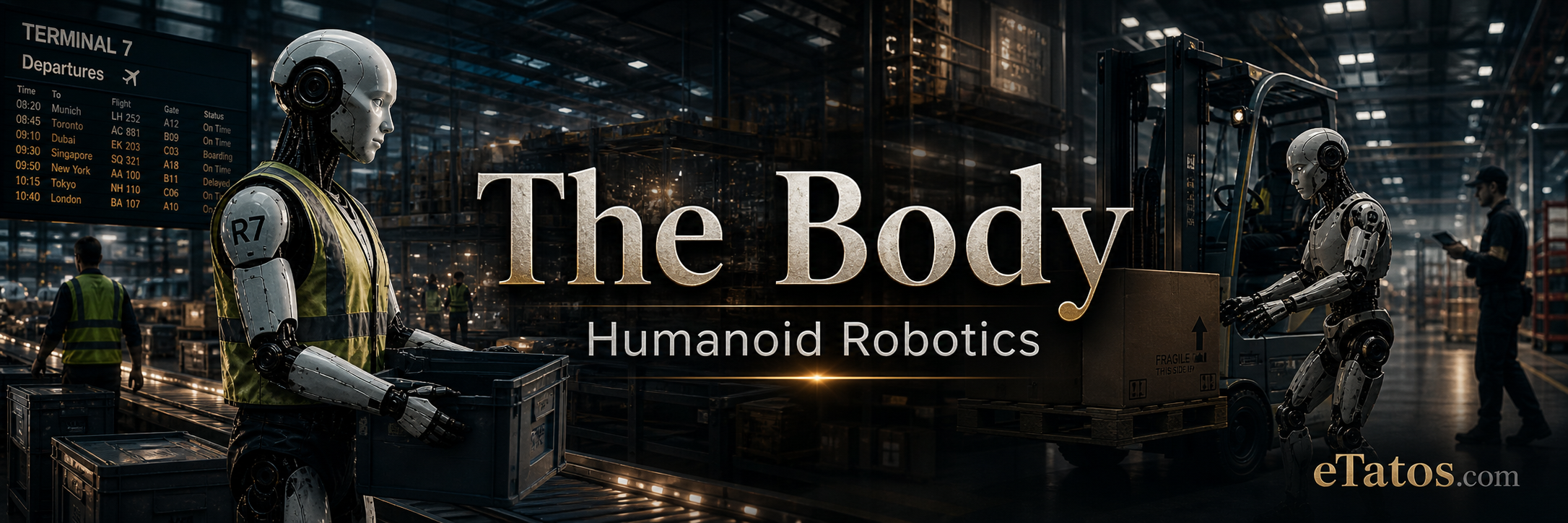
Japan Airlines, JAL Ground Service and GMO AI & Robotics are preparing a humanoid robot demonstration experiment at airports, starting in May 2026. According to JAL, it is the first experiment of its kind in Japan. The goal is not to make a robot wave nicely at passengers. It is to test whether humanoids can support ground-handling operations such as baggage and cargo loading, and eventually even cabin cleaning or the operation of ground support equipment. (JAL企業サイト)
That may sound operational. Almost boring.
But it is exactly the kind of boring that matters.
For years, humanoid robots were judged by their ability to entertain us. They walked across stages, waved at cameras, danced in viral videos or carried boxes in controlled demos. Haneda is a very different kind of test. Airports are crowded, loud, physical, time-sensitive and unforgiving. They are full of people, vehicles, schedules, luggage, safety rules and unexpected problems.
In other words: Reality.
JAL’s own explanation makes the point almost brutally clear. Ground handling relies heavily on human manual labor, often in limited spaces around aircraft, and conventional fixed automation struggles with the flexibility required in those environments. Humanoid robots are attractive precisely because they can theoretically work within existing infrastructure without rebuilding the airport around them. (JAL企業サイト)
If humanoid robots can become useful there, the conversation changes.
At the same time, Figure AI continued to push its own story from prototype to production. The company says its BotQ facility has delivered more than 350 Figure 03 robots and increased production from one robot per day to one robot per hour, a 24x throughput improvement in under 120 days. (FigureAI)
That detail matters because humanoid robotics has a data problem. You need robots in the world to collect real-world experience, and you need real-world experience to make better robots.
More robots means more data. More data means better behavior. Better behavior means more deployment. And more deployment means the flywheel starts turning.
Then Meta entered the scene again, acquiring Assured Robot Intelligence, a small San Diego startup developing AI models for humanoid robots. Meta confirmed that ARI’s work focuses on helping robots understand, predict and adapt to human behavior in complex, dynamic environments. (Business Insider)
That is the important part.
Meta is not just buying another robotics logo for a slide deck. It is buying into the intelligence layer.
The body is becoming easier to imagine. The real challenge is the brain.
A humanoid robot without intelligence is expensive theater.
A humanoid robot with useful intelligence becomes labor, logistics, infrastructure and eventually competition.
The conflict
The humanoid robotics race is entering its awkward teenage phase.
The dream is obvious. The use cases are becoming clearer. The money is arriving. The factories are being built.
But the technology still has to survive contact with the real world.
That is where the drama lives.
Not in whether a robot can walk.
In whether it can be trusted next to a tired airport worker at 4:30 in the morning, when a delayed aircraft needs to be turned around quickly and nobody has time for a beautiful demo.
The winners this week are the companies moving the conversation from performance to deployment.
The losers are the companies still selling science fiction.
2. The Mind: Artificial Intelligence
While robots were looking for a place in the physical world, AI was moving into a much colder room: National security.
The Pentagon reached agreements with Google, Microsoft, Amazon Web Services, Nvidia, OpenAI, Reflection and SpaceX to use their AI capabilities in classified computer networks. The stated goal is to augment decision-making in complex operational environments. Anthropic was notably absent after its dispute with the U.S. government over the ethics and safety of AI use in war. (AP News)
That absence became one of the most interesting parts of the story.
Anthropic has spent years cultivating a very specific identity: careful, safety-focused, principled, slightly more restrained than the rest of the AI race. That position has made the company highly respected, especially among people worried about reckless AI deployment.
But power has its own gravity.
When AI moves into defense, intelligence, classified systems and operational decision-making, safety principles stop being branding language and become strategic choices with real consequences.
The Pentagon wants multiple providers. OpenAI wants to be inside the room. Anthropic wants boundaries. And the rest of the industry is watching what happens when ethics and national security no longer fit neatly into the same sentence.
OpenAI, meanwhile, continued to raise the temperature with GPT-5.5. The company positioned the model as stronger for coding, research, information synthesis, tool use, document-heavy tasks and professional work. OpenAI also described GPT-5.5 as more persistent and reliable across longer workflows. (OpenAI)
But the more dramatic signal came from GPT-5.5-Cyber.
Sam Altman said OpenAI would begin rolling out GPT-5.5-Cyber to critical cyber defenders, with the stated focus on securing critical infrastructure. (Nextgov/FCW)
That is a very different kind of product story.
It suggests a future where the most capable models are not all released in the same way to the same audience. Some may become restricted tools for trusted actors. Some may sit behind institutional gates. Some may be treated less like apps and more like strategic capabilities.
That will be uncomfortable for a lot of people.
The internet grew up with the idea that powerful digital tools eventually spread everywhere. AI may not follow that pattern cleanly. At least not at the frontier.
And then there was Claude Code.
Anthropic published a postmortem after developers complained that Claude Code had become worse. The company explained that a combination of system changes, including an instruction to reduce verbosity, harmed coding quality before being reverted.
The technical explanation matters.
The emotional reaction matters more.
Developers were not just annoyed by a bug. They felt gaslit by uncertainty. When a tool becomes part of your daily workflow, you notice when it changes. You may not have the internal metrics, but you have the lived experience of working with it.
That is why the Claude Code episode cut so deep.
AI companies are not just selling intelligence.
They are selling trust.
And trust is much harder to patch than a prompt.
The courtroom episode: Musk v. Altman
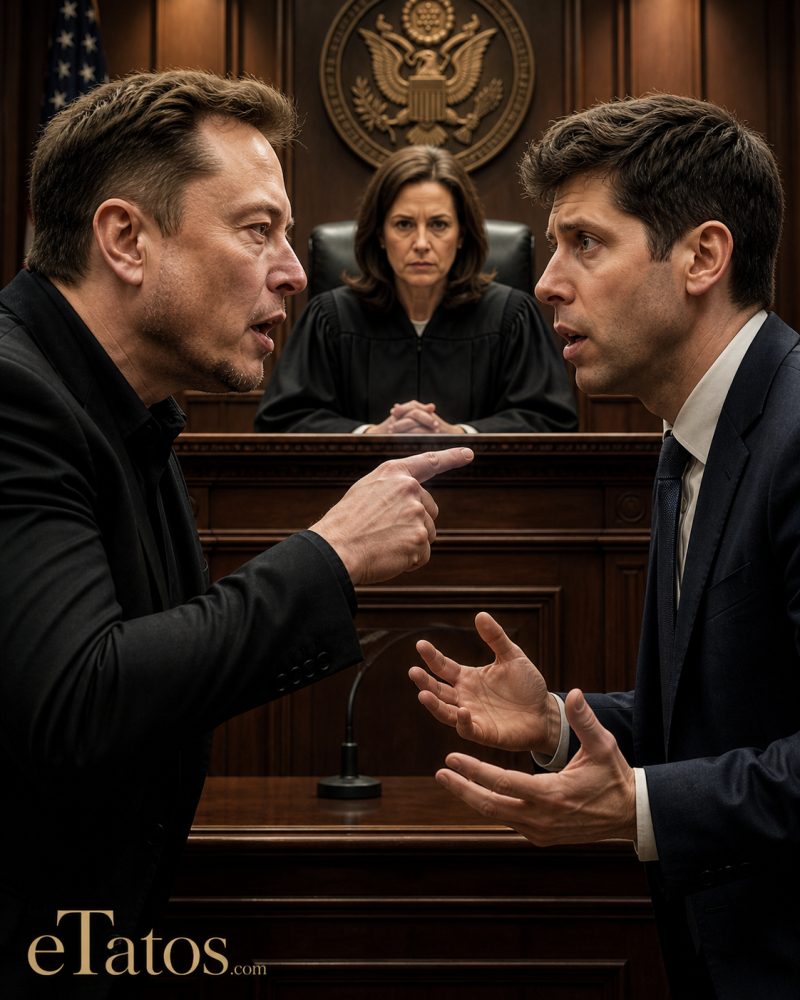
And then, of course, came the courtroom.
If this series needed a perfect soap opera subplot, Elon Musk versus Sam Altman delivered it almost too perfectly.
The trial in Oakland puts the founding myth of OpenAI under harsh fluorescent light. Musk claims that OpenAI, Sam Altman and Greg Brockman betrayed the original nonprofit mission and moved toward a profit-driven structure. OpenAI’s side argues that Musk is trying to regain control after losing influence, while also competing through his own AI company, xAI. Reuters reported that Musk testified for more than seven hours over three days. (Reuters)
This is not just a lawsuit.
It is a fight over authorship.
Who created OpenAI? Who saved it? Who betrayed it? Who gets to define its soul?
Musk repeatedly portrayed OpenAI as a charity. Reuters noted that the word “charity” did not appear in OpenAI’s 2015 launch post, which described the organization as a nonprofit AI research company. That distinction may sound legalistic, but in the courtroom it became emotionally explosive. Musk framed the case as a defense of charitable giving and the original promise of safe AI for humanity. (Reuters)
The evidence has made the drama even richer.
According to The Verge’s running review of trial exhibits, early emails show Altman proposing an AI lab with a mission to create general AI for individual empowerment and safety, with governance ideas involving Musk, Altman, Bill Gates, Pierre Omidyar and Dustin Moskovitz. Musk replied with agreement. Later exhibits show the nonprofit mission language, funding debates, concerns around Microsoft’s influence, and private exchanges where Musk called OpenAI’s later valuation and structure a kind of bait and switch. (The Verge)
There are also moments that feel almost painfully human.
An August 2018 email from Altman to Musk included a term sheet and Altman wrote that his current thought was that he would not take equity in OpenAI, saying he was not doing it for the money. Years later, that sentence reads like a time capsule from a more idealistic version of the AI industry. (The Verge)
And then came the judge.
U.S. District Judge Yvonne Gonzalez Rogers reportedly warned Musk about his behavior outside the courtroom after he posted attacks on X, including posts mocking Altman’s name and accusing him of stealing from a charity. The Washington Post described a tense courtroom atmosphere in which Musk repeatedly drew warnings from the judge. At one point, after Musk accused OpenAI’s attorney of asking a leading question, the judge had him repeat the phrase “I’m not a lawyer”, which reportedly made people in court laugh. (The Washington Post)
You could not script this better.
The world’s most visible AI conflict is not happening in a benchmark table.
It is happening in a courtroom, with old emails, bruised egos, nonprofit ideals, billions of dollars, Microsoft’s shadow, xAI’s ambition and a judge trying to keep Silicon Valley’s biggest personalities inside normal legal procedure.
That is the purest Silicon Drama imaginable.
The conflict
The AI industry is splitting into layers.
Consumer AI. Developer AI. Enterprise AI. Defense AI. Cyber AI. Restricted AI. Courtroom AI.
The old public race for the smartest chatbot is still happening, but the more consequential race may be moving behind closed doors, into military networks, enterprise contracts, cyber-defense programs and legal battles over who owns the founding promise of the AI age.
That creates a new tension.
OpenAI looks increasingly comfortable operating at the center of power. Anthropic is trying to balance trust, safety and competitiveness. Google wants the strategic position. Microsoft wants distribution. The Pentagon wants capability. Developers want transparency. Musk wants the story of OpenAI’s origin retold in court. Altman wants OpenAI’s current structure to survive the myth of its beginning.
Nobody gets everything.
That is what makes this moment interesting.
3. The Empire: Big Tech & Modern Technology
The empire story this week was about chips.
Nvidia is still the king of AI infrastructure. No serious person should pretend otherwise. The company has the hardware, the software ecosystem, the developer mindshare and the market momentum.
But kings do not only worry about enemies at the gate.
They worry about ambitious allies inside the castle.
Google and Amazon are two of Nvidia’s most important customers. They are also building their own AI chips with increasing seriousness.
Google reported a powerful quarter for Google Cloud, with revenue growing 63% to $20 billion. Sundar Pichai said enterprise AI solutions had become the primary growth driver for Google Cloud for the first time, and Reuters reported that Google has begun selling TPU chips directly to some customers. (Reuters)
That matters.
Google’s TPU strategy is no longer just an internal optimization story. It is becoming a business weapon.
Amazon is moving in the same direction with Trainium and its broader chip business. Andy Jassy said Amazon’s chips business grew nearly 40% quarter-over-quarter in Q1, reached an annual revenue run rate above $20 billion and is growing at triple-digit percentages year-over-year. (Amazon News)
That number should make the whole industry pause.
Because this is not a hobby.
The hyperscalers do not want to be trapped forever as buyers of someone else’s scarce, expensive compute. They want leverage. They want margin. They want control over the stack.
And once again, the story moves from technology to power.
Then came another geopolitical twist: China ordered Meta to unwind its $2 billion-plus acquisition of AI agent startup Manus, according to Reuters. Manus is exactly the kind of asset that makes governments nervous: An AI agent company sitting near the future interface layer of software. (Reuters)
AI agents are not just another software category. They may become the next layer between users and everything else.
Search. Apps. Workflows. Commerce. Productivity. Maybe even operating systems.
So when a deal like that becomes politically sensitive, the message is clear.
AI agents are no longer just startup territory.
They are strategic territory.
The conflict
The modern tech market is becoming vertical.
The companies at the top do not want to depend on anyone beneath them.
Cloud providers want chips. AI labs want devices. Platforms want agents. Governments want veto power. Investors want the next monopoly. Users want better tools without becoming trapped.
This is why the chip race matters so much.
It is about who gets to decide the price of intelligence.
Nvidia still holds the strongest hand.
But Google and Amazon are quietly rewriting the game around it.
4. The Fever: X & Reddit
The public mood around all of this is unstable in the most interesting way.
People are excited, but not peacefully excited.
They are excited with suspicion.
On humanoid robotics, the split is obvious. One side sees progress, productivity and the beginning of useful automation. The other side sees job disruption, fragile demos and another wave of “this will change everything” hype.
The airport robot story hit a nerve because it feels tangible. It is one thing to imagine AI replacing a spreadsheet task. It is another to imagine a humanoid robot next to airport workers, touching luggage, moving equipment and becoming part of physical operations.
The Claude Code debate was more personal.
Developers were not arguing abstractly about the future of AI. They were arguing about a tool they actually use. That is why the tone became sharp. When people build part of their workday around an AI system, model quality becomes a workplace issue.
Not a benchmark issue. A workplace issue.
The Nvidia debate was almost religious.
Believers pointed to CUDA, developer lock-in and Nvidia’s unmatched lead. Skeptics pointed to Google, Amazon and custom silicon as early signs that the hyperscalers will not tolerate dependency forever.
Both sides have a point.
That is why the debate is so good.
And then Musk versus OpenAI gave the internet the kind of founder drama it always devours.
Old emails. Broken trust. Mission versus money. Control versus independence. Microsoft in the background. xAI in the background. Mark Zuckerberg suddenly appearing in released messages. A judge trying to stop the trial from becoming an extension of X.
It almost sounds too theatrical.
Unfortunately for everyone involved, it is real.
And that is why the OpenAI trial may become one of the defining cultural moments of this AI cycle.
Not because it will answer every legal question.
But because it forces the industry to confront something it would rather hide behind product launches:
The AI revolution was built by people. With egos. With ambition. With fear. With old promises. With private messages. With money everywhere.
The mythology is now evidence.
5. The Cliffhanger
The week’s biggest signal is not one single headline.
It is the direction of travel.
AI is moving out of the browser and into the world.
Into robots. Into airports. Into chips. Into classified systems. Into courtrooms. Into geopolitics. Into the balance sheets of the most powerful companies on Earth.
That changes the stakes.
The next phase of technology will not be decided only by who builds the smartest model. It will be decided by who controls the body, the brain, the infrastructure and the distribution.
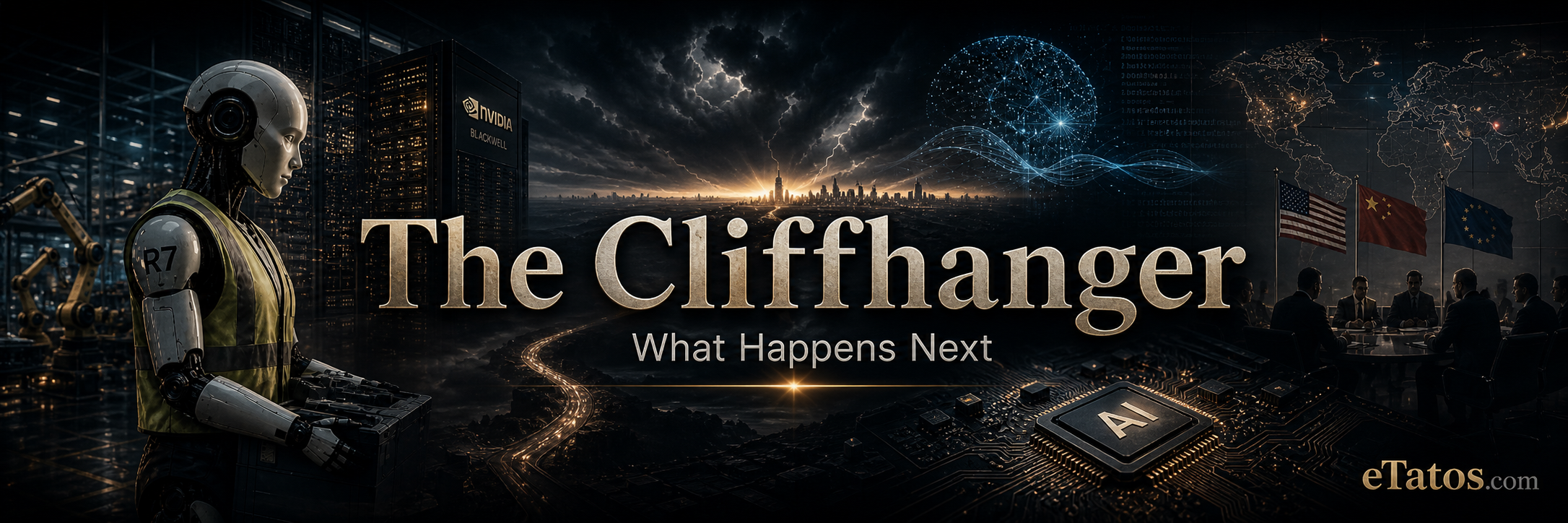
The body is robotics. The brain is AI. The infrastructure is compute. The distribution is Big Tech. The courtroom is where the origin story gets rewritten.
Put those together and you no longer have a product category.
You have a power structure.
And that is where this first episode of Silicon Drama leaves us:
Humanoid robots are approaching the workplace. AI labs are approaching national security. Cloud giants are approaching chip independence. Governments are approaching direct control over AI assets. And OpenAI’s founding myth is being pulled apart under oath.
Final Shot
The machines are no longer waiting politely at the edge of the story.
They are walking into the room.
The founders are in court. The models are behind classified doors. The chips are becoming weapons of leverage. The robots are reaching for real work.
And somewhere between the airport floor, the data center and the courtroom, one question is getting harder to avoid:
When the next world starts running on machines, who will still be holding the off switch?
If you want to follow the next episodes of Silicon Drama, subscribe to eTatos.com or our newsletter. The next power struggle is already forming.