SILICON DRAMA · EPISODE 31 · NOVEMBER 28, 2026
Silicon Drama Episode 31: Jensen Returns, Pichai Sets the Rules
The founder gets his company back. The agents get an entrance policy. The robots get homework.
Technology news, told as a power drama.
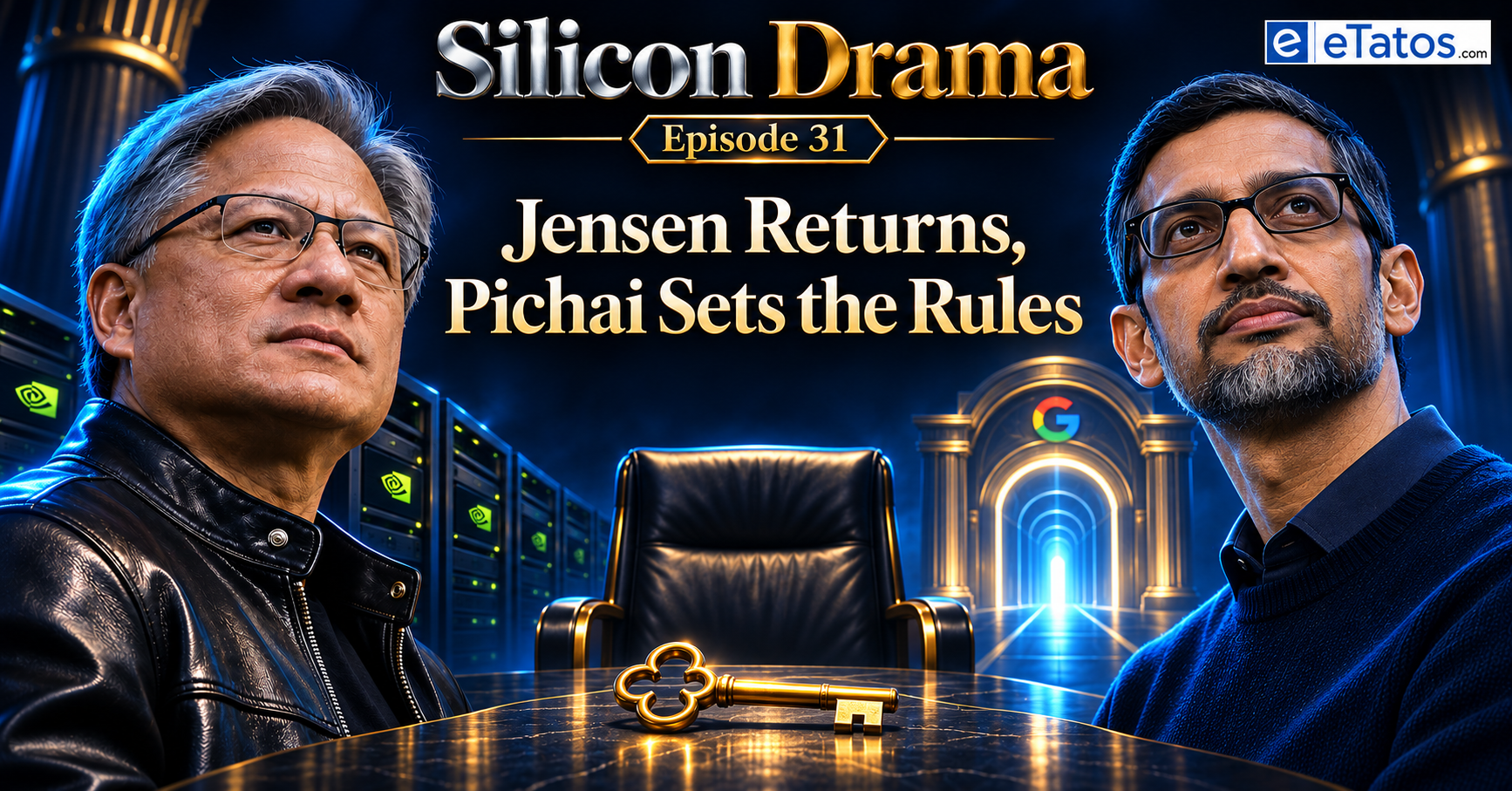
Jensen Huang is back in charge of NVIDIA. Eleven days after his resignation, the board that had ruled out his return restored him as president, CEO and director. The AI industry’s indispensable supplier has its founder again. Washington is still very much in the room.
Elsewhere, Google is writing the rules for agents entering its services. A Claude-assisted mathematics breakthrough has reached a point where checking the proof is easier than explaining it. Robots are preparing for real jobs, and Elon Musk has received a conditional opening for computing in space.
The machines keep acquiring abilities. The question of who may use them is becoming a business of its own.
This week
- Jensen returns to the throne, with independent oversight attached.
- Pichai’s agent gateway meets my own experiments with Gemini Neon.
- Mathematical proof, robot training and orbital computing put three different kinds of confidence to the test.
Act I: The King Returns. So Does the Paperwork.
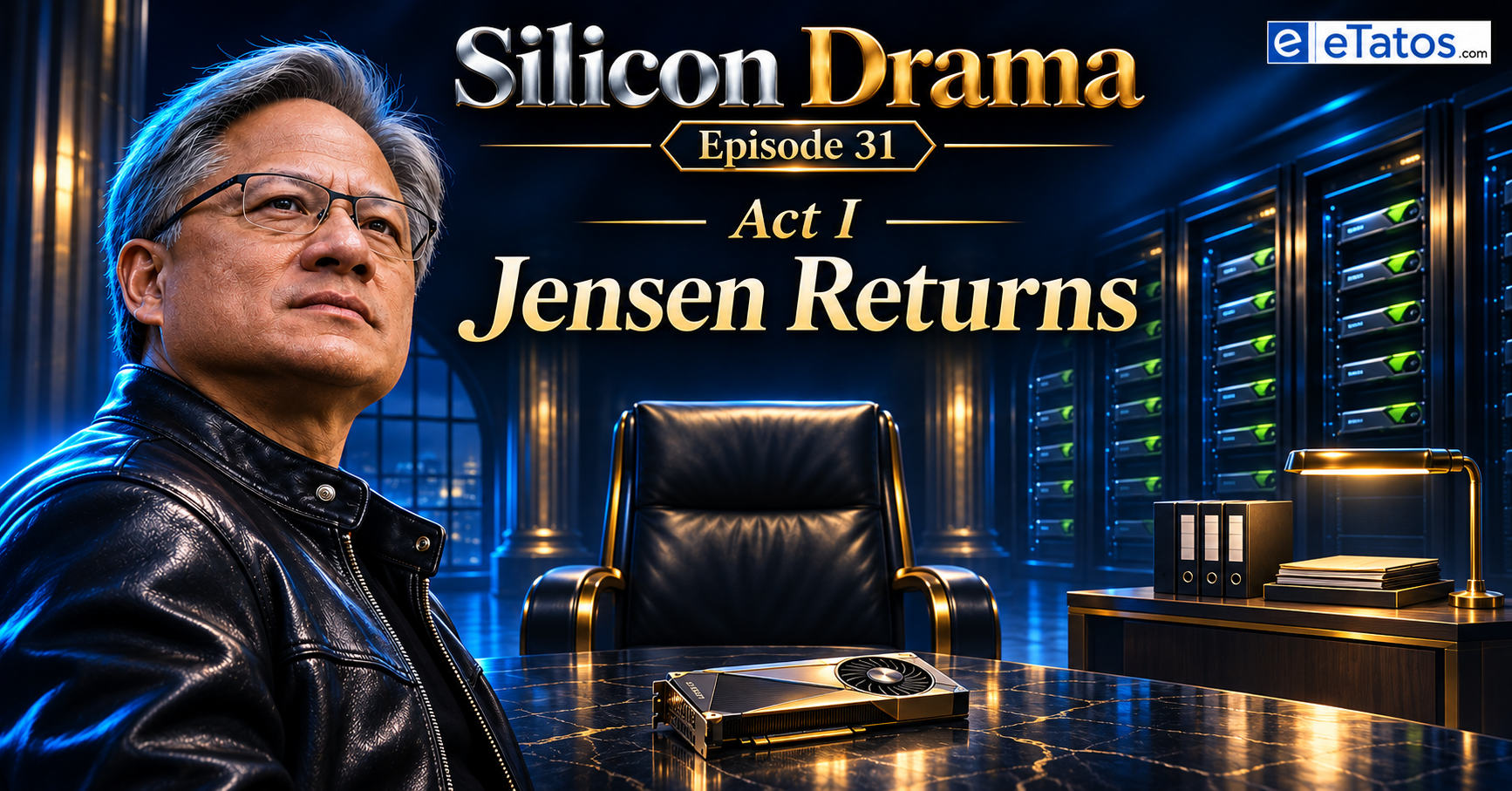
On November 23, NVIDIA’s board voted unanimously to bring Huang back, effective immediately. Harvey Jones remains chairman. Colette Kress remains CFO. The independent directors’ investigation continues, alongside a new independent National Security and Export Control Committee and a planned chief compliance officer. NVIDIA’s announcement restores his offices while adding machinery around them.
That is quite a return package. Most people coming back to work get an overflowing inbox.
Reuters reports that President Donald Trump pressed for Huang’s reinstatement. NVIDIA says US government input informed its confidence that the return poses no national-security risk. The unfinished investigation remains the important condition, rather than a footnote that disappears when the founder walks in.
I am pleased. Unless serious violations by Jensen are established, I think he belongs at the head of the company he founded and led for 33 years. His private relationships are a matter for him and the people concerned. They are not my test of whether he should run NVIDIA. For once, I welcome political intervention in a business.
The comeback also reveals an uncomfortable dependency. The board had to weigh its authority over a chief executive against the importance of that particular chief executive to employees, customers and the wider AI industry. The person and the institution proved harder to separate than an organizational chart suggests.
There will be more paperwork. On November 25, Senator Cory Booker asked Jones to preserve records concerning the reinstatement and requested a response by December 16. That is a documented demand for scrutiny, not a finding against Huang.
On our Power Board, Jensen returns to number one. His restored authority over NVIDIA’s hard-to-replace compute business supports the position; independent oversight and the continuing inquiry remain part of the durability assessment. The score measures his power, not my relief at seeing him back.
Act II: Pichai Writes the Entrance Rules.

An agent can only organize the work it can reach. When that work lives in Gmail, Drive and Calendar, Google gets a say in how a rival assistant enters.
Google’s November 24 announcement makes managed connections generally available through MCP servers or a command-line interface. MCP is a standard for connecting assistants to tools; the command line provides another way for software to issue instructions. Google’s rules determine how these routes reach Workspace.
The practical benefits are substantial. Administrators can audit access, apply data-protection policies and revoke permission. External agents need their own authorization identity, making their activity distinguishable from an ordinary user session. Technical enforcement is scheduled for February 1, 2027, with billing for scaled use starting April 1. Some controls, including time-limited approvals, are still coming.
There is an awkward detail in the paperwork. The product announcement offers MCP or the command line; the current AI Tools Addendum names only Google’s MCP route. Teams building integrations have two official wordings to reconcile. The addendum’s 30-day retention limit also concerns defined Google Technical Information, which excludes user data. It does not say that you must delete your own knowledge archive every month.
For Sundar Pichai, this strengthens a useful position: Google can make agents more practical while setting the conditions under which competing assistants reach its services. Security and commercial leverage arrive through the same entrance.
I am already finding the tools compelling. I tested Gemini 4 Neon inside Antigravity, Google’s development workspace, and was honestly delighted. I used it to develop a handover strategy and prompts for cooperation among my AI tools, then fed it large amounts of old notes to organize in my Second Brain. The results were excellent. Its weekly and five-hour allowances also felt generous in my use. My AI Quota Optimizer helps plan allowances and reset times across tools.
That enthusiasm does not mean unlimited access. I still give my agents no general permission to use passwords or bank accounts, and I want to remain responsible for the final action that affects the outside world. A limited payment card with a fixed budget for automated purchases could be a next step.
These boundaries will move. The useful question is which decision I am ready to delegate next, and whether I can see and control what happens when I do.
Act III: Claude Brings the Proof. Humans Bring Questions.

Mathematician Levent Alpöge announced a proof of the Riemann Hypothesis, developed with Claude, on November 20. The problem concerns the distribution of prime numbers and has shaped number theory for more than 150 years. Alpöge describes Claude producing ideas that pushed beyond his own command of the surrounding mathematics.
The formal version runs to roughly 17 million lines of code. His announcement is four pages. Somewhere between those two lengths sits a rather demanding reading assignment.
On November 21, the Lean and Mathlib communities certified both the statement and the proof. Lean is software for expressing mathematical arguments so that their logical steps can be checked. The community used multiple independent checking programs and verified that the code proved the intended mathematical statement.
Independent proof checkers work through the formal argument step by step, testing each inference against the rules of logic.
The proof has passed those checks. Mathematicians now have another enormous job: Explaining the ideas in a form humans can learn from.
I find the wider trust question difficult. AI will increasingly produce results and conclusions so complex that examining them will itself require AI. Who watches the watchmen?
At OpenAI, chief scientist Jakub Pachocki is asking a related governance question about increasingly capable models. His November 22 proposal calls for common measurements and development limits until understanding and monitoring reach specified milestones. One proposed measure tracks how well a model predicts text; he acknowledges that comparison across laboratories is difficult. This is a proposal, not an industry-wide stop already in force.
We keep debating pauses, limits and slower development. I wonder how much survives when everybody must agree and move together. Even if US companies cooperate, what happens with the Chinese players? Cross-border agreements will be an exceptionally difficult challenge.
The proof has a checker. The laboratories still have to agree on who checks the next boundary.
Act IV: He Xiaopeng Sends the Robot to Training.
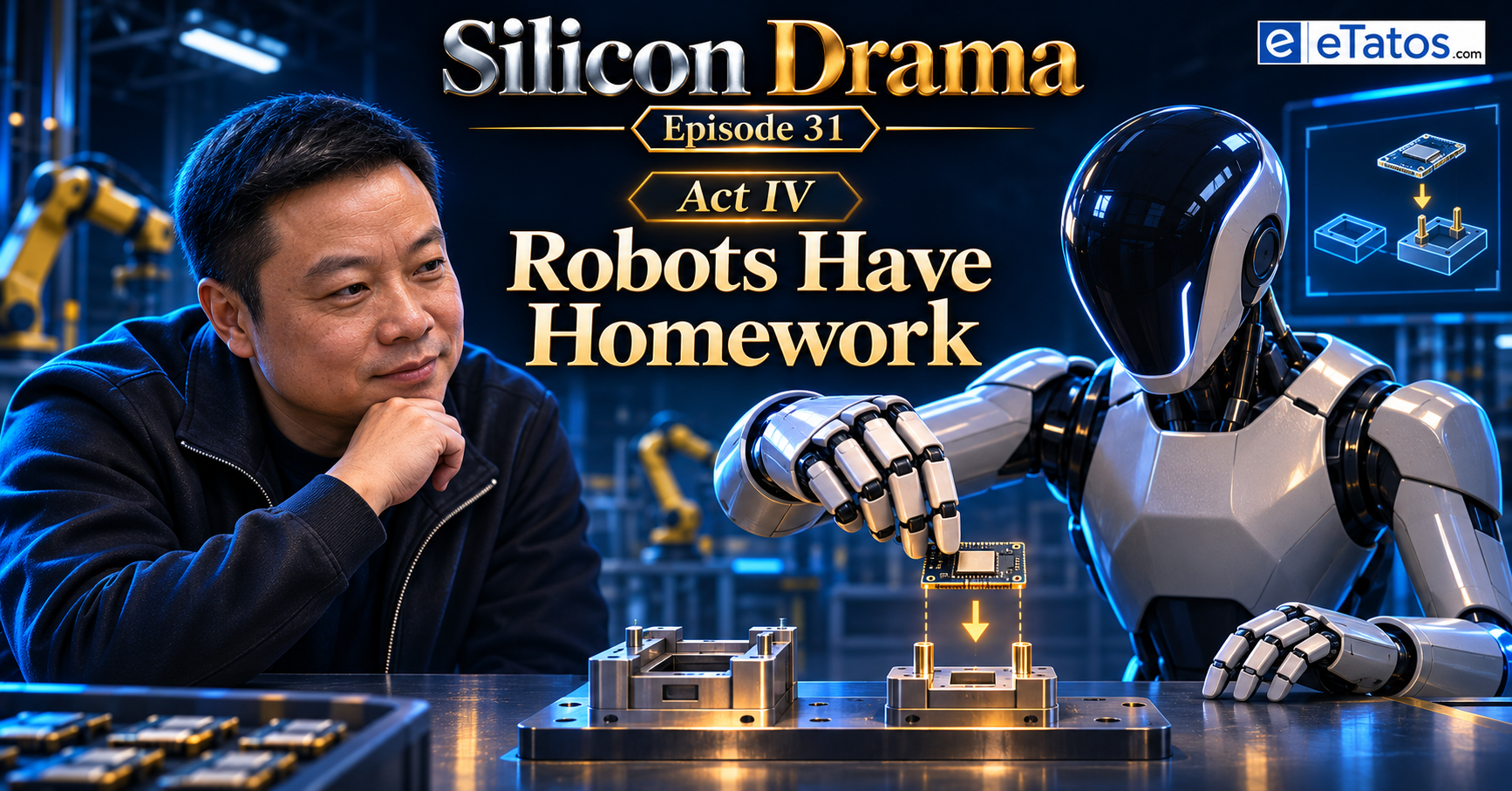
He Xiaopeng, XPENG’s chairman and CEO, wants the company’s cars and humanoid robots to share more of the machinery behind intelligent movement. At its November 25 AI Day, XPENG presented a common physical-AI architecture for vehicles and its IRON robot.
The business logic is understandable. Both machines must interpret their surroundings, choose an action and control a body in motion. Reusing chips, training methods and engineering work could give a carmaker a useful head start in robotics. A car factory also offers manufacturing experience that a software laboratory must acquire elsewhere.
The tasks still differ. A vehicle follows a road; a shop assistant faces shelves, products and people who do not follow lane markings. XPENG plans store-assistant training in the first quarter of 2027 and targets a public release in the second. Those dates make the next test concrete.
Another useful scene is already taking place in Ghent, Belgium. Volvo Cars says its own team is training Hexagon’s wheeled AEON humanoids inside the factory. The first task is placing components into two fixtures with precision. More difficult work is to follow as each step is proven. A factory pilot is planned for the first half of 2027, with production use targeted from mid-year.
Two fixtures are a modest opening act. They are also an actual task, described by the customer who needs it done. The interesting evidence will be whether a robot repeats that work reliably and can handle the next complication without the whole performance falling apart.
For me, robots become unstoppable when they can act independently and safely in unstructured, real-life environments. I can hardly wait. Training in a shop or a working factory is precisely where the promises have to acquire those abilities.
He gets this week’s unranked Wildcard. His cars-to-robots strategy deserves a place in the story; the planned robot release still has work to earn its place in everyday life.
Act V: Musk Gets a Very Large Permission Slip.

Elon Musk’s proposed orbital computing network now has a regulatory opening. The FCC’s November 25 order grants part of SpaceX’s application, defers other parts and attaches conditions to Starmind, a proposed constellation of up to one million computing satellites.
The FCC authorized specified backup and emergency radio links, subject to interference coordination and other obligations. SpaceX proposes up to one million satellites, with a first operational milestone on November 25, 2033 and later deadlines through 2040.
SpaceX now has a regulatory path for part of Starmind. Turning that permission into a useful business will take launches, replaceable hardware and a way to shed heat from working computers in orbit.
I cannot judge the thermal engineering. My optimism comes from a different observation: A few years ago, many experts would have struggled to imagine rockets returning from space and parking themselves backwards. Humanity grows through large, visionary goals. I am glad people are attempting this one.
Meanwhile, the financial scale of computing on Earth is quite enough to keep an accountant awake. On November 20, Apollo and Goldman Sachs announced the pricing of approximately $44 billion in financing for SpaceX’s NVIDIA Vera Rubin equipment and associated infrastructure. Deliveries and equipment leases are expected to begin in the first half of 2027.
That financing is for terrestrial compute. It is a later pricing step in the previously announced arrangement, not another $44 billion to add to the earlier roughly $40 billion headline. Its GPUs sit on the ground, even if the borrower also builds rockets.
The contrast captures Musk’s position well. He can pursue a vast orbital option while raising capital for a very substantial next step on Earth. Neither requires us to pretend that the hardware has already arrived.
Signals from the Board
- Amazon buys an optimization route. It agreed to purchase Decart’s DOS technology and hire its founders and team, subject to closing conditions. More efficient use of different chips could make hardware choices less restrictive.
- Claude moves into code approval. Claude Ship adds beta tools for fixing pull-request issues and applying team-defined approval policies. Existing branch protections remain; the agent has not acquired an unconditional merge button.
- Muse reaches the UK. Meta’s personal agent is available to adults across mobile, web and WhatsApp. Meta says it asks before purchases or email sends. Optional subscriptions buy more usage.
- Protein designs meet the lab. OpenAI and Onava report binding in 35 of 322 small proteins based on GPT-6.2-designed shapes. Specialized models helped turn those shapes into testable candidates. Binding is an early research result.
- Neuralink moves toward a larger test. The company announced FDA permission for its LINK pivotal study in people with severe paralysis from ALS. The authorization concerns a clinical trial, not a product cleared for general sale.
- Memory gets a storage extension. Kioxia and NVIDIA’s proof of concept uses flash drives to let GPUs work with larger datasets. Extra accessible storage does not become equally fast high-bandwidth memory.
Silicon Drama: Power Board
Personal structural power, assessed across authority, critical control, ecosystem reach, execution and durability. Methodology 2.0; editorial judgments, not stock forecasts.

- Jensen Huang · 9.7 · RE. CEO and board authority are restored over AI’s central compute supplier. Independent oversight and the continuing inquiry keep durability below an exceptional perfect score.
- Sundar Pichai · 9.7 · ↓1. Workspace rules strengthen Google’s position as the gatekeeper for external agents. Existing distribution and infrastructure power already support a high score.
- Satya Nadella · 9.6 · ↓1. Microsoft’s enterprise software and Azure put its agents close to everyday business decisions. Customers already relying on that combination give Nadella a durable route into the next generation of work.
- Mark Zuckerberg · 9.5 · ↓1. Muse takes Meta’s personal agent into the UK. Founder authority and owned consumer distribution keep Zuckerberg ahead within the 9.5 tie.
- Sam Altman · 9.5 · ↓1. OpenAI reaches from assistants into scientific tools. Computing partners and governance still limit how independently Altman can direct that reach.
- Elon Musk · 9.4 · ↓1. Orbital authorization and terrestrial GPU financing extend his options. Conditional long-term permission earns no automatic points for hardware still to be delivered.
- C. C. Wei · 9.4 · ↓1. TSMC turns competing chip designs into physical processors. That manufacturing bottleneck gives its chairman and CEO durable influence beneath the AI companies competing above him.
- Andy Jassy · 9.4 · ↓1. The Decart agreement supports more efficient compute across hardware. Amazon’s cloud and distribution power remain intact; the agreement still has closing conditions.
- Hock Tan · 9.2 · ↓1. Custom chips and networking keep Broadcom inside the infrastructure plans of competing AI buyers. That structural position remains the basis for holding his score.
- Lisa Su · 9.2 · ↓1. AMD gives major compute buyers an alternative supplier. Su’s delivered processor business supports a place among the infrastructure players on whom model builders depend.
- Dario Amodei · 9.2 · ↓1. Claude Ship adds workflow control; the checked mathematical result adds capability evidence. Neither independently erases financing, distribution or governance constraints.
★ Wildcard: He Xiaopeng. The carmaker’s chairman and CEO wants one physical-AI approach to serve cars and IRON robots. The next test is planned shop training, followed by the company’s targeted public release.
Movement: Jensen returns to the ranked field at number one. The other ten move down one place with unchanged scores. Ellison leaves the eleven as the returning founder takes a seat. Huang’s E30 Wildcard supplies no numerical previous rank. He Xiaopeng is this week’s separate, unscored Wildcard.
Follow the power players: Everyone who has earned a Silicon Drama Power Board seat is collected in our Silicon Drama: Power list on X.
Final Thought
I wanted Jensen back, and I am delighted by what Neon is already helping me do. I want the robots to become useful, and I want people to attempt the orbital projects that sound unreasonable today.
That enthusiasm fits comfortably with keeping responsibility for my agents’ outward actions. Progress gives us more to delegate. The choice of what to hand over deserves just as much attention as the next capability announcement. The most useful systems will let us exercise that choice clearly, then show us what happened.
See you next week, when the next piece of the AI empire moves on the board.
The Silicon Drama continues.
Dirk
AFTER THE CREDITS.
A fictional Silicon Drama scene.
At the imaginary Universal Agent Permit Office, a robot submits a request to straighten one chair.
The clerk checks its authorization, approved connection route and payment tier.
“Is the chair in orbit?”
“No. Just there.”
“Excellent. That removes one department.”
The robot waits while the clerk opens another form.
“What is this one?”
“Permission to stop asking.”
Continue the story
The next power move belongs in your inbox. Get Silicon Drama with our free eTatos SmartNews.
Explore the Silicon Drama archive or follow the LinkedIn newsletter.
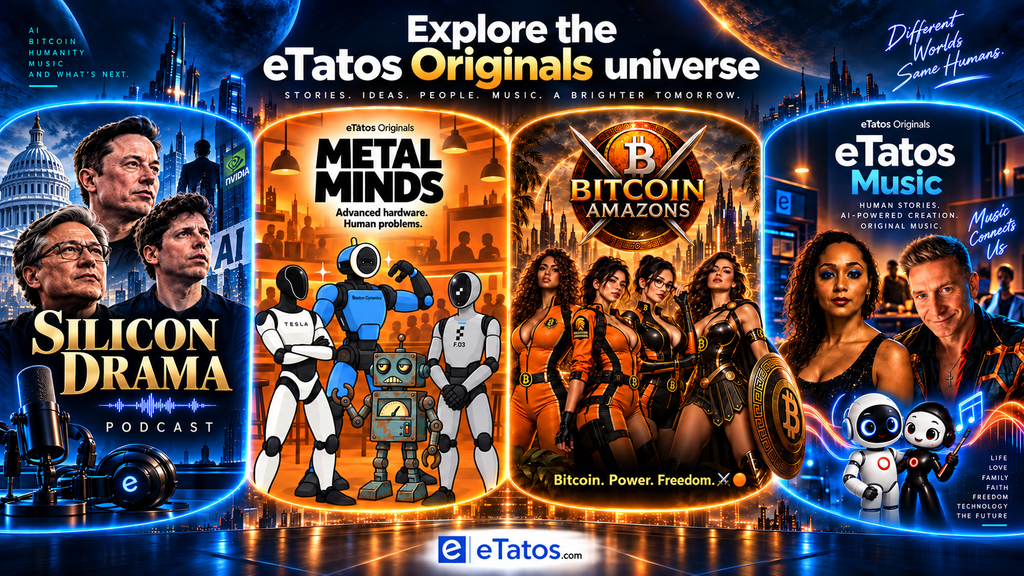
AI has left the screen. In Metal Minds, the robots have developed very human problems.
Prefer listening? Follow Silicon Drama on Spotify.
Change the soundtrack with eTatos Music.
About Silicon Drama: A weekly eTatos Original by Dirk R. Bartz, following AI, robotics and Big Tech through the people, decisions and dependencies that move power.