
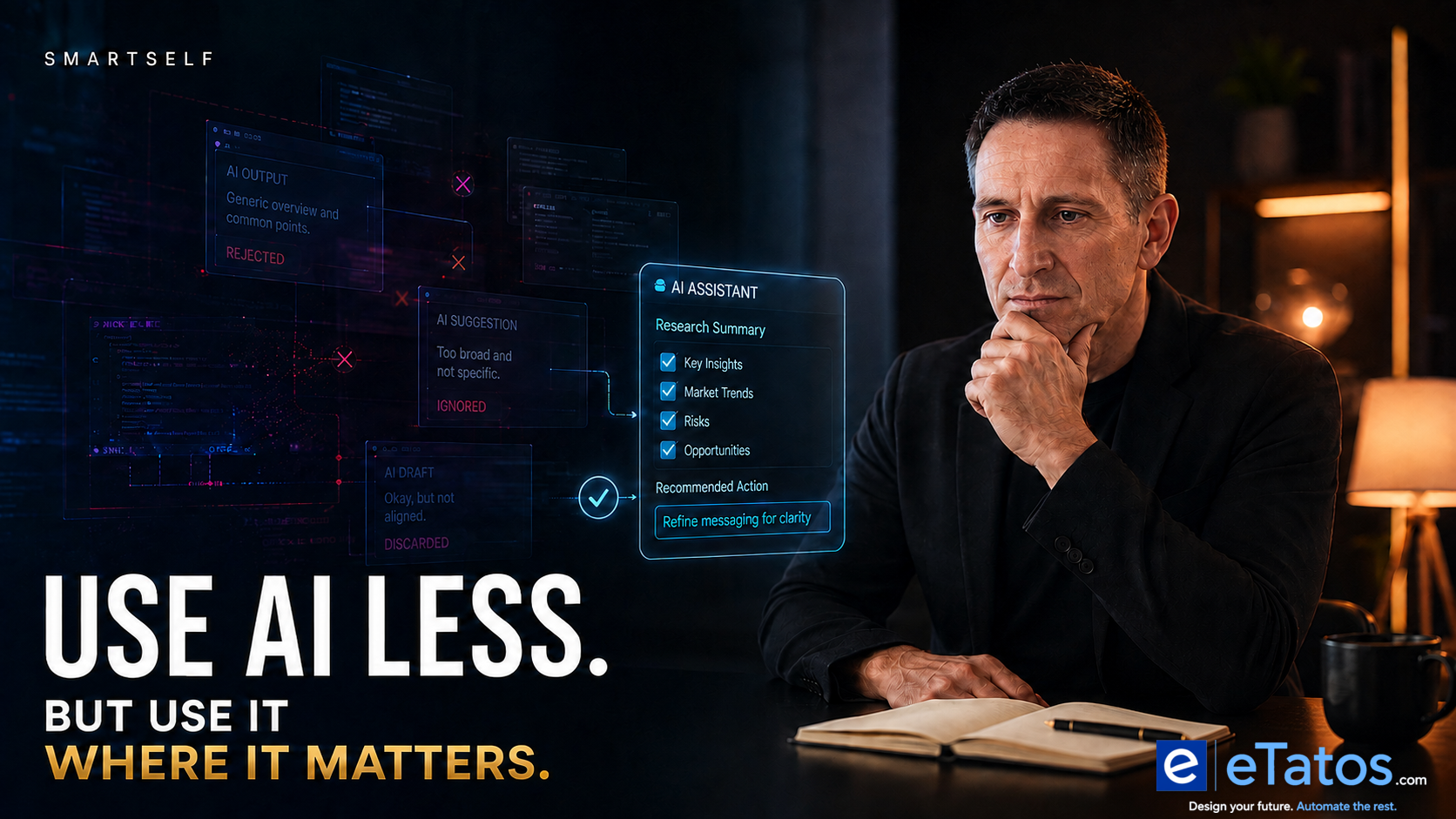
Why using AI more often does not automatically make us more productive and why human competence matters more than ever in the age of AI.
The latest productivity illusion goes like this: The more often you use AI, the more modern, efficient and effective your work becomes. It sounds plausible. But it makes about as much sense as judging a carpenter by the number of power tools in the workshop.
AI can complete in seconds tasks that once took hours. It can organize information, develop alternatives, reveal connections and automate tedious routines. At the same time, it can turn a simple task into a surprisingly elaborate cycle of prompting, reviewing, correcting and prompting again. Sometimes AI saves two hours. Sometimes it takes ten minutes to do something you could have finished in two.
So the crucial question is not: How often do I use AI?
It is: Where does AI actually create value?
Using AI Is Not the Same as Being Productive
Using AI to complete a task proves only one thing: You used AI. Whether it improved productivity depends on the result.
If you write an elaborate prompt for every short email, generate three versions, compare them and then remove the artificial tone from the final draft, you have certainly used AI. But you have not necessarily become more productive.
The equation changes when AI turns a messy meeting transcript into a clear action list in minutes, checks a complex document for contradictions, or transforms recurring tasks into a reliable workflow. In those cases, the system removes work without adding unnecessary complexity.
The difference can be expressed with a simple formula:
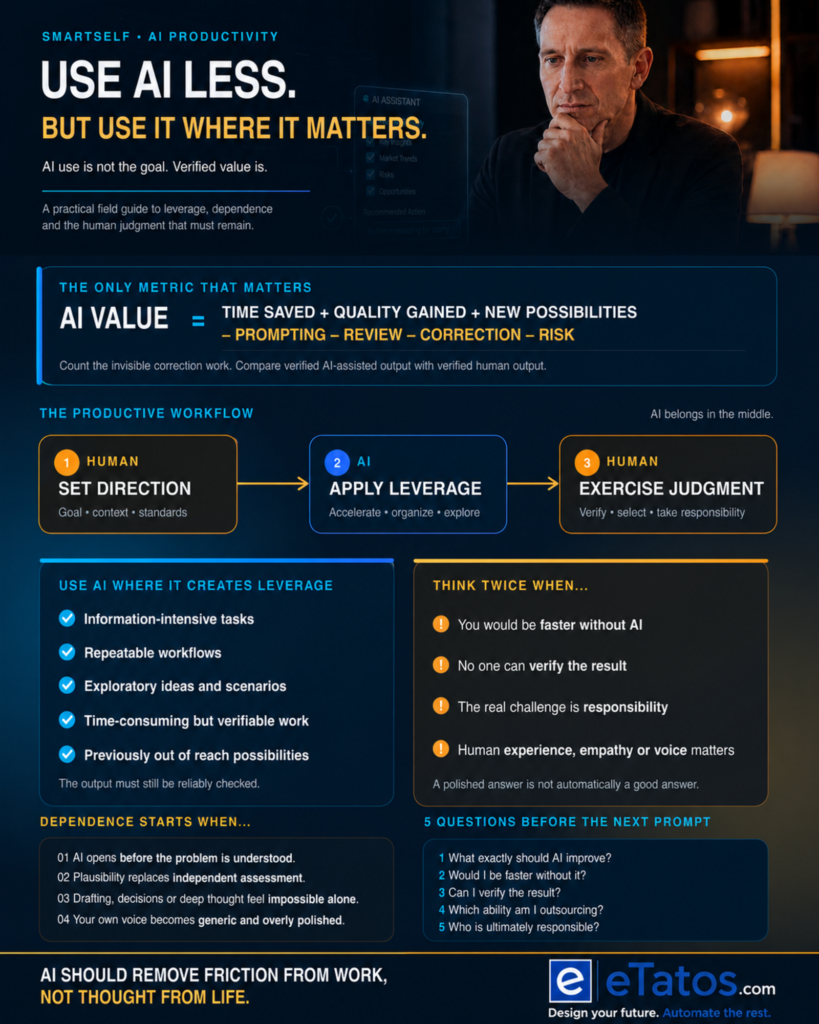
AI value = time saved + quality gained + new possibilities minus prompting, review, correction and risk
If the final result is clearly positive, using AI made sense. If all that remains is the pleasant feeling of having used a modern tool, it was probably just digital busywork.
The Invisible Correction Factory
AI-generated results have one dangerous quality: They often look almost finished. That “almost” can be expensive.
A confidently written text may contain false claims. A summary may omit the most important objection. A concept may sound professional while resting on a flawed assumption. An email may be grammatically perfect but sound nothing like the person supposedly sending it. The more polished the result appears, the easier it becomes to mistake plausibility for quality.
The real achievement is not generated output. It is verified output you can stand behind. The true production time also includes:
- writing the prompt,
- providing the right context,
- verifying facts and sources,
- correcting tone, logic and details,
- protecting confidential information,
- and taking responsibility for the final result.
If that pre- and follow-up work takes longer than completing the original task yourself, AI has not created value. It has simply moved the work around while making the initial production step look faster.
This does not mean an AI-generated result must be perfect on the first try. Human work also requires revision. The comparison simply has to be fair: Not “AI in 20 seconds” versus “a person in one hour,” but verified AI-assisted work versus verified human work.
When Use Turns Into Dependence
AI dependence does not begin only when someone can no longer work without a chatbot. It starts much earlier, often almost unnoticed.
Some warning signs:
- You open an AI tool before you have understood the problem yourself.
- You ask it to validate every minor decision.
- You accept answers because they sound plausible, not because you can assess them.
- You can no longer produce a first draft without assistance.
- Your own voice becomes generic and overly polished.
- You lose patience for slow, concentrated thought.
- You no longer have clear quality standards for evaluating the result.
The number of prompts is not what matters. A developer who uses AI all day as a precise tool and can evaluate every output may be less dependent than someone who delegates one simple decision a day to ChatGPT because he no longer trusts his own judgment.
Dependence begins when AI does more than take over work. It begins when AI gradually replaces the ability to understand that work, evaluate it, or perform it independently when necessary.
AI can amplify competence. It can also conceal a lack of competence for a surprisingly long time.
Where AI Creates Real Value
AI is especially powerful when a task has at least one of these characteristics:
- Information-intensive: Large volumes of text must be organized, compared, or condensed.
- Repeatable: Similar processes recur and can be standardized.
- Exploratory: Many ideas, perspectives, or scenarios need to be developed quickly.
- Time-consuming but verifiable: Execution takes significant time, but the result can be checked reliably.
- Previously out of reach: AI enables something that once required more time, money, or specialized expertise than was available.
Building a weekly briefing from reliable sources, structuring a long document, preparing multiple communication options, analyzing recurring support requests, or automating a clearly defined process can all create enormous value.
AI is less convincing when you could complete the task faster yourself, when no one can competently verify the result, or when the real challenge is not processing information but exercising responsibility, experience, and human judgment.
AI may make a personal condolence message more eloquent while making it less human. It can help prepare a strategic decision, but the decision itself should not be delegated to the system. And a short reply you can write honestly in 30 seconds rarely needs a five-step prompting workflow.
The H-A-H Method: Human, AI, Human
A productive AI workflow begins and ends with a person.
1. Human: Set the direction
What is the actual goal? Which facts matter? What should the result accomplish? What are the quality standards? Forming one clear thought of your own before writing the first prompt prevents AI from defining the problem for you.
2. AI: Apply the leverage
Now the system can accelerate, organize, compare, generate alternatives, identify weaknesses, or take over routine work. AI contributes scale, speed and additional perspectives.
3. Human: Exercise judgment
At the end, a person reviews, selects, rejects, expands and takes responsibility. Does the result match reality? Is it accurate? Does it sound like me? Would I put my name on it?
This sequence protects against two common failures: Blind trust in machine-generated suggestions and the gradual erosion of our own ability to think. AI belongs in the middle of the process, not at the beginning of every idea or at the end of every decision.
Five Questions to Ask Before Your Next Prompt
Before using AI, ask yourself five quick questions:
- What exactly should AI improve? Time, quality, scale, or something that was not previously possible?
- Would I be faster without AI? For small tasks, the answer is surprisingly often yes.
- Can I verify the result reliably? If not, the risk may grow faster than the value.
- Which ability am I outsourcing right now? Routine can disappear. Judgment should remain.
- Who is ultimately responsible? The answer is almost never the AI system.
If you cannot clearly answer the first question, you probably do not need a better prompt. You may not need a prompt at all.
Human Competence Is Not a Legacy System
Human competence does not become obsolete in the age of AI. Its center of gravity shifts.
The ability to produce an average first draft is becoming less valuable. The ability to ask the right question, understand context, recognize quality, set priorities and make a well-founded decision is becoming more important.
AI can generate twenty ideas. A person must recognize which one matters.
AI can formulate arguments. We must decide what we stand for.
AI can imitate a voice. We contribute experience, conviction and genuine human connection.
AI can calculate possibilities. We decide which future is worth pursuing.
As AI produces more and more, selection, taste, responsibility and judgment become more valuable. The scarcest resource of the future may not be content, information, or computing power. It may be the ability to choose the one truly right result from an endless supply of acceptable ones.
Less AI. More Impact.
“Use AI Less” is not a call for artificial restraint. The goal is not to write as few prompts as possible. It is to use AI deliberately where it creates real leverage and to leave it out where it produces only extra work, dependence, or mediocrity.
Mature AI use is not about finding an AI use case for everything. It is about knowing when your own thinking, voice and judgment matter more.
AI should remove friction from work, not thought from life.
The eTatos motto captures it perfectly: Design your future. Automate the rest.
The essential part comes first. We design the future ourselves. We automate the rest, not what matters most.


![Read more about the article The Ultimate Business Email Course: Smart Mailing & Inbox Zero [Part 4]](https://etatos.com/wp-content/uploads/2023/09/Beitragsbild-Newsletter-Part-4-1200-x-600-768x384.png)