

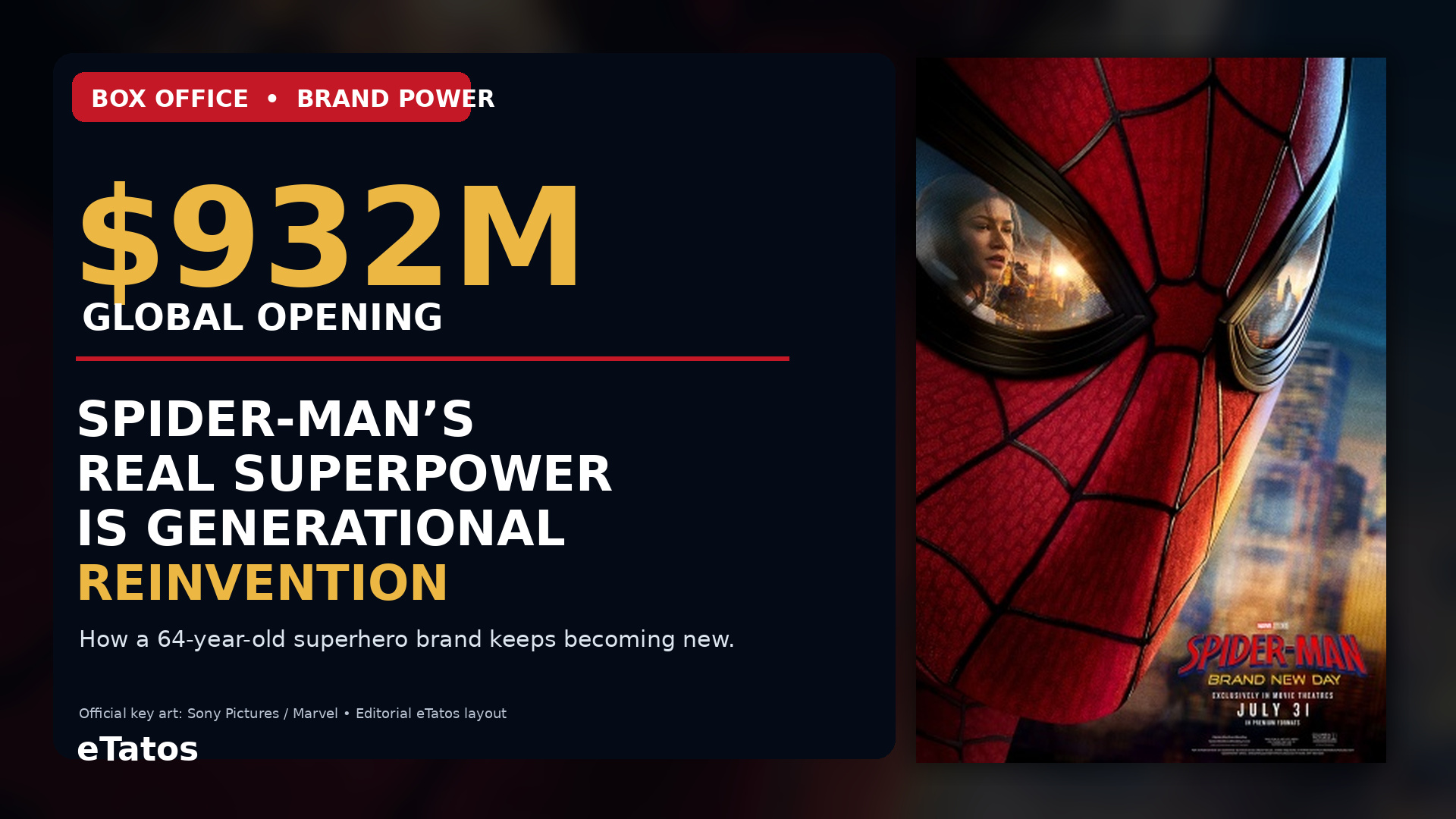
A 64-year-old superhero just delivered one of the biggest movie openings in history. The reason may have less to do with superpowers than with one of entertainment’s smartest generational brand strategies.
A $932 million global opening weekend is more than another superhero box-office record. It is evidence that Marvel and Sony have built something far more valuable than a successful movie franchise: A character that continuously recruits its next generation of fans.
Spider-Man can climb walls, sense danger, lift cars and swing between skyscrapers.
But none of those abilities explains why a character created in 1962 can arrive in theaters more than six decades later and generate $932 million worldwide in a single opening weekend.
The final opening-weekend numbers for Spider-Man: Brand New Day are extraordinary:
$360 million in North America.
$572 million internationally.
$932 million worldwide.
That makes Brand New Day the biggest domestic opening weekend in movie history in nominal dollars, surpassing the $357 million opening of Avengers: Endgame. Globally, it delivered the second-biggest opening weekend ever, behind only Endgame.
That is not simply another win for Marvel.
It is a remarkable demonstration of brand longevity.
Spider-Man’s most important superpower is reinvention.
Not the desperate kind in which a fading franchise changes its logo, adds a younger cast and hopes nobody notices the declining relevance. Spider-Man reinvents himself by offering every generation its own entrance into the same mythology.
$932 Million Says Something Bigger Than “Hit Movie”
Opening-weekend numbers this large are normally discussed as entertainment-industry statistics.
Records. Screens. Premium formats. International markets. Ticket prices.
But Brand New Day tells a much more interesting business story.
A character first published when John F. Kennedy was president has just produced one of the largest theatrical launches in cinema history in 2026.
Think about what that requires.
The audience buying tickets today is not simply the original Spider-Man audience getting older.
It includes people who discovered the character through Tobey Maguire, Andrew Garfield, Tom Holland, Miles Morales, animated movies, video games, comics, toys, television and, increasingly, preschool entertainment.
Spider-Man has not merely retained an audience.
He has repeatedly replaced it, expanded it and connected new generations to the generations that came before.
That is an extraordinarily difficult thing for any brand to achieve.
And the numbers make the scale visible.
A $360 million North American opening means Spider-Man did not merely beat another superhero movie. In nominal dollars, he just produced the largest opening weekend ever recorded at the domestic box office.
International audiences contributed another $572 million, including roughly $121 million from China.
This is not a niche fandom turning up for opening night.
It is a global cultural property operating across generations.
A Brand New Day by Returning to the Beginning
The success is even more interesting because Brand New Day does not appear to have achieved it simply by making Spider-Man bigger.
It makes Peter Parker important again.
The film continues from the devastating consequences of Spider-Man: No Way Home. The world no longer remembers Peter Parker, while Peter watches the people he loves continue their lives without him.
Jon Bernthal’s Punisher and Mark Ruffalo’s Hulk provide recognizable Marvel scale. Sadie Sink adds another major new element to the cast.
But the emotional center remains Peter.
Critical reception has also been strong, with reviews particularly praising Tom Holland’s more mature performance and the return to a more grounded Spider-Man story.
Marvel appears to have remembered something surprisingly easy to forget:
Spider-Man does not need another multiverse collapsing above Manhattan to be compelling.
He needs a difficult choice.
Spider-Man Becomes Stronger When His World Becomes Smaller
The character has always worked best when extraordinary powers collide with painfully ordinary problems.
Peter Parker may be able to stop a speeding vehicle, but he cannot prevent every personal loss.
He can save New York and still fail the people closest to him.
He can defeat a villain and discover that victory has created an entirely new problem.
That tension separates Spider-Man from heroes built primarily around power fantasies.
Spider-Man is not interesting because he escapes ordinary life.
He is interesting because extraordinary responsibility makes ordinary life even harder.
That is why the return to a more grounded Peter Parker matters. After years of portals, alternate realities, cosmic threats and increasingly complicated cinematic universes, Brand New Day brings the focus back to the human being underneath the mask.
And audiences responded with $932 million in three days.
The superhero spectacle attracts the audience.
The personal consequences make them care.
The Billion-Hour Preschool Superhero
While Tom Holland’s Spider-Man is dealing with adulthood, isolation and responsibility, another version of the hero is doing something equally important for the franchise.
He is teaching preschoolers about teamwork.
Since its 2021 debut, Disney Jr.’s Spidey and His Amazing Friends has reportedly generated approximately 1.25 billion viewing hours, according to Nielsen data previously cited by The Wall Street Journal.
That number should not be dismissed as background entertainment playing repeatedly in family living rooms.
It represents audience formation.
The preschool series removes much of Peter Parker’s tragedy, insecurity and adolescent anxiety. In their place, it emphasizes friendship, cooperation, colorful action and easily understandable moral lessons.
Peter, Miles Morales and Gwen Stacy become a superhero team designed for viewers who may not yet be able to pronounce “multiverse,” but already understand the idea of helping a friend.
Around that experience sits an entire ecosystem of toys, books, clothing, music, plush figures, playsets and role-playing products.
The show is not merely adapting Spider-Man for children.
It is creating future Spider-Man fans.
And a $932 million theatrical opening makes that observation considerably more important.
The Same Hero, Different Doorways
Spider-Man’s generational strategy works because there is no single required entry point.
A preschooler can enter through Spidey and His Amazing Friends.
An older child can discover animated Spider-Man.
A teenager can enter through video games, comics or movies.
Young adults can follow a Peter Parker dealing with sacrifice, loneliness, relationships and consequences.
Parents who grew up with Tobey Maguire or Andrew Garfield can introduce their children to a character they once considered their own.
And increasingly, several generations can walk into the same theater together.
Each version changes the tone, visual language, complexity and emotional weight.
But the central idea survives:
A normal person receives extraordinary abilities and must decide what kind of person to become.
That is stronger than continuity.
It is transferable mythology.
Reinvention Without Erasure
Many franchises misunderstand consistency.
They assume that protecting a brand means presenting the same version of it repeatedly.
The same tone. The same audience. The same conflict. The same visual formula.
Eventually, familiarity becomes stagnation.
Spider-Man follows a more sophisticated model.
The character’s essential promise remains stable, but the delivery system changes.
The preschool series does not invalidate the emotional pain of No Way Home. Miles Morales does not diminish Peter Parker. Tom Holland does not erase Tobey Maguire or Andrew Garfield.
Different versions coexist because they serve different audiences, emotional needs and stages of life.
The franchise is not built around one definitive interpretation.
It is built around a recognizable emotional core that survives interpretation.
That distinction matters far beyond entertainment.
The strongest brands do not force each new generation to inherit exactly the same product. They preserve the meaning while redesigning the entrance.
A Franchise That Acquires Its Own Future Customers
This is where the strategy becomes particularly interesting from a business perspective.
Brand New Day monetizes an enormous existing global audience.
Spidey and His Amazing Friends helps create the next one.
A four-year-old watching Spidey today may want the costume, the toy and the birthday decorations. Later come comics, animated films, video games, theme-park experiences and eventually major theatrical releases.
This is not simply cross-promotion.
It is a long-term customer acquisition funnel measured in decades.
At the bottom of the age ladder, Marvel introduces the character through simple stories and play.
Higher up, the mythology becomes more complex.
Eventually nostalgia joins discovery, and former children become paying adults, collectors and parents introducing Spider-Man to their own children.
Few entertainment properties can move so naturally from a preschool bedroom to a teenage game console and then to a $932 million opening weekend.
Spider-Man can because the franchise does not depend exclusively on lore, scale or cinematic continuity.
It depends on recognition.
Behind the mask is somebody overwhelmed by life, trying to do the right thing anyway.
That idea works at almost any age.
$932 Million Is the Result, Not the Strategy
There is another important distinction.
The opening-weekend record itself is not Spider-Man’s competitive advantage.
It is the outcome of it.
Ticket prices have increased since Avengers: Endgame opened in 2019, so comparing nominal box-office records across different years is never a perfect measurement of audience size.
But that does not weaken the larger point.
Quite the opposite.
At a time when Hollywood has spent years discussing franchise fatigue and superhero fatigue, Spider-Man has just convinced audiences around the world to generate $932 million in one weekend.
And Brand New Day did it while moving the character back toward something smaller, more personal and recognizably Spider-Man.
The lesson is not that audiences will watch superheroes forever.
The lesson is that audiences will continue returning to characters that successfully evolve without forgetting why people loved them in the first place.
The Real Meaning of a Brand New Day
The title Brand New Day describes Peter Parker’s latest beginning, but it also captures the larger strategy behind Spider-Man.
The character is constantly allowed to begin again.
New actor.
New animation style.
New audience.
New universe.
New emotional tone.
Yet responsibility, vulnerability, humor and hope remain attached to the character.
That is why Spider-Man has survived changing generations, changing media habits, superhero fatigue, cinematic resets, competing studios and increasingly complicated fictional universes.
And now we have a $932 million reminder of just how powerful that strategy can become.
His greatest ability is not swinging above New York.
It is reaching a child, a teenager, an adult and a parent through completely different experiences while convincing every one of them that Spider-Man belongs to their generation.
Spider-Man does not remain young by refusing to change.
He remains timeless because every generation is allowed to reinvent him.
Official key art: Sony Pictures / Marvel. Editorial layout: eTatos.